Clay is the default answer when a GTM team wants many data providers in one spreadsheet. It is also the tool people search for alternatives to most often in this category, and the reasons are consistent: the bill is hard to predict, the learning curve is real, and since March 2026 the plan you need for API access starts at $446 a month.
This guide covers the ten alternatives we'd actually put in front of a buyer in September 2026, with prices taken from each vendor's own pricing page this month. One of the ten is ours. We run the same providers Clay does, so we know the economics of this category from the inside, and we've tried to be as plain about where Clay wins as about where it doesn't. If you want the long version on Clay itself first, read the Clay review and pricing breakdown.
The short version
Tool | What it is | Entry paid plan | Unit cost | Best for |
|---|---|---|---|---|
Databar | Aggregator workspace: 160+ providers, waterfalls, AI research, plus API, Python SDK, CLI and MCP | $99/mo, 5,000 credits | Plan credits only, charged on results | Teams that want Clay's data model without action limits, and want to drive it from code |
Apollo | Own database of 240M+ contacts plus sequences and a dialer | $49/user/mo (annual) | Per seat, credits included | Small sales teams that want data and outreach in one login |
ZoomInfo | Largest proprietary B2B database, intent, Copilot, GTM Studio | Not published; buyers report ~$15k/yr entry | Annual contract, credits per export | US enterprise sales orgs with procurement and budget |
Cognism | Human-verified contact data, strongest in EMEA | Not published | Annual contract | EMEA-first teams that need compliant, verified mobiles |
FullEnrich | Waterfall email and mobile finder across 20+ vendors | EUR 55/mo, 1,000 credits | ~EUR 0.055 per credit | Teams whose only problem is contact data |
Bitscale | Aggregator workspace with agents and signals, bundled onboarding | $349/mo, 15,000 credits | ~$0.023 per credit | Teams that want a Clay-style workspace with hands-on setup help |
Cargo | Code-native GTM infrastructure with versioned workflows | $165/mo, 1,500 credits | ~$0.11 per credit | GTM engineers who want workflows in version control |
Freckle | Terminal-first Clay alternative for coding-agent users | $99/mo, ~5,000 credits | ~$0.02 per credit | Solo GTM engineers living in Claude Code or Codex |
Deepline | Bring-your-own-key GTM system in code, data in your own Postgres | $0 platform fee + usage; Growth $395/mo | $0.005 per call above 50,000/mo, plus your provider bills | Technical teams that already hold provider contracts |
Lusha | Contact database with a Chrome extension | Seat-based tiers | Per seat | Reps who look up one contact at a time |
Prices are what each vendor showed on its own pricing page in September 2026, converted to the cheapest paid tier. ZoomInfo and Cognism don't publish prices, so those rows quote what buyers report.
Why teams leave Clay
We asked the same question of everyone who has migrated to us from Clay, and we read the public reviews every quarter. Three reasons cover almost every case.
The bill is two meters, and one of them is invisible until it bites. Since 11 March 2026 Clay charges Data Credits for lookups and Actions for everything else: workflow steps, AI calls, CRM syncs and, newly, HTTP requests. The Launch plan gives you 3,000 credits and 15,000 actions a month; Growth gives you 6,000 and 40,000. A workflow that touches one row eight times spends eight actions before it buys any data. Teams find this out from the overage line, not from the pricing page. The full mechanics are in the Clay pricing section of our review.
API access starts at $446 a month. HTTP integrations used to be free and available on the middle tier. They now consume actions and are gated to Growth. If you built your enrichment around your own provider keys and custom HTTP calls, the March change moved your fixed cost to a variable one and raised the floor to $446, billed annually.
It takes weeks to be good at it. The most common complaint in Clay's G2 reviews is the learning curve, with reviewers reporting two to four weeks to reach basic proficiency. Clay's answer is Clay University, a template library and an agency ecosystem, which are genuinely good. But the operator who has to build a waterfall for the first time still does it alone, and the credit burn during that learning period is the second most common complaint.
None of this makes Clay a bad product. It is the most complete workbench in the category and it has the largest community. It means Clay is priced and built for a team that runs GTM as an engineering discipline, and a lot of teams that buy it aren't that.
If you want to put a number on what the two meters cost your team before you decide, the enrichment cost-modeling guide walks through the arithmetic.
How we picked these ten
The list is not every tool with a landing page that mentions Clay. We included a tool if it does at least one of Clay's jobs, is a company you can still buy from in September 2026, and publishes enough about its pricing and product to compare honestly. That rule removed two names you'll still see on older lists: Persana, which was absorbed into Rox in March 2026 and is being sunset, and Clearbit, which is now HubSpot's Breeze Intelligence rather than a standalone product.
Three things decide which of the ten fits you: whether you want a workspace or a data feed, whether the consumer of the data is a person or a script, and whether you sell into the US mid-market or somewhere the big databases don't reach.
Whatever you shortlist, test it on your own accounts before you sign. How to verify a data provider has the sample-size math, and the data enrichment software buyer guide lists the questions to ask on the sales call.
1. Databar
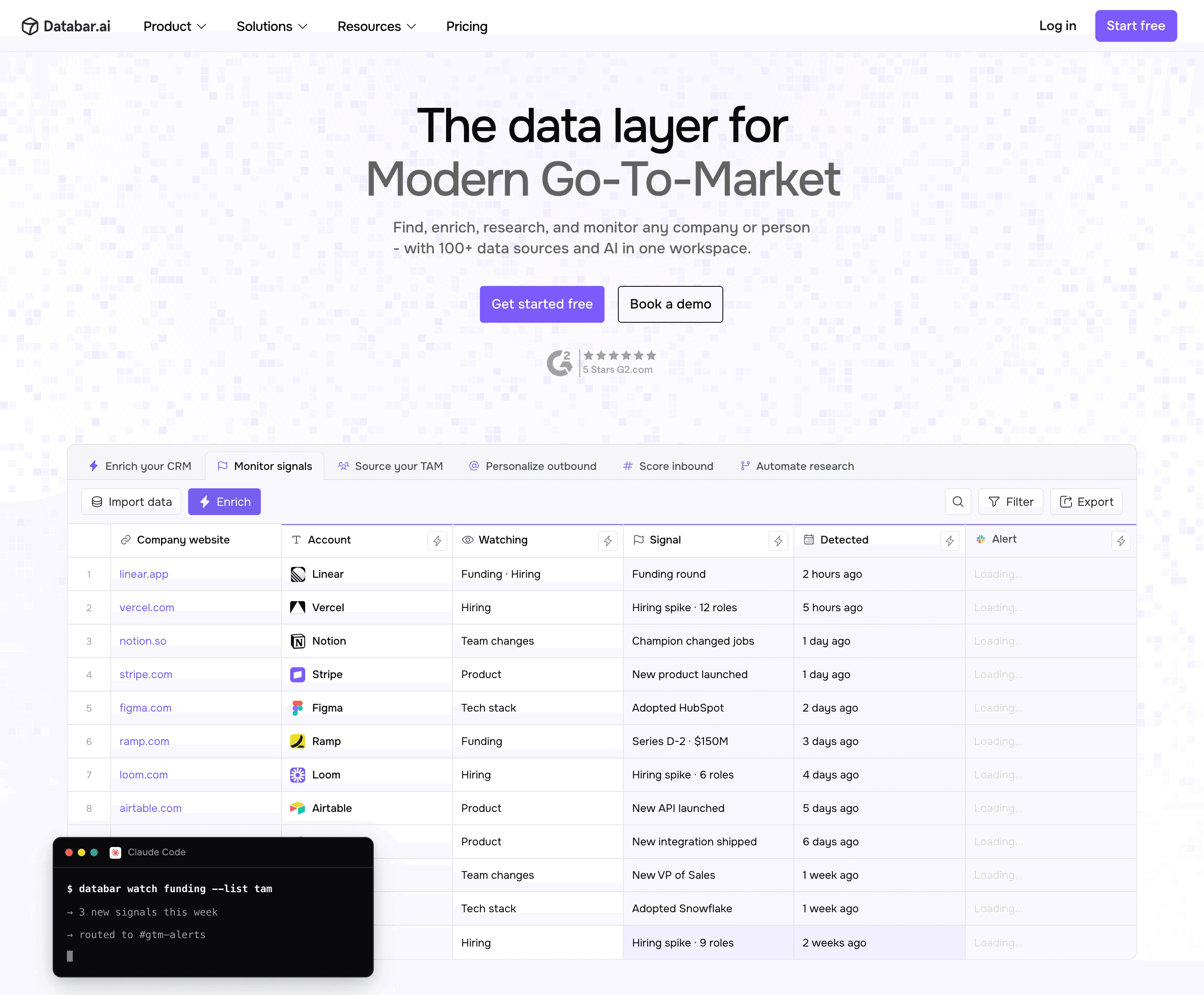
Databar is the closest thing on this list to Clay's data model with a different bill. It is an aggregator workspace: you bring companies, people, domains or emails into a table and enrich them through 160+ data providers, with waterfalls that try providers in order and stop at the first hit, AI research columns that browse the web, and exporters that push results to HubSpot, Salesforce and the rest. Many of the providers are the same ones behind Clay's marketplace, which is why waterfalls rebuild one to one when teams move.
The difference is everything around the data. There are no action limits, so a workflow step costs nothing until a provider returns a result, and a lookup that comes back empty is free. There are no row limits per table. And the same engine has five surfaces: the spreadsheet, a REST API, a Python SDK, a command-line tool and an MCP server, all included on every plan. That last part is why GTM engineers who work in Claude Code or Cursor tend to land here: the agent can build and run a table instead of clicking through one. The Databar API and MCP server guide for GTM engineers builds the same table from code, and Claude Code with Databar for outbound is the end-to-end setup.
Pricing. Build is $99 a month for 5,000 credits and three editors. Scale is $495 for 50,000 credits, ten editors and a dedicated queue. Annual billing takes 12% off. Every plan includes the API, MCP, webhooks and CRM sync. New workspaces get a 14-day trial of the full product with 100 credits, and if you're leaving Clay with credits unused, Databar matches them one for one. The line-by-line comparison, including what 2,000 work emails or 1,500 phone numbers cost on each platform, is on the Databar vs Clay page.
Where it beats Clay. Cost per result, and the absence of the second meter. Programmatic access on every plan rather than the $446 tier. Onboarding that includes build hours with a GTM engineer rather than a course.
Where Clay is ahead. Clay's template library and community are much larger, its certified-agency marketplace is bigger, and a few loss-leader lookups (Icypeas emails, the smallest AI prompts) are priced below Databar's. If your team learns from templates, Clay has more of them.
Best for. RevOps and GTM engineering teams that want Clay's provider breadth, need the API or MCP without paying for the top tier, and are tired of forecasting two currencies.
➔ Start free · 14-day full-product trial. No data, no charge.
2. Apollo
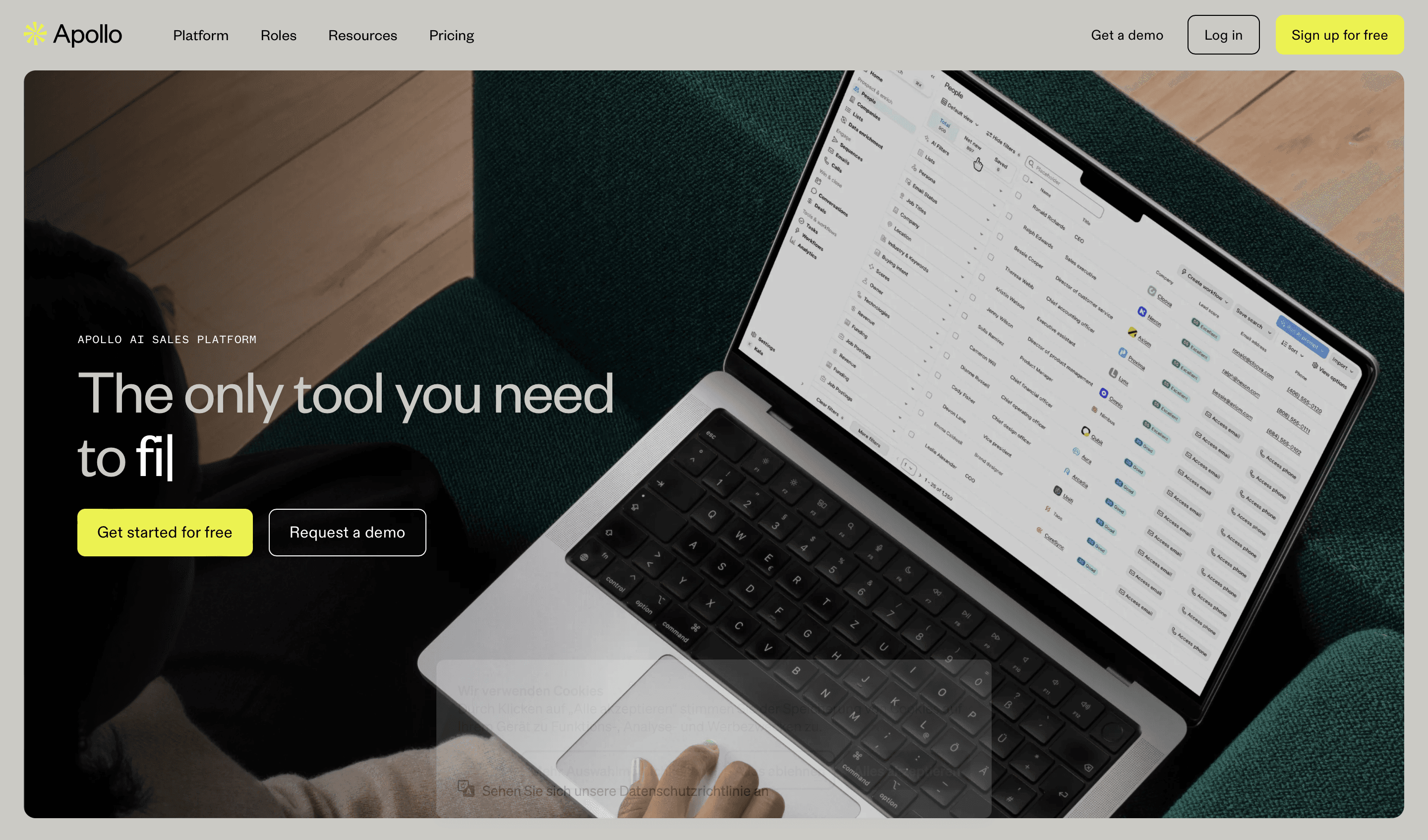
Apollo is a different category that gets compared to Clay constantly, because a lot of teams try both. Instead of aggregating other people's data, Apollo sells its own database, 240M+ contacts and 30M+ companies by its own count, and bundles it with sequences, a dialer, meetings, deal tracking and an AI assistant. Over 600,000 companies use it, most of them small sales teams that want one login for the whole outbound motion.
Pricing. Free plan with a small credit allowance. Basic is $49 per user per month billed annually ($59 monthly), Professional $79 ($99), Organization $119 ($149) with a three-user minimum. Credits for emails, mobiles and exports are included per seat.
Where it beats Clay. Time to first email. A rep can sign up, search, and be sending sequences in an afternoon. The all-in-one bundle is genuinely cheaper than Clay plus a sequencer for a two-person team.
Where Clay is ahead. Coverage outside the US mid-market, and everything about enrichment logic. Apollo is one source: when it doesn't have the contact, the cell is blank and nothing falls back. Clay, or any aggregator, will ask the next provider.
Best for small US sales teams that want data and outreach together. We wrote up the head-to-head in Clay vs Apollo, and if Apollo is on your shortlist against the other big database, Apollo vs ZoomInfo covers that.
3. ZoomInfo
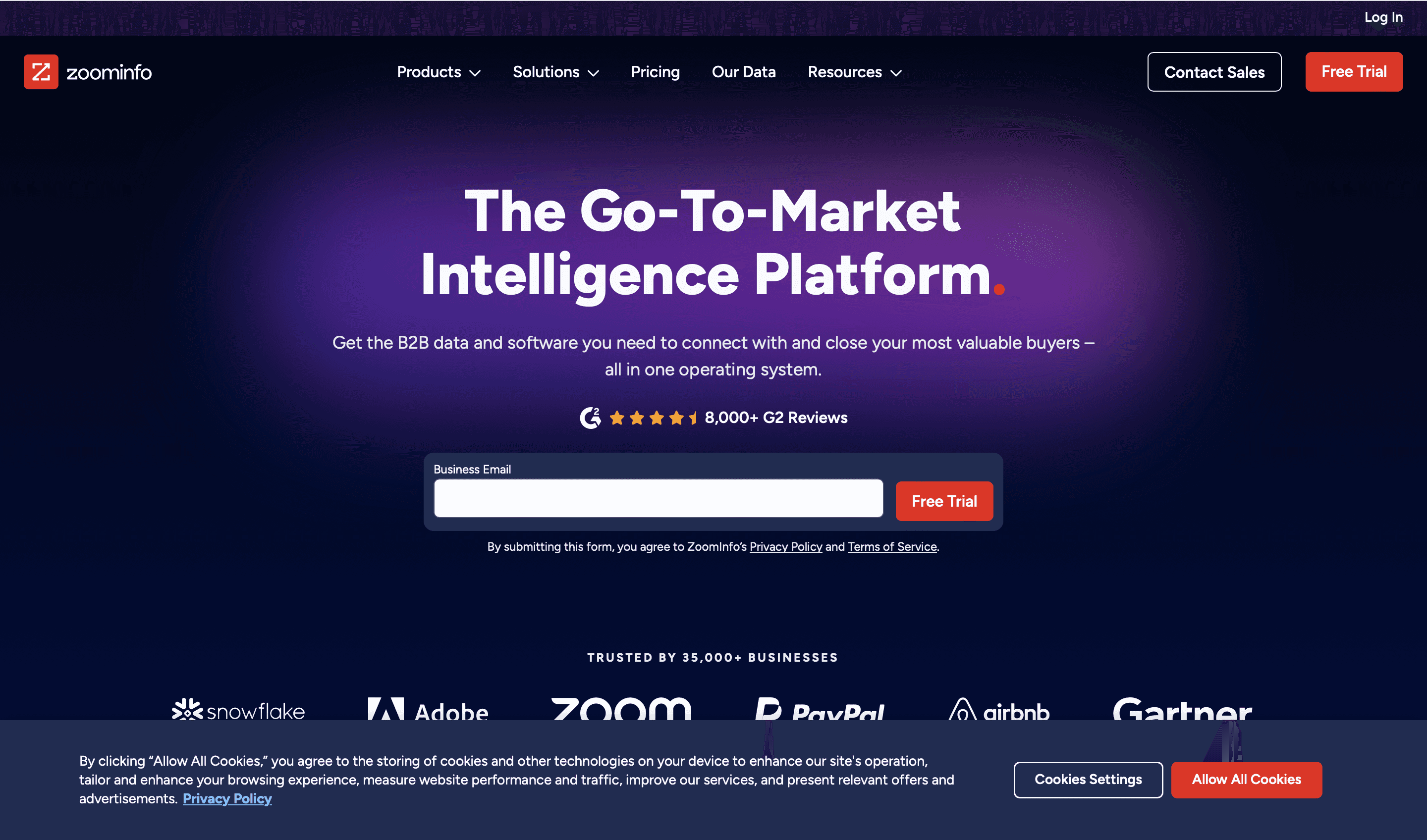
ZoomInfo is the largest proprietary B2B database, with claims of 500M contacts and 100M companies maintained by 300+ human researchers, plus intent data, a Copilot for reps and, since 2025, GTM Studio, which runs its own waterfall across 25+ external sources in parallel and picks the highest-confidence match. That last feature exists specifically to compete with Clay, and ZoomInfo now publishes its own Clay comparison page.
Pricing. Not published for any paid plan. Buyers consistently report entry contracts around $15,000 a year, annual terms, and pricing that scales with licenses and credits. There is a free trial.
Where it beats Clay. Depth and verification inside US enterprise accounts, intent signals with a decade of history, and a single vendor to hold accountable. If procurement wants one contract that covers data, intent and execution, this is the one.
Where Clay is ahead. Everything self-serve. Signup in minutes instead of a sales cycle, coverage outside North America, and the freedom to swap providers when one gets worse.
Best for US enterprise sales organizations with budget and a procurement team. The details are in Clay vs ZoomInfo.
4. Cognism
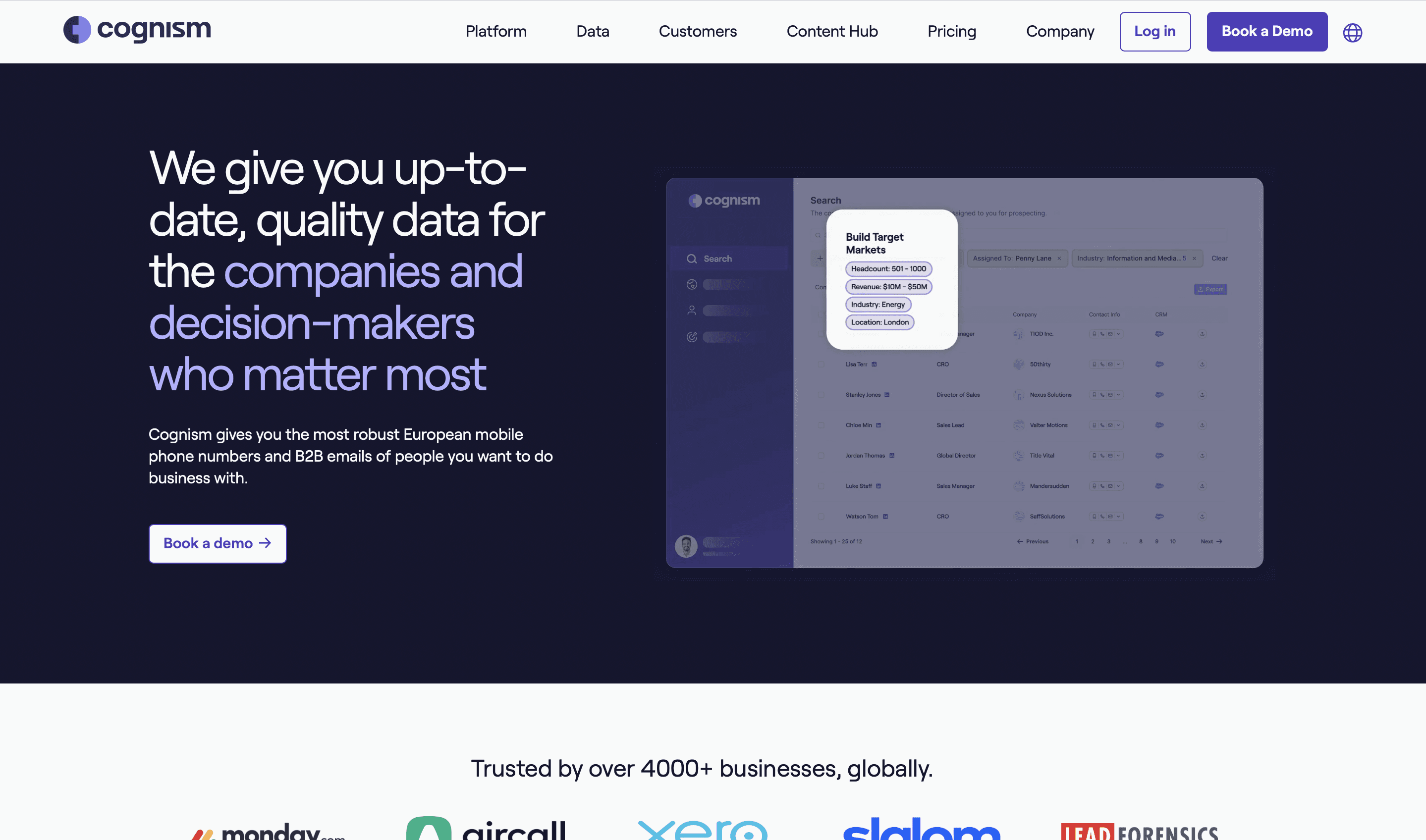
Cognism is a contact-data vendor rather than a workspace, and it wins on one specific thing: human-verified mobile numbers with EMEA compliance built in. Its Diamond Data product phone-verifies numbers before they reach you, which matters when your motion is cold calling into Europe, where GDPR and the local do-not-call registries make unverified data a liability.
Pricing. Not published. Annual contracts sold through sales.
Where it beats Clay. EMEA mobile accuracy and compliance paperwork. Clay can route a phone lookup to several providers, but none of them carries Cognism's verification on European numbers.
Where Clay is ahead. Everything except phones. No workflows, no AI research, no aggregation. Most Cognism customers run it beside a workspace like Clay or Databar, not instead of one.
Best for EMEA-focused teams whose pipeline depends on connect rates. Databar vs Cognism covers the global-versus-European trade-off, and Cognism vs Apollo the head-to-head by region.
5. FullEnrich
FullEnrich does one job: find a work email or mobile by trying 20+ vendors in a waterfall, and it publishes per-region find rates and an 80%-plus overall claim. It is the tool people pick when the only thing wrong with their Clay setup is the contact-finding column.
Pricing. Entry at EUR 55 a month for 1,000 credits, roughly EUR 0.055 per credit, unlimited seats, and credits only burn on a returned result. It also plugs into Clay, n8n, Make and Zapier, so some teams use it as a provider inside another workspace.
Where it beats Clay. Simplicity and a published find rate. Nothing to learn.
Where Clay is ahead. Everything that isn't email and phone.
Best for teams whose problem is contact data, not workflow. If phones are the gap, the best phone number enrichment tools compares eight of them on connect rates.
6. Bitscale
Bitscale is the closest to a like-for-like Clay replacement in shape: a spreadsheet workspace with 100+ data sources, AI agents (BitAgent), live buying signals and CRM push, positioned as the GTM data layer for your CRM. What sets it apart commercially is that paid plans bundle GTM-engineer onboarding hours and the top tier includes a private Slack channel, so you buy setup help with the software.
Pricing. Growth at $349 a month for 15,000 credits, about $0.023 per credit, not priced per seat. Credits burn only on returned results.
Where it beats Clay. Hands-on onboarding, and a simpler credit model with no action meter.
Where Clay is ahead. Provider count, templates, community, and the breadth of integrations. Bitscale is a much smaller company.
Best for teams that want a Clay-style workspace and someone to build the first workflows with them.
7. Cargo
Cargo calls itself GTM infrastructure for AI agents and means it: workflows are versioned, runs are replayable with a full execution trace, and enriched data lives in Data Models you own rather than in tables inside the vendor's UI. It ships 19 open-source skills for Claude Code, Codex and Cursor and claims 138 providers.
Pricing. Starter at $165 a month for 1,500 credits, which works out to about 11 cents a credit, the highest unit cost on this list, with unlimited seats and a 20% partner program.
Where it beats Clay. Reliability as a feature: retries, diffs, and a trace of every run. If your workflows are production systems, this is the argument.
Where Clay is ahead. Price per lookup, by a wide margin, and a UI a non-engineer can operate.
Best for GTM engineering teams that want their playbooks in version control and are happy to pay for it.
8. Freckle
Freckle repositioned in May 2026 from the Clay alternative for non-technical users to the Clay alternative built for GTM engineers who live in coding agents. The product is a CLI first and a workspace second, with 40+ providers, AI columns and unlimited seats.
Pricing. Build at $99 a month for around 5,000 credits, about two cents each, and a 250-credit free tier. Credits only burn on results.
Where it beats Clay. If your whole day is a terminal and a coding agent, Freckle meets you there and Clay doesn't.
Where Clay is ahead. Provider breadth (40 versus 200+), signals, audiences, sequencer, community. Freckle is eleven people.
Best for solo GTM engineers and small agencies working from Claude Code. If that's you, our own comparison of Claude Code and Clay is the more useful read.
9. Deepline
Deepline removes the aggregator markup. Its default mode is bring your own keys: you connect your Apollo, Findymail or other provider accounts, pay those vendors directly, and pay Deepline half a cent per call once you pass 50,000 calls a month. Plays are versioned TypeScript, and the data lands in a Postgres you control. It publishes a comparison page aimed squarely at credit-based aggregators, Databar included.
Pricing. No platform fee to start, $0.005 per call above 50,000 a month, plus whatever your providers charge. Growth is $395 a month with $200 of usage included.
Where it beats Clay. Unit economics at high volume, if you already hold provider contracts, and data you own outright.
Where Clay is ahead. You have to go and negotiate with every provider yourself, and you have to be able to write TypeScript. Deepline is nine months old.
Best for technical teams with existing provider deals and a preference for owning the database. If what appeals is running enrichment inside an automation engine you already own, the Databar n8n node does that without the TypeScript.
10. Lusha
Lusha is a contact database with a Chrome extension, built for a rep who needs one verified email or number while looking at a LinkedIn profile. It has an API and a simple export, and that is about the extent of the overlap with Clay.
Pricing. Seat-based tiers with credit allowances; check the current page, the tiers change often.
Where it beats Clay. Zero setup for an individual rep.
Where Clay is ahead. Everything about batches, workflows and fallback.
Best for individual reps, not for the person building the team's data pipeline.
Which one, by team
If you are | Start with | Because |
|---|---|---|
A RevOps or GTM-engineering team that wants Clay's data without the action meter | Databar | Same providers, one currency, API and MCP on every plan |
A 1 to 5 person US sales team that wants data plus sequences | Apollo | Cheapest complete outbound stack per seat |
An enterprise org with procurement and a US focus | ZoomInfo | Deepest verified US data and a single contract |
An EMEA cold-calling team | Cognism, beside a workspace | Verified mobiles and compliance |
A team whose only gap is emails and phones | FullEnrich | Published find rates, nothing to learn |
A team that wants Clay's shape with setup help included | Bitscale | Onboarding hours bundled in |
Engineers who want workflows in git with a run trace | Cargo or Deepline | Versioning, replay, owned data |
A solo operator working from Claude Code | Freckle or Databar | CLI-first, cheap per credit |
A non-technical ops team that learns from templates | Clay | The template library and community are still the largest |
When Clay is still the right call
Stay on Clay if your team is non-technical and builds from templates, if you use its native sequencer or ad audience sync as part of the workflow, or if the agency you work with is Clay-certified and you don't want to retrain them. The template marketplace and Clay University are real advantages that no alternative matches, and if the action meter isn't hurting you, the switching cost may not be worth it.
Move if the two-currency bill is the thing you dread every month, if you need API access and don't want to pay $446 for it, or if the person running your data is a GTM engineer who would rather write the workflow than click it.
Migrating off Clay
Every tool on this list imports CSV, and Clay exports every table to CSV, so the data itself moves in an afternoon. The part that takes thought is the waterfalls. On an aggregator that runs the same providers, which is most of them, you rebuild each waterfall in the same order and get the same results; on a single-database tool like Apollo or ZoomInfo you're replacing the waterfall with one source and should test match rates on a sample first. Databar rebuilds waterfalls one to one, opens a shared Slack channel on day one, and matches remaining Clay credits one for one. The full migration path is on the Databar vs Clay page. The CRM side of a move, keeping records clean while the source changes, is covered in CRM migration and enrichment.
Frequently asked questions
What is the best Clay alternative in 2026?
It depends on who runs the data. For RevOps and GTM engineers who want Clay's provider breadth with API and MCP access on every plan and no action limits, Databar. For a small sales team that wants data and outreach in one tool, Apollo. For US enterprise procurement, ZoomInfo. For EMEA phone data, Cognism.
Is there a free Clay alternative?
Apollo has a free plan with a small credit allowance. Freckle gives 250 free credits, Bitscale 200, Databar a 14-day full-product trial with 100 credits. Clay's own free plan gives 100 data credits and 500 actions a month, capped at 200 rows per table.
Why did Clay's pricing change in March 2026?
Clay split billing into Data Credits and Actions, cut marketplace data prices by 50 to 90 percent, and made HTTP requests consume actions, moving API access to the Growth tier. Teams heavy on marketplace data got cheaper; teams heavy on custom HTTP integrations got more expensive. The review has the tier-by-tier detail.
Can I use Clay and one of these together?
Yes, and many teams do. FullEnrich and Cognism are commonly used as providers inside a workspace. Databar and Clay both export to the same CRMs, so some teams enrich in one and orchestrate in the other during a migration.
Which alternatives have an MCP server or CLI?
Databar (API, Python SDK, CLI and MCP on every plan), Deepline (SDK, CLI, MCP), Cargo (CLI and skills), Freckle (CLI beta), Apollo (MCP), ZoomInfo (a hosted MCP server included with every subscription), Bitscale (MCP), FullEnrich (MCP). Clay has an agent plugin with API and CLI access on paid tiers. If the consumer of your data is an agent, see the data APIs GTM teams use with Claude Code.
Do any of these charge for lookups that return nothing?
Clay, Bitscale, FullEnrich, Freckle and Databar all charge only when a provider returns a result. Apollo and ZoomInfo meter exports rather than lookups. Cargo and Deepline meter calls.
Where does Clay still lead?
Templates, community, agency ecosystem, and a native sequencer and ad-audience sync inside the workflow. If those are what you use most, the alternatives on this list are cheaper without being better for you.
Related reading
➔ Start free · 14-day full-product trial. No data, no charge.
Prefer a walkthrough? Book a founder demo.
Related articles
See all