

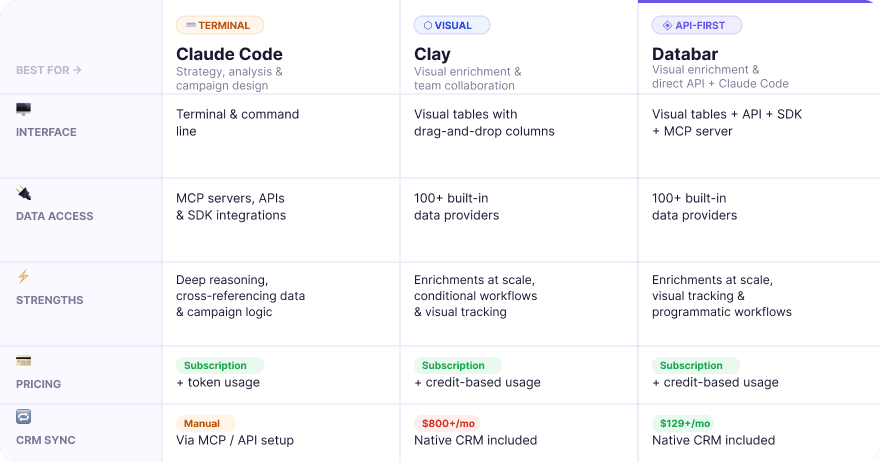
That table answers the question most people searching "Claude Code vs. Clay" actually have. But the real answer is more nuanced than any comparison grid, because these tools operate at different layers of the GTM workflow, and the enrichment layer has more options than most teams realize.
Clay reached $100M in annual revenue by the end of 2025, establishing itself as a dominant platform for data enrichment and prospecting workflows. Claude Code, meanwhile, has grown to a $2.5B run rate, with business subscriptions quadrupling since the start of 2026. The overlap between their user bases is growing fast. GTM engineers, agency operators, and RevOps teams are trying to figure out where one tool ends and the other begins, and whether both are still necessary.
We think the answer depends on what you actually need from each layer. The strategic layer (Claude Code) and the enrichment layer (where Clay, Databar, and others compete) serve different purposes. Getting clear on that distinction saves teams real money and produces better campaigns.
What Each Tool Actually Does
Before getting into workflows, it is worth clarifying what these tools are, since comparing them requires understanding that they solve fundamentally different problems.
Clay is a visual workflow platform built specifically for sales and marketing data operations. You build enrichment workflows by adding columns to a spreadsheet-like table, where each column represents a data operation: find an email, look up company data, verify a phone number, run an AI classification, push to CRM. Clay connects to 100+ data providers and lets you build conditional logic (waterfall enrichment, if/then routing, fallback providers) without writing code. The visual interface makes it easy to see what is happening at every step, share workflows with teammates, and monitor enrichment progress in real time. For a deeper look at how Clay works and where it fits, we published a full review.
Claude Code is an AI agent that runs in your terminal. It reads files, executes scripts, browses the web, connects to external services through MCP servers and API integrations, and produces structured output based on instructions you give it in plain English. It was originally built for software development, but GTM teams have adopted it for strategic work: ICP analysis, competitive research, market sizing, campaign architecture, closed-won pattern identification, and messaging development. Its strength is reasoning across large amounts of unstructured data (call transcripts, CRM exports, competitive intel) and producing structured analysis.
Databar is a data enrichment platform with 100+ data sources accessible through a single API, SDK, and MCP server as well as visual table-interface. It offers the same core enrichment capabilities teams use Clay for (email finding, company data, phone numbers, tech stack detection, waterfall enrichment) but with an API-first architecture that makes it natively compatible with Claude Code and other programmatic workflows. It also has a visual table interface for teams that want to run enrichments and see the workflows in detail.
The simplest way to think about it: Claude Code is where you do the thinking. The enrichment platform, whether that is Clay, Databar, or something else, is where you get the data.
Where Claude Code Wins
Strategic Analysis and Research
Claude Code excels at work that requires synthesizing multiple data sources into a coherent strategy.
When you need to analyze 100 closed-won deals across a dozen dimensions to identify which segments convert best, Claude Code processes the CRM export, cross-references it with outreach campaign data, reads through call transcript notes, and produces a structured analysis that identifies the patterns. No enrichment platform does this. They are designed to enrich individual records, not to reason about patterns across an entire dataset.
The same applies to ICP refinement. You can feed Claude Code your current ICP definition alongside actual deal data, and it will tell you where the definition matches reality and where it does not. Maybe your stated ICP says "companies with 200 to 1,000 employees" but your closed-won data shows that 70% of your wins are in the 200 to 400 range. Claude Code finds that discrepancy and recommends the adjustment.
Competitive Intelligence
Claude Code can browse the web through MCP connections, visit competitor websites, read their blog posts, analyze their positioning, and produce a competitive analysis document. It can compare your client's messaging against three competitors and identify the specific angles nobody else is using. This type of open-ended research requires reasoning and synthesis, which is Claude Code's core strength.
Campaign Architecture
Designing a multi-segment outbound campaign involves decisions that go beyond data operations. Which segments to target first? What messaging framework to use for each? How to structure the sequence cadence? What personalization variables matter for this particular audience?
Claude Code handles this planning work because it can reference your existing SOPs, your client's context, and your historical campaign performance data all at once. The output is a campaign blueprint that specifies everything the enrichment layer needs to execute.
Working with Unstructured Data
Call transcripts, meeting notes, long-form competitive reports, sales playbooks: Claude Code reads and reasons about all of these.
If your best insights about buyer behavior are buried in 50 discovery call recordings, Claude Code can process the transcripts and extract the patterns. Enrichment platforms operate on structured, tabular data. They need clean columns with defined fields. The messy, narrative data that often contains the most valuable insights lives outside their scope.
Where Enrichment Platforms Win (and How They Differ)
The enrichment layer is where most teams spend the majority of their GTM tooling budget. This is also where the choice between Clay and Databar matters most.
What Both Platforms Do Well
Both Clay and Databar handle the core enrichment operations GTM teams need:
Email finding with waterfall logic across multiple providers
Company data enrichment (firmographics, funding, tech stack, headcount)
Phone number lookups across multiple sources
Contact discovery at target companies
Email verification to protect sender reputation
AI-powered classification and data processing
These are table-stakes capabilities for any serious enrichment platform. The differences are in how you access them, what they cost, and how they fit into a broader workflow.
Where Clay Has an Edge
Visual workflow building. Clay's spreadsheet interface makes workflows inspectable and shareable in a way that terminal-based sessions are not. You can see exactly which enrichment ran on which record, what the output was, which records failed, and why. For teams where multiple people need to understand and maintain the same workflow, this visibility matters.
Conditional logic and branching. Clay's workflow builder handles complex conditional enrichment well. If the company has more than 500 employees, use this enrichment path. If they are in financial services, add this additional data point. These branching workflows are a core feature, and they run without manual intervention once configured.
Community and ecosystem. Clay has built a large community of GTM engineers and agencies. There are bootcamps, certifications, and a network of 100+ agencies building workflows on the platform. If you are hiring people who already know Clay, that has real value.
Clay's Tradeoffs
CRM sync gating. Native CRM integrations sit on Clay's Growth plan. As of September 2026, Clay lists Growth from $446/month billed monthly, or $185/month billed annually, with the Launch plan below it starting at $167/month monthly and $54/month annual. CRM integrations are listed as not included on Launch, so teams that need HubSpot or Salesforce connectivity have to move up a tier to get it.
Two currencies to track. Clay now separates actions (platform usage, meaning enrichment and GTM execution) from data credits (which buy data and AI from vendors in Clay's marketplace). Launch includes 15,000 actions and 3,000 data credits a month, Growth includes 40,000 actions and 6,000 data credits, and the free plan includes 500 actions and 100 data credits. Actions reset every billing cycle and do not roll over. Unused data credits accumulate up to 2x your monthly credit amount on Launch and Growth. Forecasting a month means forecasting both numbers, not one.
Programmatic access starts a tier up. Clay's plan comparison lists HTTP API integrations on Growth and Enterprise, and marks them as not included on Launch. If your workflow involves Claude Code, n8n, Make, or any other programmatic orchestration, you either move up a plan or work around the limitation with CSV exports and imports. The same is true for anything where an agent, not a person, drives the tool.
Where Databar Differs
API-first architecture. Every enrichment available in Databar's visual interface is also available through its API, SDK, and MCP server. This matters for teams using Claude Code, because the enrichment layer becomes a native tool call instead of a separate platform you switch to. No CSV exports. No manual imports. The agent calls the API and gets the data back in the same session.
Single-API provider access. Instead of integrating with each data provider individually, Databar gives you access to 100+ data sources through one API. One authentication, one response format, one billing relationship. The waterfall endpoints handle cascade logic server-side: you make one call, and Databar tries multiple providers until one returns a result, with built-in email verification.
Built-in caching. Repeat lookups inside the 24-hour cache window come back without a provider call and without consuming credits. Pass skip_cache: true when you need a fresh result inside that window. For agencies running overlapping campaigns on the same accounts, that removes a lot of duplicate spend in a single day of list building.
CRM push without a plan jump. Databar's CRM exporters are available on every paid plan, and the entry plan is Build at $99 per month for 5,000 credits (September 2026). You do not move up a tier to connect HubSpot.
How They Work Together in Practice
The pattern emerging across GTM agencies and in-house RevOps teams in early 2026 looks like this:
Phase 1: Strategy and research in Claude Code. Build the client context file. Analyze closed-won data. Define the ICP. Research competitors. Design the campaign architecture. Produce segment definitions, messaging frameworks, and enrichment specifications. This is the thinking work, and it happens entirely in Claude Code.
Phase 2: Execution in the enrichment layer. Take the segment definitions from Phase 1 and build the lists. Run waterfall enrichment to find verified contacts. QA the data. Push approved records to CRM. For teams using Claude Code, this step can happen inside the same session via API or MCP calls to Databar. For teams that prefer a visual interface, Databar's table view provides the same enrichment capabilities with progress tracking, error handling, and shareable results.
Phase 3: Iteration back in Claude Code. Analyze campaign results. Compare performance across segments. Identify what worked and what did not. Refine the ICP, adjust the messaging, redesign the segments. Feed the updated strategy back into Phase 2 for the next campaign cycle.
The back and forth between strategy and execution is not a workaround. It is the workflow.
A practical example: An agency onboards a new B2B SaaS client. In Claude Code, they analyze the client's CRM export, identify that companies with 50 to 200 employees in the financial services vertical convert at 3x the average rate, discover that a recent VP of Sales hire is a strong buying signal, and build a messaging framework around the client's integration with a specific CRM platform.
They then run the enrichment directly from Claude Code using Databar's API: build a list of financial services companies with 50 to 200 employees, enrich for recent job postings to flag the VP of Sales signal, find the right decision-maker contacts via waterfall email enrichment, and verify emails. The finished data pushes to the client's HubSpot with custom fields populated according to the campaign specifications. No platform switching. No CSV files. One continuous workflow.
This is the key architectural difference. With Clay, the enrichment step happens in a separate platform, which means exporting and importing data between tools. With Databar, the enrichment step is a function call inside the same session.
When You Do Not Need Both
Not every team needs both a strategy layer and a separate enrichment platform. Here is a simple framework for deciding.
You only need Claude Code if your primary challenge is strategic. You are an early-stage company figuring out your ICP. You need to analyze your existing deals to find patterns. You are building your first outbound campaign and need help designing the approach. You have more strategy questions than execution needs. Once the strategy is clear, you can run small-batch enrichments directly from Claude Code using Databar's API and skip the visual platform entirely.
You only need an enrichment platform if your strategy is already defined and your primary need is running enrichment workflows at volume. The question then is which platform fits your workflow: if you prefer a visual spreadsheet interface and Clay's workflow builder fits your team, Clay works. If you want API-first access, transparent pricing, and the ability to integrate with Claude Code or other programmatic tools, Databar is the better fit.
You need both if you are running ongoing campaigns that require regular strategic iteration. Agencies fall into this category almost universally. In-house teams doing account-based marketing with evolving ICP definitions also benefit from both. Any operation where the quality of targeting matters as much as the volume of outreach benefits from the think-then-execute pattern.
Three Scenarios That Cover Most Teams
The framework above is about capability. This one is about who runs the workflow and how much volume passes through it, which is usually the faster way to decide.
Scenario 1: a non-technical two to five person GTM team running under 1,000 rows a month. Stay on the visual builder. Onboarding speed is worth more than unit cost at that volume, and the cost curve does not bite yet. Revisit the decision when monthly volume crosses roughly 10,000 rows, or when you hire someone who can write Python.
Scenario 2: a technical solo founder, a GTM engineer, or an AI-native team. Default to Claude Code on top of a programmable data layer. You will move faster with an API you can call than with a UI you have to babysit, and you can run workflows an operator would never queue up by hand. A visual table still earns its place for spot checks and client-facing output.
Scenario 3: a mature GTM team with both ops and engineering. Run both, in separate lanes. Ops owns the recurring visual workflows. Engineering owns the agentic and bulk motions. The split usually settles within a quarter once both sides see the contrast, and it maps cleanly onto the three-phase pattern above.
Write the volume thresholds down somewhere your finance team can see them. Under 1,000 rows a month the tooling choice barely moves your P&L. Above 10,000, the difference between paying per row processed and paying only when data comes back starts showing up as a line item your finance team will ask about. How waterfall enrichment works covers where those costs actually land, and the MCP vs SDK vs API breakdown covers which surface to reach for once you are in scenario 2 or 3.
What to Expect Over the Next 12 Months
The line between strategy tools and execution tools is blurring. Clay released Sculptor, a feature for describing workflows in natural language. Claude Code's MCP ecosystem is expanding. Both are moving toward more conversational interfaces, which means the workflow gap between them will narrow over time.
What will not change is the need for a flexible data layer underneath. Regardless of whether you build your enrichment workflow in a visual tool or run it from a terminal, you need access to the right data providers at the right price.
For teams making decisions today: start with the layer that matches your biggest bottleneck. If your execution runs fine but your targeting is mediocre, Claude Code solves your immediate problem. If your strategy is solid but you need better enrichment, evaluate your options on the enrichment layer.
If both need work, start with strategy (Claude Code) because better strategy makes execution more efficient. Better execution without good strategy just means you reach the wrong people faster.
The teams that will outperform over the next year are the ones building a cycle where the intelligence layer improves the data layer, and the data layer feeds back into the intelligence layer. That cycle is where compounding returns live, and it starts with choosing tools that give you flexibility rather than locking you into a single vendor's pricing structure.
If Clay itself is the open question, these three go deeper on it.
Also interesting
FAQ
Which tool should I learn first?
If you already have defined ICPs, proven messaging, and a working outbound process, learn your enrichment platform first. It will immediately improve your enrichment speed and data quality. If you are still figuring out your market, refining your positioning, or struggling with inconsistent targeting, learn Claude Code first. The strategic clarity it provides will make every subsequent tool in your stack more effective.
Can I use Claude Code and Clay together?
Yes, and plenty of agencies do. Claude Code handles the analysis and the campaign design, then the enrichment runs wherever your data lives. The friction is the handoff: Clay's HTTP API sits on the Growth plan, so on Launch you move data between the two with CSV exports. With an API-first enrichment layer the handoff is a tool call inside the same session.
Does Clay have an API?
Yes, on the paid tiers that include it. Clay's plan comparison lists HTTP API integrations on Growth and Enterprise and marks them as not included on Launch (September 2026). If your workflow is driven by an agent or a script, check which tier you are on before you design around it.
How do the costs compare?
Clay lists Growth at $446 per month billed monthly or $185 per month billed annually, and Launch at $167 monthly or $54 annual, with actions and data credits tracked separately (September 2026). Databar prices in credits on one meter: Build is $99 per month for 5,000 credits and Scale is $495 per month for 50,000, billed on outcomes, so an empty lookup costs nothing. Model your own volume before comparing headline prices, because the two meters count different things.
Do I need to be technical to use Claude Code for GTM work?
Less than you might think. Claude Code runs in a terminal, which looks intimidating, but the interactions are in plain English. You describe what you want, and it executes. The technical skill required is not coding but context engineering: structuring your files, writing clear CLAUDE.md configurations, and connecting the right MCP servers. Most GTM professionals can become productive within a few days of focused learning.
Related articles
See all