
"You don't have a data team. You barely have a sales team. You still need good data."
You're an early-stage founder running GTM with a skeleton crew. Maybe it's just you and one SDR. Maybe you're doing outbound yourself between product calls. Either way, you need accurate contact data to fill your pipeline, and you don't have weeks to evaluate vendors or months to implement enterprise tools.
This founder enrichment stack weekend guide gives you a working enrichment system in two days. Saturday, you set up the infrastructure. Sunday, you automate it so it runs without you. Total cost: under $200 to start. Total time: about 8 hours across the weekend.
Bottom line up front: Databar gives you access to 100+ data providers with credit-based pricing where you only pay for results. You only pay when data is returned. If Databar can't find the data, you don't pay. You can sign up, connect your CRM, and run your first enrichment in under 15 minutes. By Sunday evening, you'll have an automated workflow that enriches new leads as they come in and keeps your database clean.
Saturday morning: set up your enrichment platform (1 hour)
Step 1: Sign up for Databar (5 minutes)
Go to databar.ai and create your account. No credit card required for the free tier. You get enough credits to test everything today before you spend a dollar.
Step 2: Understand what you're working with (15 minutes)
You're not signing up for a single data provider. You're getting access to 100+ providers accessible through one platform. Search for companies, find contacts, verify emails, look up tech stacks, check funding data, and more. All through one interface or API.
The key feature for founders: waterfall enrichment. Instead of relying on one provider (which caps your coverage at 50-60%), waterfall cascades through multiple providers until one returns a verified result. This pushes coverage to 80-85%.
How waterfall enrichment boosts data quality and coverage by 40%
Step 3: Run your first enrichment (20 minutes)
Start with a small test. Take 20-30 companies from your target list. Upload them to Databar. Run a company enrichment to pull firmographic data (size, industry, revenue, tech stack). Then run contact discovery to find the decision-makers you want to reach.
Look at the results. Check the fill rate. How many companies returned full data? How many contacts did you find? Are the emails verified? This gives you a baseline for what to expect at scale.
Step 4: Connect your CRM (20 minutes)
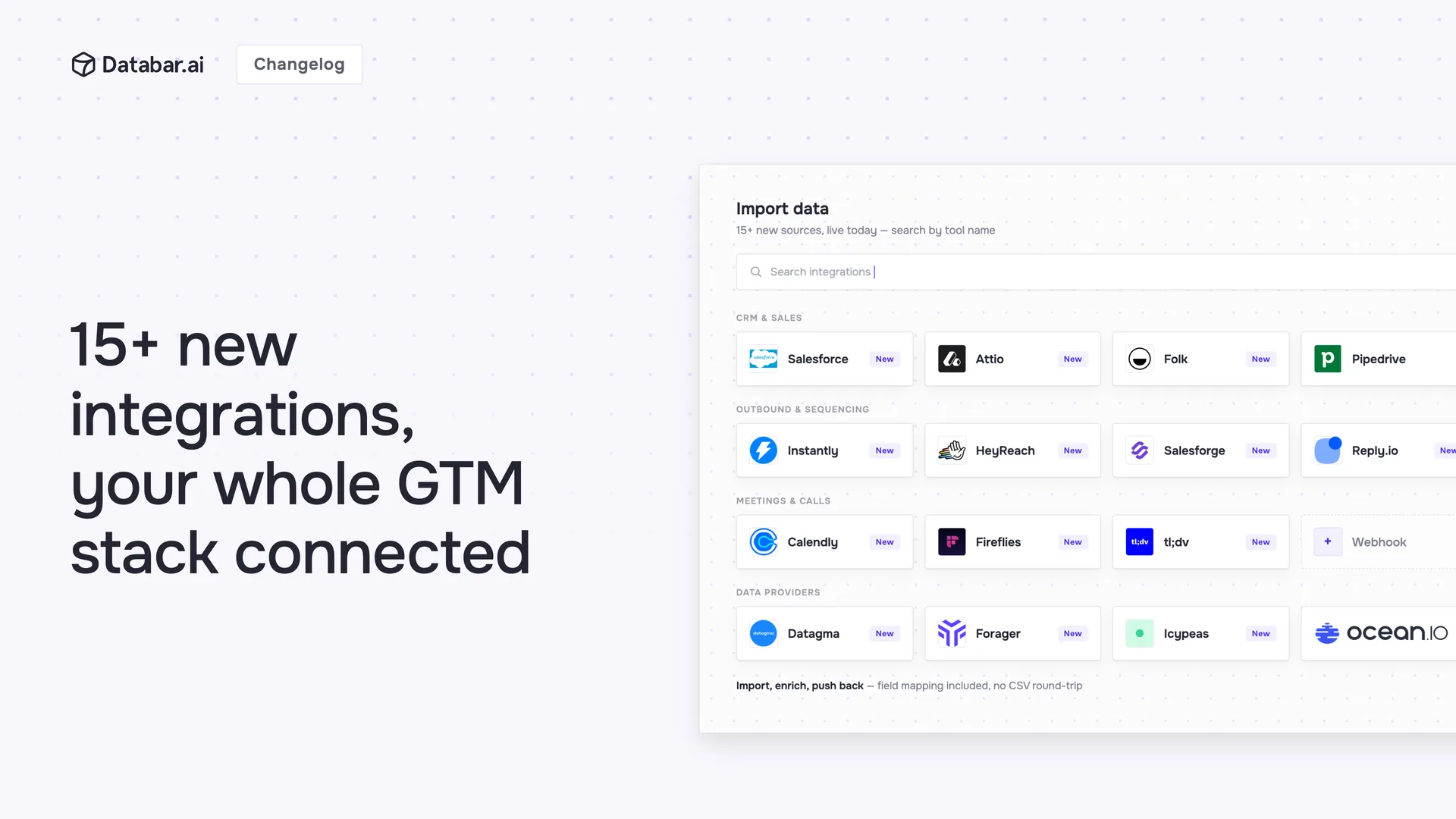
Whether you use HubSpot, Salesforce, Attio, or another CRM, connect it to Databar. This lets you enrich records directly from your CRM and push enriched data back without manual exports.
If you're pre-CRM (some early-stage founders run everything in a spreadsheet), that works too. Databar has a built-in table interface where you can manage your lists and export to CSV.
Saturday afternoon: enrich your existing database (2 hours)
Now that your platform is set up, it's time to fix the data you already have.
Step 5: Audit your current data (30 minutes)
Export your CRM contacts. Look at the gaps. Common problems founders face:
Missing email addresses (or unverified ones that bounce)
Job titles from 2 years ago (people change roles every 18 months on average)
Company data that's wrong or incomplete (employee count, industry, website)
No direct phone numbers
No tech stack or intent data
Count the gaps by field. If 40% of your contacts are missing verified emails, that's where you start.
Step 6: Run batch enrichment on your full list (30 minutes to set up, runs in background)
Upload your full contact list to Databar. Run waterfall enrichment for the fields that matter most. For most founders, the priority order is:
Email verification: Confirm existing emails are still valid. Replace the ones that bounce.
Contact discovery: Find emails for contacts where you only have a name and company.
Company enrichment: Fill in missing firmographic data for lead scoring and prioritization.
Phone numbers: Direct dials for high-priority prospects.
Let the batch run while you grab lunch. Depending on list size, it could take 15 minutes to an hour.
Step 7: Review results and push to CRM (1 hour)
Check the enrichment results. Look at fill rates by field. For a typical B2B list targeting US mid-market:
Email fill rate: 78-85% (waterfall)
Phone fill rate: 40-60% (waterfall)
Company data fill rate: 80-90% (waterfall)
Tech stack data: 60-75%
Push the enriched data back to your CRM. Map the fields correctly. Make sure emails go to the email field, not a notes field. Double-check that existing good data isn't overwritten with worse data.
Everything you need to know about CRM enrichment
Sunday morning: build automated workflows (2 hours)
Yesterday was about fixing what you have. Today is about making it automatic so you never fall behind again.
Step 8: Set up inbound lead enrichment (45 minutes)
Every time a new lead enters your CRM (form submission, demo request, signup), it should be enriched automatically. Set up a workflow that triggers on new contact creation:
New lead created in CRM
Databar enriches with company data + email verification
Lead is scored based on enriched attributes (company size, industry, tech stack)
High-scoring leads get routed to your outreach queue immediately
For founders doing outbound themselves, this means every inbound lead arrives with full context. No more spending 10 minutes researching a company before your first call. The data is already there.
Step 9: Set up weekly database refresh (30 minutes)
Contact data decays at 2-3% per month. That means 25-30% of your database goes stale every year. Set up a weekly job that:
Scans your CRM for records not enriched in the last 30 days
Re-verifies email addresses
Updates job titles and company data
Flags contacts who left their company
This runs in the background. You don't touch it. Your data stays fresh.
Step 10: Set up pre-outbound enrichment (45 minutes)
Before you send any outbound campaign, you need verified data. Build a workflow that runs automatically when you tag a list as "ready for outbound":
Verify all email addresses in the list
Remove or flag contacts with invalid emails
Fill missing company data for personalization
Add the list to your outbound tool
This prevents the most common founder outbound mistake: blasting 500 emails to a list where 15% bounce, which destroys your sender reputation.
CRM data cleaning: why manual isn't enough
Sunday afternoon: set up monitoring and optimize (2 hours)
Step 11: Build your data quality scorecard (30 minutes)
Create a simple dashboard (a Google Sheet works fine) that tracks:
Email fill rate: % of contacts with verified email
Email bounce rate: from your last 3 outbound campaigns
Company data completeness: % of accounts with all key fields filled
Enrichment cost this month: from your enrichment dashboard
Update this weekly. It takes 5 minutes. But it tells you if your data quality is improving, holding steady, or degrading.
Step 12: Calculate your enrichment budget (30 minutes)
Now that you've run real enrichment on real data, you know your per-record costs. Typical numbers for founders:
Activity | Monthly volume | Cost per record | Monthly cost |
|---|---|---|---|
New lead enrichment | 100-300 leads | $0.05-0.15 | $5-45 |
Contact discovery | 200-500 prospects | $0.10-0.30 | $20-150 |
Email verification | 500-1,000 emails | $0.01-0.03 | $5-30 |
Database refresh | 500-2,000 records | $0.05-0.10 | $25-200 |
Total | $55-425 |
For most early-stage founders, enrichment costs $100-300 per month. That's less than one seat on most enterprise enrichment tools. With a credit-based model where you only pay when data is returned, you're never locked into spending more than you need.
How much should you spend on data enrichment in 2026
Step 13: Optimize your waterfall order (30 minutes)
After your first batch, look at which providers in the waterfall returned the best results for your specific ICP. You can reorder the cascade. Put the highest-performing provider first to minimize costs (you only pay for the provider that returns data).
If your ICP is US-based SaaS companies, certain providers will dominate. If you're targeting European SMBs, different providers win. The data from your first batch tells you which order works best.
Step 14: Plan your first enriched outbound campaign (30 minutes)
You now have clean, enriched data. Plan a small campaign (50-100 prospects) using the enriched list. Write personalized openers using the company data, tech stack, and context you now have for each prospect. Send it Monday morning.
This is where the weekend work pays off. Your first campaign with enriched data will outperform anything you've sent before. Better deliverability. Better personalization. Better reply rates.
What you've built in a weekend
By Sunday evening, here's what you have:
A connected enrichment platform with 100+ data providers
A clean, enriched CRM database
Automated inbound lead enrichment
Automated weekly database refresh
Pre-outbound verification workflow
A data quality scorecard
Your first enriched outbound campaign ready to send
Total cost: $50-200 for the initial batch enrichment. Ongoing: $100-300/month. Time invested: about 8 hours. And it runs on autopilot from here.
Compare that to the enterprise approach: 3-month vendor evaluation, $30K annual contract, 6-week implementation, dedicated ops person to manage it. As a founder, you don't have that time or budget. This approach gets you 80% of the result in 0.5% of the time.
Best CRM enrichment tools that move the revenue needle
Start building this weekend
This founder enrichment stack weekend guide gets you from zero to a working enrichment system in two days. Databar gives you 100+ data providers, credit-based pricing where you only pay for results, and you only pay when data is returned. Sign up, run your first enrichment, and send a better outbound campaign on Monday than anything you've sent before.
Sign up for Databar and start building
Founder Enrichment Stack Weekend Guide: FAQ
Do I need technical skills to set up Databar?
No. The no-code interface handles everything in this guide. You can upload lists, run enrichment, and set up workflows without writing a line of code. If you want API access later for custom integrations, that's available too.
What if I'm pre-CRM and just using spreadsheets?
That works fine. Databar has a built-in table interface. You can manage your lists directly in Databar, run enrichment, and export to CSV. When you're ready for a CRM, you'll have clean data to import.
How do I know which enrichment providers to use?
Start with waterfall enrichment and let the platform optimize the provider order for you. After your first batch, review which providers returned the best results for your ICP. Adjust the cascade order based on actual performance data.
Can I use this setup if I'm doing outbound myself as a solo founder?
Absolutely. This guide is designed for that exact scenario. The automated enrichment means you spend your limited outbound time on actual outreach instead of manual research. Even if you're sending 20 emails a day, enriched data makes each one more likely to get a reply.
Founder Enrichment Stack Weekend Guide: Also interesting
Related articles
See all