
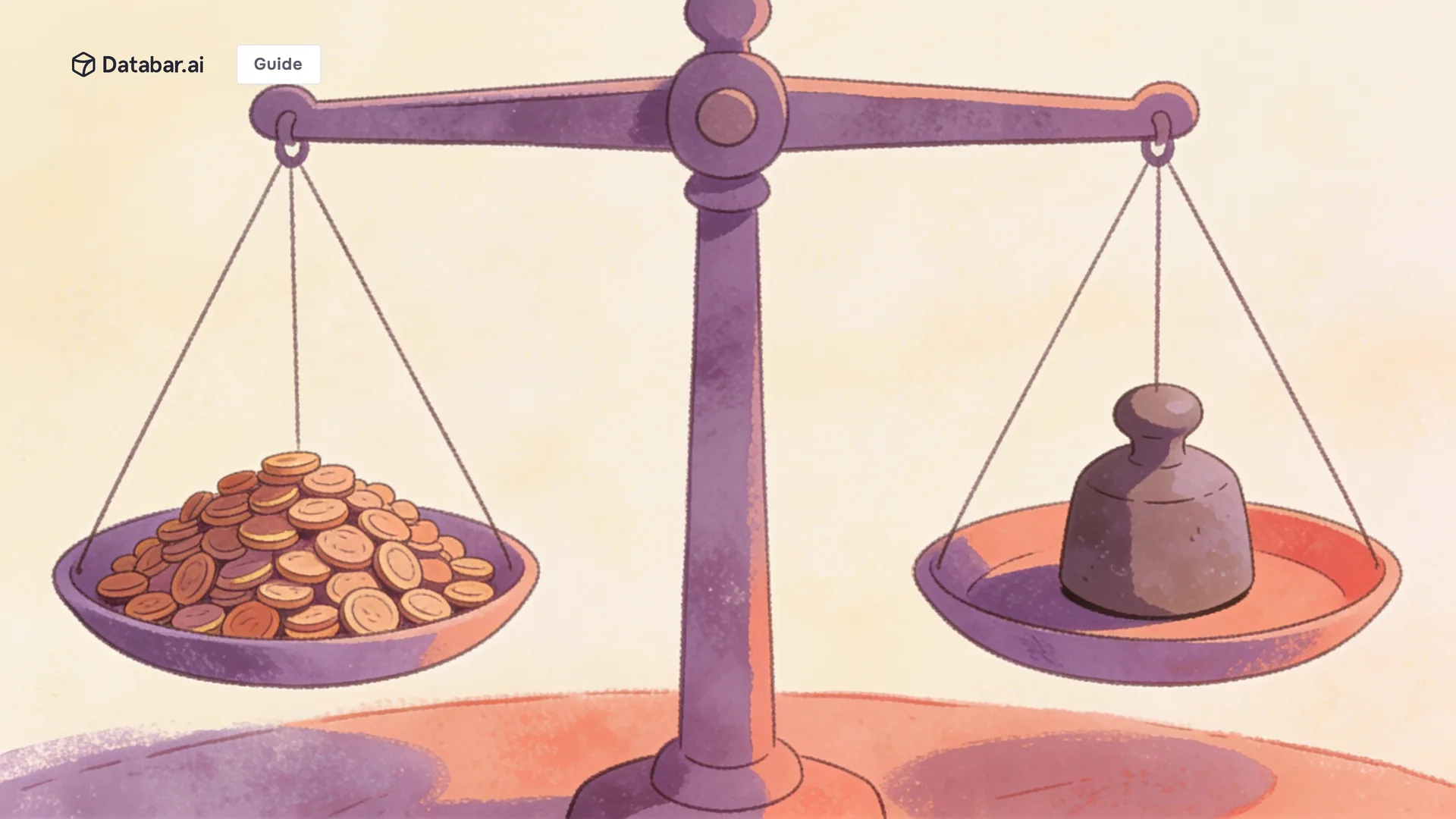
One enterprise client reported cutting their per-enrichment cost from 25 cents to less than 10 cent while simultaneously boosting coverage rates. That's not a typo. The gap between overpaying for data and optimizing your enrichment budget can be that dramatic.
The reality is most companies either underspend on enrichment (and suffer from incomplete data that kills conversion rates) or overspend dramatically (locked into enterprise contracts they don't fully use). Finding the right number requires understanding what you're actually buying, how pricing models work, and where your dollars generate the highest return.
Here's how to build an enrichment budget that makes financial sense for your GTM operation in 2026.
Understanding What You're Paying For
Before setting any budget, you need clarity on what enrichment actually costs and why prices vary so dramatically across the market.
Data enrichment pricing typically falls into one of three models, and the model matters as much as the sticker price:
Per-seat licensing is the traditional enterprise approach. ZoomInfo, for instance, starts around $15,000+ per year for basic packages and scales to $100,000+ for larger teams. You're buying access for your team regardless of how much data you actually use. This works for organizations with predictable, high-volume needs. It doesn't work for smaller teams or those with variable usage.
Credit-based systems charge per enrichment or per record. Apollo.io offers plans starting at $49/user/month with included credits. Clearbit (now Breeze Intelligence under HubSpot) sells credits in packs of 100, 1,000, or 10,000. This model gives flexibility but can surprise you with costs if volume spikes unexpectedly.
Usage-based pricing charges based on actual consumption without pre-purchasing credits. This is increasingly common among newer platforms and tends to align costs most closely with value received.
The key insight: there's no "market rate" for enrichment. A single email verification might cost anywhere from $0.01 to $0.25 depending on your provider and volume. Understanding your actual usage patterns is essential before committing to any model.
The Budget Framework: Percentage of What?
When finance asks how much to allocate for data enrichment, the honest answer is: it depends entirely on your GTM motion and what enrichment enables.
That said, some benchmarks exist. B2B marketing budgets average about 9.4% of revenue, with tools and data typically representing 15-23% of that marketing spend. For companies prioritizing outbound or ABM motions, data enrichment often commands a higher share, sometimes 3-5% of total marketing budget or more.
But percentage-based thinking can mislead. A better approach ties enrichment costs directly to the revenue they enable.
The deal-based calculation works like this: if your average deal size is $50,000 and enrichment helps close one additional deal per year, you can justify up to $50,000 in enrichment spending just to break even. Obviously you want better returns than break-even, but this frames the ceiling.
A more practical version: if enrichment improves close rates by 30-50% (which is what happens when reps have phone numbers instead of just email addresses), and your team closes $1M in pipeline annually, that improvement represents $300K-$500K in additional revenue. Spending $10K-$20K on enrichment to capture even a fraction of that uplift is clearly justified.
The efficiency calculation adds another dimension. If your SDRs spend 2 hours daily researching prospects manually, and enrichment eliminates 80% of that research time, you're recovering 1.6 hours per rep per day. Across a 10-person team working 250 days per year, that's 4,000 hours. At a fully-loaded cost of $40/hour, that's $160,000 in recovered productivity. Enrichment that costs $20,000/year to achieve that represents an 8:1 return on efficiency alone, before counting any conversion improvements.
Price Ranges by Company Stage
What makes sense financially varies dramatically based on company size, deal values, and GTM complexity.
Early-stage startups (under $1M ARR) should expect to spend $1,000-$5,000 annually on enrichment. At this stage, you likely need basic contact and company data, not enterprise intent signals. Low-cost plans, or similar lightweight solutions provide enough coverage without committing significant budget. The priority is validating your ICP and outbound motion, not scaling it.
Growth-stage companies ($1M-$10M ARR) typically land in the $5,000-$30,000 annual range. This is where enrichment becomes strategic rather than tactical. You need reliable data across more contacts, faster enrichment to support scaling outreach, and potentially intent signals to prioritize accounts. Credit-based systems or mid-tier platform subscriptions make sense here.
Scaling companies ($10M-$50M ARR) often spend $30,000-$100,000 annually. At this stage, data quality directly impacts revenue predictability. You're likely running multiple GTM motions (inbound, outbound, ABM) that each need enrichment support. Enterprise platforms become justifiable, but aggregation approaches that combine multiple providers often deliver better coverage at lower cost.
Enterprise ($50M+ ARR) budgets range from $100,000 to $500,000+ depending on team size and GTM complexity. The decision becomes less about whether to invest and more about optimizing the mix of providers, ensuring compliance, and integrating enrichment into automated workflows.
Where Budget Allocation Goes Wrong
The most expensive mistake isn't overpaying per credit, it's paying for the wrong things entirely.
Paying for coverage you don't use. Enterprise contracts with major providers often include data sets your team never touches. If you're only enriching contact information but paying for technographic, firmographic, and intent data bundled together, you're subsidizing capabilities you don't need. Unbundled or usage-based pricing eliminates this waste.
Single-provider dependency. Relying on one data source caps your coverage at whatever that provider can match - often 40-60% for any single source. When 40% of your prospects have incomplete data, your outreach suffers. Waterfall enrichment (routing records through multiple providers) achieves 80%+ coverage, often at lower total cost than single-provider enterprise contracts.
Manual enrichment hidden in headcount. Many companies don't realize their enrichment costs because they're buried in SDR labor. If your reps spend hours researching prospects, that's enrichment - just expensive, slow, and inconsistent enrichment. Automated tools costing $10,000/year easily replace $50,000+ in manual research labor.
Over-investing in intent too early. Intent data providers can cost $30,000-$100,000+ annually. This makes sense when you have the sales capacity to act on intent signals and the deal sizes to justify the investment. For companies still validating product-market fit or running lean sales teams, intent data represents premature optimization.
Building Your 2026 Enrichment Budget
Here's a practical framework for setting your data spending for the coming year.
Step 1: Audit current state. Before budgeting, understand what you're already spending. Include obvious line items (data provider subscriptions), hidden costs (rep time on manual research), and indirect costs (deals lost due to incomplete data). Most companies underestimate current spend by 30-50% when they first audit comprehensively.
Step 2: Define enrichment requirements. What data points do you actually need? Contact information (email, phone)? Company firmographics? Technographics? Intent signals? Each adds cost. Be ruthless about what drives revenue vs. what seems nice to have.
Step 3: Calculate volume. How many records do you need to enrich monthly? This includes new leads, CRM refresh cycles, and any bulk enrichment projects. A 10,000-contact database needing quarterly refreshes means 40,000 enrichment events annually. Volume drives provider selection and pricing tier.
Step 4: Model provider scenarios. Get quotes from multiple providers with your actual volume and requirements. Compare total cost of ownership, not just per-credit pricing. A provider charging $0.10/enrichment with 80% match rates beats one charging $0.05/enrichment with 40% match rates.
Step 5: Build in flexibility. GTM needs shift. Budget for your baseline plus 20-30% buffer for experiments, scaling, or unexpected volume. Usage-based pricing provides natural flexibility; annual contracts require more conservative planning.
The Multi-Provider Advantage
One structural decision dramatically impacts budget efficiency: whether to use a single provider or aggregate multiple specialized sources.
Traditional thinking favored consolidation - one vendor for all data needs, simpler management, single contract. But the math increasingly favors aggregation.
Coverage improves dramatically. No single provider excels at every data type. Provider A might have the best phone number coverage but weak international data. Provider B might excel at technographics but lack direct dials. Waterfall enrichment—trying multiple sources sequentially until you get a match, achieves 80-90% coverage compared to 40-60% from any single source.
Costs often decrease. Enterprise providers bundle everything together at premium prices. Aggregation platforms let you pay only for what you use, from the most cost-effective source for each data type.
Flexibility increases. Locked into a single provider, you're stuck when their data quality declines or coverage gaps emerge. With multiple providers accessible through one platform, you can shift sources based on performance without renegotiating contracts.
Platforms like Databar aggregate 160+ data providers through a single interface, handling the complexity of managing multiple sources while giving you access to best-in-class data for each field type. Instead of managing five separate subscriptions and building custom integrations, you configure your enrichment priorities once and let the platform orchestrate provider selection.
What’s The ROI On Data Enrichment?
Budget decisions require ROI tracking. Here's how to measure whether your enrichment costs generate acceptable returns.
Direct conversion impact. Track conversion rates for enriched vs. non-enriched leads through your funnel. If enriched leads convert at 15% and non-enriched at 8%, you can directly calculate the revenue value of enrichment.
Time savings. Measure hours spent on manual research before and after automated enrichment. Multiply by fully-loaded hourly cost. This is often the easiest win to quantify.
Data completeness metrics. Track the percentage of records with complete contact information, company data, and other required fields. Measure how completeness correlates with outcomes like meeting rates and deal velocity.
Cost per enriched record. Divide total enrichment spend by total records enriched. Compare this to the revenue per customer and your overall CAC. Enrichment cost should be a small fraction of total customer acquisition investment.
A healthy enrichment operation should deliver at least 5:1 ROI - $5 in value (revenue uplift plus efficiency gains) for every $1 spent on data. Best-in-class programs achieve 10:1 or better.
Budget Planning Checklist
Before finalizing your 2026 GTM budget allocation for enrichment, verify you've addressed these considerations:
Have you audited all current enrichment costs including hidden labor? Do you know your actual volume requirements (records per month, refresh frequency)? Have you prioritized data types by revenue impact? Have you compared multiple providers with your specific requirements? Does your budget include buffer for experimentation and scaling? Have you defined success metrics and ROI expectations? Does your pricing model align with usage patterns (variable vs. predictable)? Have you considered multi-provider approaches vs. single vendor?
The companies that nail enrichment budgeting share one trait: they treat data as infrastructure investment, not expense. Like sales headcount or marketing programs, the right enrichment investment directly enables revenue. The question isn't whether to invest, but how to invest efficiently.
FAQ
How much do companies typically spend on data enrichment?
Spending varies dramatically by company size and GTM motion. Early-stage startups might spend $500-$5,000 annually, while enterprise organizations can spend $100,000-$500,000+. A useful benchmark: enrichment typically represents 3-5% of total marketing budget for companies prioritizing outbound or ABM motions. The more important question is whether your spend generates positive ROI through improved conversions and efficiency gains.
What's the difference between credit-based and usage-based enrichment pricing?
Credit-based pricing requires purchasing credits upfront (in packs of hundreds or thousands) that you then use for enrichment. Usage-based pricing charges based on actual consumption without pre-purchasing. Credit-based works well for predictable needs but can waste money if you overestimate volume. Usage-based provides flexibility but requires monitoring to avoid unexpected costs. Some platforms offer both options.
Is it better to use one comprehensive data provider or multiple specialized sources?
Multiple sources typically deliver better results. No single provider excels at every data type, so single-provider approaches cap coverage at 40-60%. Waterfall enrichment, routing records through multiple providers sequentially, achieves 80-90% coverage. Platforms that aggregate multiple providers let you access this coverage advantage without managing separate subscriptions and integrations.
What enrichment investments should early-stage companies prioritize?
Focus on contact data (verified emails, phone numbers) and basic company firmographics before investing in advanced capabilities like intent data. The priority is validating your ICP and enabling rep productivity, not sophisticated targeting. Start with affordable credit-based providers, prove ROI, then scale investment as your GTM motion matures. Intent data and advanced enrichment make sense once you have sales capacity to act on the signals.
Related articles
See all