
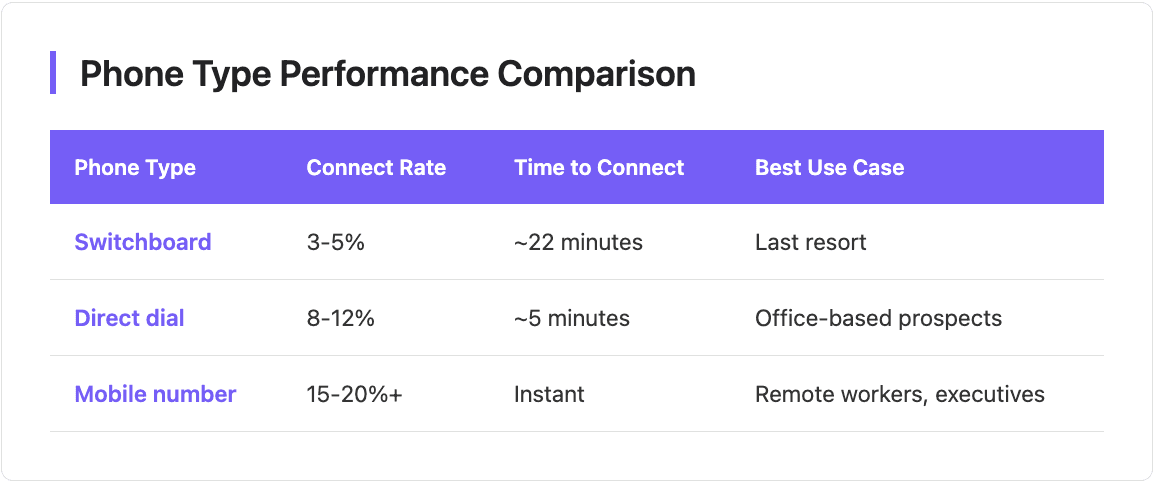
It takes 22 minutes to connect using switchboard numbers. With direct dials, that drops to 5 minutes. With verified mobile numbers, you're reaching decision-makers directly, no gatekeeper, no voicemail tree, no "let me transfer you."
That difference isn't marginal. It's the difference between an SDR making 8 meaningful conversations per hour or 2.
Phone number enrichment is how modern outbound teams get direct dials and mobile numbers at scale. Instead of manually hunting for contact information, enrichment automatically appends verified phone numbers to your CRM records, giving reps the data they need to actually reach prospects.

Why Phone Data Matters for Cold Outbound
The phone remains one of the highest-converting outbound channels. Research from the Bridge Group shows phone-based reps report 6.8 quality conversations per day compared to just 3.3 for email-centric reps. But those numbers only work if you can actually reach people.
The Gatekeeper Problem
When you dial a company's main line, you're playing a game you're designed to lose. Gatekeepers are trained to screen calls. Even if you get through, you've burned time and energy before the real conversation starts.
Direct dial numbers bypass this entirely. You're calling the prospect's direct line, their desk phone that rings on their desk, not through a receptionist.
The impact is dramatic: according to research, when dialing direct dials at the VP level, SDRs are 147% more likely to connect than when calling switchboard numbers. At the director level, it's still a 46% improvement.
The Remote Work Shift
Here's the thing: direct dials to office phones are becoming less valuable as more companies embrace remote and hybrid work. If your prospect isn't at their desk, that direct dial rings into voicemail.
Mobile numbers solve this. They reach people wherever they are - home office, coffee shop, or commuting. For today's distributed workforce, mobile is often the only reliable phone channel.
Teams using verified mobile numbers report connect rates up to 80% of their calling list, a transformation from the 3-10% typical of switchboard calling (SalesHive).
Direct Dial Enrichment: How It Works
Direct dial enrichment adds direct phone numbers to your contact records automatically. Here's the process:
Data Matching
You provide an identifier, typically email address, name + company, or LinkedIn profile. The enrichment system matches against databases of business phone numbers to find the corresponding direct line.
Verification Layers
Quality providers verify numbers through multiple methods:
Database cross-referencing: Checking multiple sources to confirm the number
Phone verification: Actually calling numbers to confirm they reach the right person
Recency checks: Flagging numbers that may be stale or disconnected
The best providers don't just return "a number", they return a verified, accurate number with confidence scoring.
CRM Integration
Enriched phone numbers flow directly into your CRM fields. When a rep opens a contact record, the direct dial is already there. No manual lookup, no switching between tools.
Mobile Enrichment: The New Standard
Mobile enrichment specifically targets personal mobile numbers for B2B contacts. This is different from direct dial enrichment - you're not finding their office extension, you're finding the phone in their pocket.
Why Mobile Outperforms Direct Dial
Mobile numbers have several advantages:
Availability. People carry their phones everywhere. A prospect working from home, traveling, or in meetings can still see your call.
Caller ID. Mobile phones display caller information. Prospects can see it's a business call and decide whether to answer. (This actually helps serious buyers often pick up business calls.)
Text capability. Mobile numbers enable SMS follow-up. With a 98% open rate text messages cut through noise that email can't.
Direct access. No assistant answers someone's personal mobile. You're reaching the decision-maker directly.
Mobile Data Quality
Mobile data requires more careful verification because:
People change mobile numbers less frequently, but the consequences of wrong numbers are higher
Privacy regulations (GDPR, CCPA, TCPA) apply differently to mobile outreach
Prospects may have both personal and work mobile numbers
Look for providers that verify mobile numbers are actually reachable and belong to the right person, not just that they're formatted correctly.
Phone Validation: Ensuring Data Quality
Phone validation confirms that numbers in your database are accurate, properly formatted, and likely to connect. This is different from enrichment (which adds new numbers), validation checks numbers you already have.
What Validation Catches
Invalid formats. Numbers missing digits, with wrong country codes, or impossible area codes.
Disconnected lines. Numbers that have been deactivated or reassigned.
Line type. Distinguishing mobile from landline from VoIP, important for compliance and strategy.
Validation Frequency
Phone data decays just like email data. People change jobs, companies reassign extensions, mobile numbers get ported. Industry data suggests contact data decays at roughly 22-30% per year.
For active outbound campaigns:
Validate before any major calling campaign
Re-validate contacts you haven't called in 90+ days
Set up ongoing validation for new records entering your CRM
Compliance Considerations
Phone outreach has specific compliance requirements:
Do Not Call (DNC) lists. The U.S. National DNC Registry, plus state-specific lists and industry lists, contain numbers that legally cannot receive unsolicited sales calls.
TCPA regulations. The Telephone Consumer Protection Act governs calls to mobile phones, including requirements around consent and calling times.
GDPR and international rules. European and other international regulations affect how you can use phone data for prospects in those regions.
Quality phone enrichment providers scrub against DNC lists automatically. But ultimate compliance responsibility sits with you - make sure your data and processes meet requirements.
Building Your Phone Enrichment Workflow
Getting phone enrichment working requires connecting data sources, your CRM, and your outbound tools.
Prioritize High-Value Contacts
Not every record needs phone enrichment. Prioritize:
High-intent leads showing buying signals
Target accounts in your ABM program
Decision-makers at qualified companies
Stalled deals where you've lost email momentum
Phone data typically costs more per record than email data. Focus enrichment spend where it matters most.
Waterfall Enrichment for Coverage
No single phone data provider has complete coverage. One provider might have strong U.S. data but weak European coverage. Another might excel at mobile numbers but miss direct dials.
Waterfall enrichment queries multiple providers in sequence:
Check Provider A for mobile number
If not found, check Provider B
If still not found, check Provider C
Return best available result
This approach maximizes coverage while controlling costs - you stop searching once you find a match.
Real-Time vs. Batch
Real-time enrichment adds phone numbers as leads enter your system. A new inbound lead gets phone data before hitting the sales queue.
Batch enrichment processes existing records in bulk. Use this for database cleanup, campaign prep, or periodic refresh of stale data.
Most teams need both: real-time for new records, batch for ongoing maintenance.
How to Use Enriched Phone Numbers Effectively
Having phone numbers is only half the equation. Using them strategically is what converts data into pipeline.
Timing Your Calls
Call timing significantly impacts connect rates. Research from SalesHive shows calls made during peak windows can be 40-70% more successful than calls at random times.
Best windows:
Early morning (8-9am local time): Catch prospects before their day fills with meetings
Late afternoon (4-5pm local time): Decision-makers often clear email and take calls as the day winds down
Just after lunch: A secondary window when people are back at their desks
Avoid Monday mornings (inbox catch-up) and Friday afternoons (mentally checked out). Test what works for your specific audience and adjust.
Multi-Channel Sequencing
Phone works best as part of a coordinated sequence, not in isolation. SDRs using a "triple touch" approach (phone + email + social) have 28% higher MQL-to-SQL rates than those using just phone and email.
Effective sequence pattern can be:
Day 1: Email introduction
Day 2: Phone call + voicemail if no answer
Day 3: LinkedIn connection request
Day 5: Follow-up email referencing the call attempt
Day 7: Second phone call at different time
Day 10: Final phone + email combo
High-growth organizations average 16 touchpoints per prospect over a 2-4 week span. A single call rarely converts, persistence across channels does.
Mobile-Specific Tactics
Mobile numbers enable tactics that office lines don't:
SMS follow-up. After a missed call, send a brief text: "Hi [Name], just tried calling about [specific reason]." Keep it under 160 characters.
Voicemail + text combo. Leave a voicemail, then immediately text: "Just left you a VM about [topic]. Happy to find a time that works better." This dual touch increases callback rates.
Caller ID optimization. Mobile recipients see your number. Use local presence dialing when possible - calls from local area codes get answered more frequently than toll-free or out-of-state numbers.
Voicemail Strategy
Most calls go to voicemail. Make those 30 seconds count.
Effective voicemail structure:
Your name and company (5 seconds)
Specific reason for calling - not generic "checking in" (10 seconds)
One clear value statement relevant to them (10 seconds)
Your number, spoken slowly (5 seconds)
Keep voicemails under 30 seconds. According to research reports, the average cold call interaction is just 80-95 seconds, voicemails should be even shorter.
Prioritizing Your Call List
Not all enriched numbers deserve equal effort. Prioritize based on:
ICP fit. Call your best-fit accounts first. Firmographic match should drive call order.
Intent signals. Prospects showing buying signals (website visits, content downloads, job changes) get priority over cold contacts.
Data freshness. Recently enriched or verified numbers before older data.
Previous engagement. Contacts who've opened emails or engaged on LinkedIn are warmer than completely cold prospects.
Build a tiered call list: A-tier (high-fit, high-intent) gets called immediately, B-tier (high-fit, lower-intent) gets called next, C-tier waits or goes into nurture sequences.
Measuring Phone Enrichment ROI
Phone enrichment costs money. Here's how to measure whether it's paying off.
Input Metrics
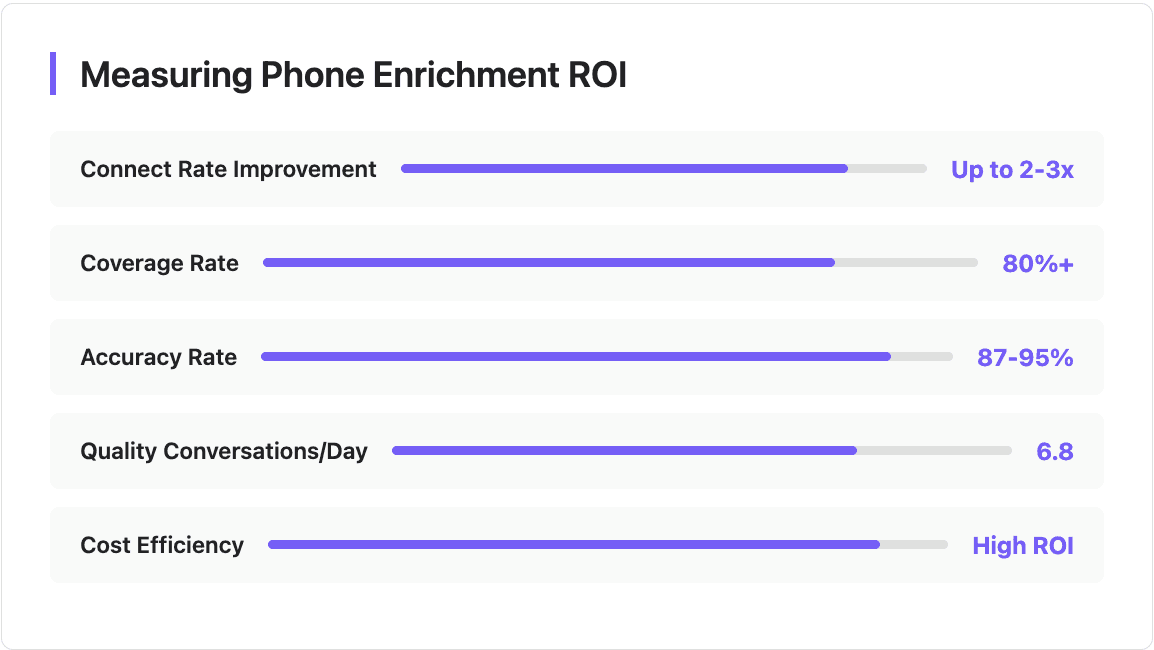
Coverage rate. What percentage of target contacts got phone numbers? Track separately for direct dials vs. mobile.
Accuracy rate. What percentage of enriched numbers actually work? Measure through connect attempts.
Fill rate. Of records missing phone data, how many got filled by enrichment?
Output Metrics
Connect rate improvement. Compare connect rates before and after implementing enrichment. Teams often see 2-3x improvements.
Conversations per day. Are reps having more quality conversations with enriched data?
Meetings booked. The ultimate metric, are phone conversations converting to pipeline?
Common Phone Enrichment Mistakes
Over-Enriching Low-Value Records
Enriching every record in your database wastes money. An unqualified lead from a free webinar doesn't need a $0.50 mobile number. Focus enrichment on records that will actually get called.
Ignoring Validation
Adding phone numbers is only half the battle. If you're not validating those numbers, you're still wasting rep time on disconnected lines and wrong numbers. Combine enrichment with ongoing validation.
Single-Provider Dependence
Relying on one phone data provider limits your coverage. Different providers have different strengths. Use waterfall enrichment to maximize coverage without overpaying for redundant lookups.
What's Next for phone number enrichment
Phone number enrichment turns cold outreach from a shot in the dark into a targeted strategy. When reps have verified direct dials and mobile numbers, they spend time talking to prospects instead of fighting through switchboards and voicemail trees.
The teams seeing the biggest gains aren't just buying better data, they're building systems. Real-time enrichment for new leads. Waterfall logic for maximum coverage. Ongoing validation to catch decay. Compliance scrubbing baked into every workflow. Start with your highest-value contacts. Measure connect rate improvements & scale based on results.
FAQ
What is phone number enrichment? Phone number enrichment is the process of automatically adding direct dial and mobile phone numbers to your CRM contact records. Starting with basic contact information (name, email, company), enrichment appends verified phone numbers that enable sales outreach.
What's the difference between direct dial and mobile enrichment? Direct dial enrichment finds office phone numbers that ring directly to a prospect's desk, bypassing the switchboard. Mobile enrichment finds personal cell phone numbers. Mobile typically has higher connect rates since it reaches people regardless of location, while direct dials only work when prospects are at their office desk.
How accurate is phone enrichment data? Accuracy varies significantly by provider. Top providers achieve 87-95% accuracy through phone verification (actually calling numbers to confirm). Lower-quality providers may have 50-60% accuracy. Always test accuracy with a sample before committing to a provider.
How does phone validation differ from enrichment? Enrichment adds new phone numbers to records that don't have them. Validation checks existing phone numbers to confirm they're still accurate, properly formatted, and not disconnected. Most teams need both, enrichment to fill gaps, validation to maintain quality.
How often should phone data be refreshed? Re-validate before any major calling campaign and re-enrich contacts you haven't reached in 90+ days. Contact data decays at 22-30% annually, so ongoing maintenance is essential. High-value accounts may warrant quarterly refresh.
Is phone enrichment worth the cost? For outbound-focused teams, typically yes. Phone data costs more than email data ($0.07-0.50+ per mobile number), but connect rate improvements of 2-3x quickly offset costs. One additional meeting booked can pay for hundreds of enriched records.
Related articles
See all