

Ask five people at your company to define your ideal customer profile, and you'll likely get five different answers. The head of sales will describe it through win rates. Marketing will talk about lead sources. Customer success will focus on retention patterns. None of them are wrong, exactly, but none of them have the complete picture either.
That's the core problem with most ICPs: they're built on gut feeling and incomplete information. Teams describe their ideal customers using qualitative attributes like "data driven" or "tech savvy," phrases that sound meaningful but can't actually be targeted or measured. Or they rely on industry classifications like "B2B SaaS" that seem specific but don't exist in most data taxonomies.
The solution is enriching your B2B account data to build an ICP grounded in real, actionable attributes. When you know not just who your best customers are, but what specific firmographic, technographic, and behavioral signals they share, you can actually target and score prospects against that profile.
This guide covers how to enrich B2B account data for better ICP definition, the data categories that matter most, and the tools to update and maintain enriched ICP data over time.
What Does ICP Enrichment Actually Mean?
An Ideal Customer Profile describes the type of company most likely to buy from you, succeed with your product, and stick around as a valuable customer. Unlike buyer personas, which focus on individual decision makers, ICPs are about the organization itself.
ICP enrichment is the process of appending additional data points to your account records so you can identify patterns among your best customers and apply those patterns to find new ones.
Without enrichment, most companies work from sparse CRM records. Maybe you have company name, industry, and employee count for your customers. That's not enough to find meaningful patterns. With enrichment, you might discover that your best customers share specific traits: they use Salesforce plus HubSpot, have raised Series B funding in the last 18 months, have at least three people with "RevOps" in their title, and are headquartered in North America.
That level of specificity turns your ICP from a vague description into a targeting filter you can practically use.
The Data Categories That Define Your ICP
Not all data is equally useful for ICP definition. Here are the categories that matter most, organized by how actionable they are for targeting and scoring.
Firmographics
This is the baseline. Company size (employee count), annual revenue, industry, geographic location, and company structure. Most organizations start here because firmographic data is widely available and easy to filter on.
But firmographics alone are too broad. Saying your ICP is "companies with 50 to 200 employees in the technology sector" describes thousands of businesses, most of which aren't a good fit. You need to layer in additional signals.
Technographics
What technology does a company already use? This matters because it indicates budget allocation, technical sophistication, and integration requirements. If you sell a tool that integrates with Salesforce, knowing which prospects use Salesforce is obviously valuable.
Technographic data includes: CRM platform, marketing automation tools, customer support software, cloud infrastructure, development frameworks, and more. Companies that track technographics can see which tool combinations correlate with their best customers.
Funding and Financial Signals
For companies selling to growth stage businesses, funding data is often more predictive than revenue. A company that just closed a Series B has different needs (and budgets) than one that raised the same amount three years ago. Recent funding often indicates hiring plans, new initiatives, and increased tool adoption.
Related signals include recent acquisitions, IPO preparation, or expansion into new markets.
Hiring Patterns
Job postings reveal priorities. A company posting multiple data engineering roles is investing in infrastructure. A company hiring its first VP of Sales is building out a go to market function. These hiring patterns often precede purchase decisions.
Intent and Behavioral Data
This category captures signals that a company is actively researching solutions in your category. Intent data providers track topics companies are researching across the web, identifying when an account is "in market." Some organizations also track direct behavioral signals: website visits, content downloads, event attendance.
Intent data is powerful for timing outreach but less useful for defining your static ICP, since it changes constantly.
Engagement History
Your own first party data, meaning how accounts have interacted with your company, is often underweighted. Which accounts responded to outreach? Attended webinars? Started trials? This engagement data, when combined with outcome data, helps refine which attributes actually predict success.
How to Enrich B2B Account Data for ICP Definition: A Practical Process
Here's the step by step approach for turning raw customer data into a data driven ICP.
Step 1: Start With Your Best Customers
Don't build your ICP from hypotheticals. Start with the accounts that have already proven to be valuable. Define "valuable" based on objective measures:
High lifetime value. Customers who pay well and renew consistently.
Low support burden. Customers who succeed without requiring excessive hand holding.
Short sales cycles. Customers who moved through your pipeline quickly, indicating strong fit.
Expansion revenue. Customers who have grown their relationship over time.
Export a list of 50 to 100 of your best customers. If you don't have enough customers yet, include your best qualified opportunities even if they haven't closed.
Step 2: Enrich These Accounts With External Data
Take your customer list and append additional data points. The goal is to find what your best customers have in common that you couldn't see from CRM data alone.
Platforms like Databar allow you to run enrichment workflows that pull from 160+ data providers without code. You can append firmographic, technographic, funding data, and more to your existing records, then analyze the results to find patterns.
For each account, try to capture:
Precise employee count ranges (not just "small, medium, large")
Industry classifications at a granular level
Technology stack, especially tools that integrate with your product
Funding history including round and timing
Geographic breakdown if you sell to specific regions
Leadership team composition, particularly if certain roles indicate fit
Step 3: Analyze for Correlation
Once your best customers are enriched, look for attributes that appear significantly more often in this group than in your general prospect database or in customers who churned.
For example, you might find that 80% of your best customers have between 100 and 500 employees. Or that 70% use both Salesforce and a marketing automation platform. Or that accounts with a dedicated RevOps function have 3x higher retention.
Be disciplined about distinguishing correlation from causation. The goal is identifying signals you can use for targeting, not proving that these attributes cause success.
Step 4: Define Your ICP Criteria
Based on your analysis, define the specific attributes that characterize your ideal customer. Be concrete:
Instead of: "Mid market technology companies"
Write: "Companies with 100 to 750 employees, in SaaS, fintech, or martech verticals, headquartered in US, Canada, or UK, using Salesforce as their CRM, with at least $10M in funding raised"
The more specific your criteria, the more useful your ICP becomes for targeting and scoring.
Step 5: Score Your Prospect Database
Apply your ICP criteria to your entire prospect database. Each account can be scored based on how many ICP attributes it matches. Common approaches include:
Tiered scoring: Assign accounts to tiers (A, B, C) based on fit. A tier accounts match all critical criteria. B tier accounts match most. C tier accounts match some.
Weighted scoring: Assign point values to different attributes based on how predictive they are. An account's total score reflects overall fit.
This scoring informs prioritization, routing, and resource allocation.
Tools to Update and Maintain Enriched ICP Data
Enrichment isn't a one time project. B2B data decays rapidly. People change jobs. Companies raise funding, get acquired, or shut down. Technology stacks evolve. An ICP built on stale data leads you back to gut feel decisions.
Here are the best platforms for enriching and scoring ideal customer profiles in 2026, organized by use case.
For Multi Source Enrichment
Databar connects to 160+ data providers and lets you build enrichment workflows without code. You can waterfall across multiple sources to fill gaps, normalize data to consistent formats, and write enriched records back to your CRM. This is particularly valuable if you need flexibility across firmographic, technographic, and contact data without committing to a single vendor's database.
For Standard B2B Intelligence
ZoomInfo is the enterprise standard for B2B contact and company data. Their database includes 300M+ contacts with firmographic, technographic, and intent data. ZoomInfo is powerful but expensive, with contracts often starting at $15K+ annually.
Apollo.io offers a strong alternative with a more accessible pricing model. Their 210M+ contact database includes basic enrichment and intent signals. Good for teams that want enrichment and outreach in one platform.
Cognism focuses on global coverage, particularly in European markets, with strong GDPR and CCPA compliance. Their verified mobile number coverage is better than most competitors.
For Specific Data Types
Crunchbase excels at funding and investment data. If funding stage is a key ICP attribute, Crunchbase provides detailed information on rounds, valuations, and investors.
BuiltWith and HG Insights focus on technographic data, showing which technologies companies use across their web properties and infrastructure.
Bombora and 6sense specialize in intent data, tracking topics companies are researching across the web.
For CRM Native Enrichment
HubSpot's Breeze Intelligence (formerly Clearbit) provides enrichment directly within HubSpot. Records are automatically enriched as they enter your CRM, reducing manual workflows.
Databar also offers a native Salesforce integration that continuously enriches and updates records.
ICP Definition and Enrichment Template
To put this into practice, here's a simple framework you can adapt:
Part 1: Define Your Value Metrics
Before analyzing customers, agree on how you define "best":
What revenue threshold qualifies as high value?
What retention rate indicates strong fit?
What sales cycle length is ideal?
What support burden is acceptable?
Part 2: Enrichment Attributes to Capture
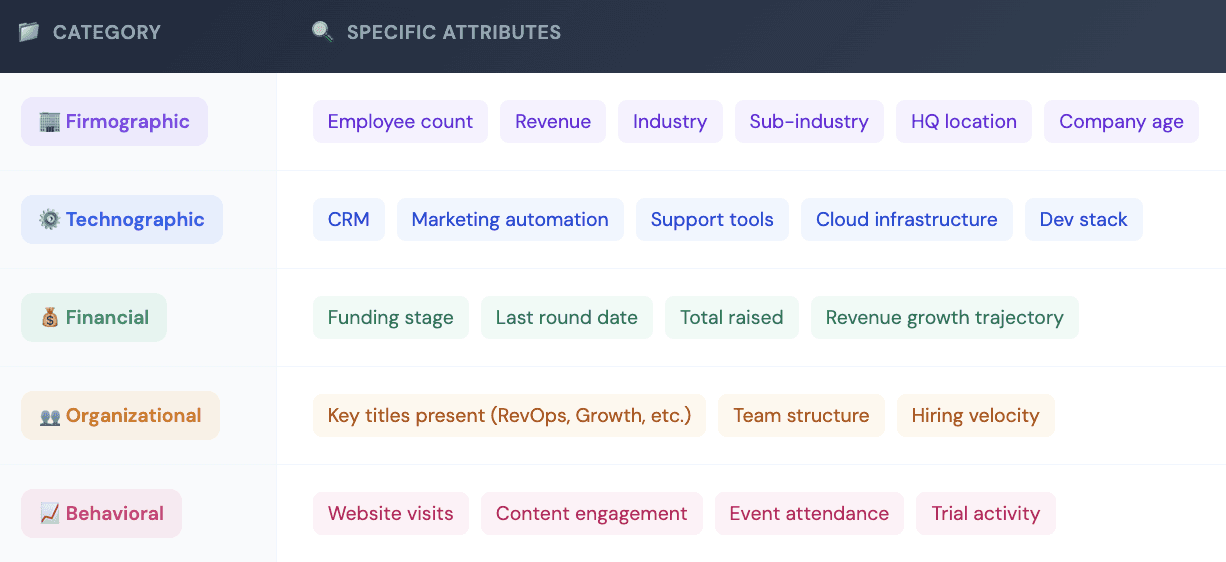
Part 3: ICP Criteria Template
Based on your analysis, document your ICP with this structure:
Primary Criteria (must have): List the attributes that all ideal customers share. These are deal breakers.
Secondary Criteria (nice to have): List the attributes that most ideal customers share but aren't absolute requirements.
Disqualifying Criteria (do not target): List the attributes that indicate a company is not a fit, regardless of other signals.
Part 4: Scoring Model
Define how you'll score accounts:
Each primary criteria match = X points
Each secondary criteria match = Y points
Any disqualifying criteria = automatic disqualification
Tier A = Z+ points, Tier B = W to Z points, etc.
Keeping Your ICP Current
The work doesn't end when you define your ICP. Here's how to maintain accuracy over time.
Continuous enrichment. Set up workflows that regularly refresh account data. Quarterly is a reasonable cadence for most fields, though some data (like employee count or funding) changes more frequently.
Closed loop analysis. Every quarter, re analyze your best customers against your ICP criteria. Are the patterns holding? Are new patterns emerging? Your ICP should evolve as your customer base grows.
Win/loss analysis. Track not just who you win, but who you lose and why. If you're losing deals to companies that perfectly match your ICP, something in your model might be wrong.
Field validation. Sales and customer success teams interact with customers daily. Create feedback loops so they can flag when ICP criteria don't seem to match reality.
Frequently Asked Questions
What's the difference between ICP and buyer persona?
An ICP describes the ideal company, meaning firmographic and technographic attributes of the organization. A buyer persona describes the ideal individual within that company, meaning their role, goals, challenges, and decision making process. You should define your ICP first, then develop personas for the key stakeholders within ICP fit accounts.
How many data providers do I need for ICP enrichment?
It depends on your criteria. Most organizations need at least firmographic data (available from many providers) plus two or three specialized sources (technographics, funding, or intent). Platforms that aggregate multiple providers, like Databar, let you access diverse data without managing multiple vendor relationships.
How often should I update my ICP?
Review quarterly at minimum. Major updates should happen when you launch new products, enter new markets, or see significant shifts in your customer base. The enrichment data underlying your ICP should refresh more frequently, at least quarterly for most fields.
Can I define multiple ICPs?
Yes, if you sell to genuinely different segments with distinct buying patterns. For example, a company might have one ICP for enterprise customers and another for mid market. But be cautious about proliferating ICPs. Too many segments diffuse focus and make analysis harder.
What if I don't have enough customers to analyze?
Start with the data you have, even if it's limited. Supplement with analysis of your best opportunities (not just closed won) and look at industry benchmarks for companies similar to yours. As you close more customers, continuously refine your ICP based on actual outcomes.
How do I handle ICP attributes I can't target programmatically?
Some attributes matter for fit but can't be filtered in databases, such as company culture, decision making speed, or strategic priorities. Acknowledge these in your ICP documentation, but focus your enrichment and scoring on attributes you can actually use for targeting. Qualitative criteria can inform discovery conversations once you're engaged with an account.
Related articles
See all