

Your SDR sends 500 cold emails on Monday morning. By Tuesday, 27 have bounced. By Wednesday, your domain's sender reputation has taken a hit. By Friday, even your emails to existing customers are landing in spam folders.
This is what happens when invalid emails pile up in your CRM unchecked. And once your sender reputation tanks, it affects everything - not just the bad emails, but the good ones too.
Email validation for CRM prevents this spiral before it starts. Validate addresses before they enter your database, catch decaying data before it bounces, and keep your deliverability strong so your sales and marketing emails actually reach inboxes.
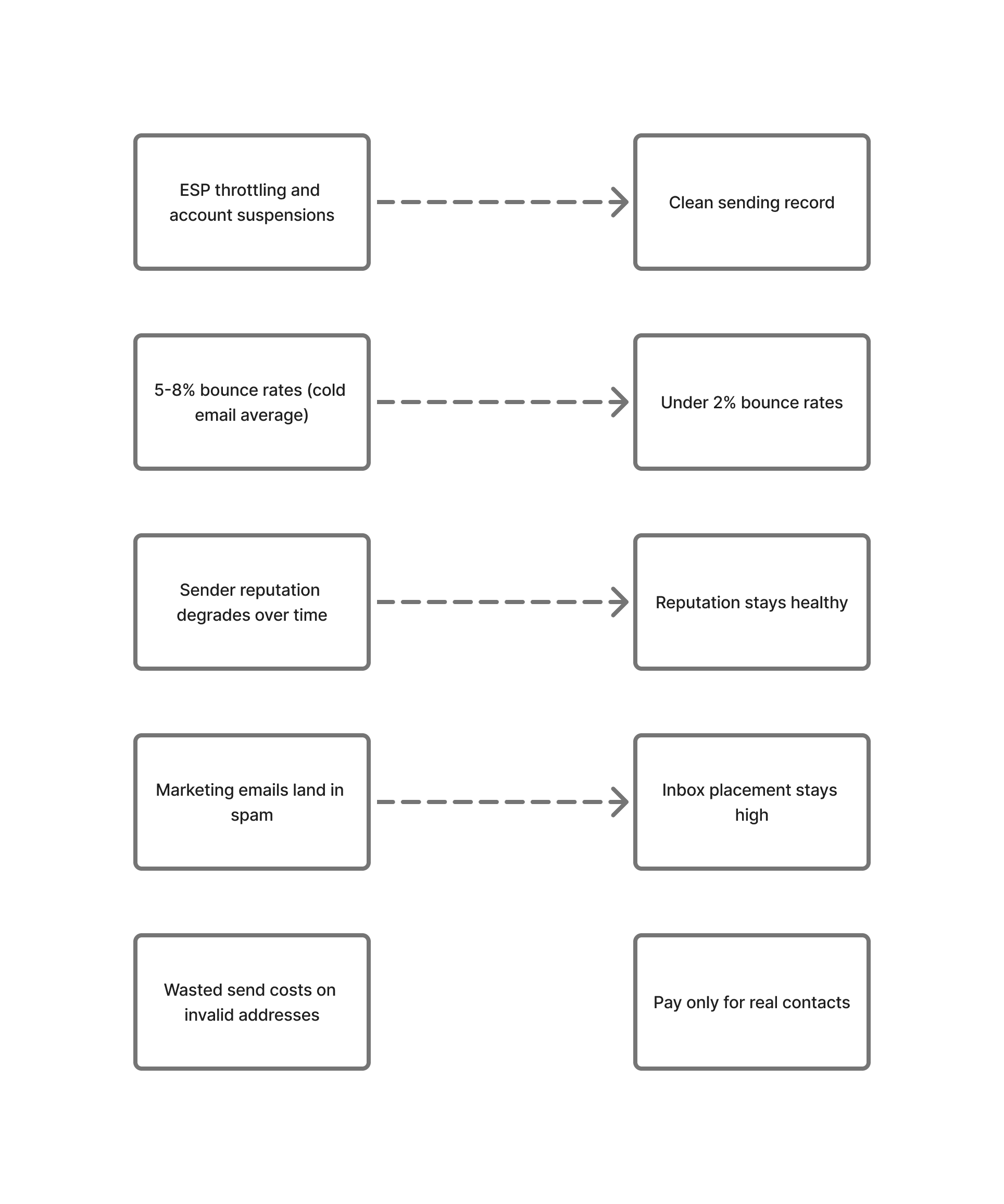
Here's the stat that matters: each bounced email doesn't just waste one send - it can cause 3 additional good emails to fail because of the reputation damage. That's the multiplier effect of poor list hygiene.
The fix isn't complicated. But it requires making validation a standard part of your CRM operations, not an occasional cleanup project.
Why Email Bounces Hurt More Than You Think
Let's talk about what actually happens when emails bounce, because the damage extends way beyond "that message didn't deliver."
The Reputation Multiplier
Email providers (Gmail, Microsoft, Yahoo) assign your domain a sender reputation score based on how you behave. High bounce rates signal that you're either careless with your data or possibly a spammer. Either way, they start treating your emails with suspicion.
According to Validity's research, top senders with reputation scores of 91-100 have average hard bounce rates of 0.9%. Drop just one tier to 81-90, and bounce rates jump to 3.2%. But here's the kicker: the difference in inbox placement between those tiers is roughly 10%.
So every bounced address costs you delivery of roughly three good ones. That's the multiplier effect in action.
The ESP Problem
Your email service provider is watching too. Most ESPs flag or suspend accounts exceeding 2% hard bounce rates. Some are stricter - some players in the space recommend keeping flow bounce rates under 0.35%.
Hit 20% bounces on a single campaign? Your account might get suspended entirely. Even if it doesn't, you'll face sending restrictions that cripple your outreach until you clean things up.
The Money Drain
Every bounced email is money wasted. You're paying your ESP for sends that never deliver. Your team spent time crafting messages no one sees. Your domain reputation, worth far more than any single email, takes damage with each bounce.
If you're spending $2,000 monthly on email marketing and running 6% bounces, that's $120/month burned. Over a year? $1,440 on literally nothing. And that's before counting the opportunity cost of emails that land in spam instead of inboxes.

How Email Validation Actually Works
Email verification isn't magic, it's a systematic check across multiple layers. Here's what good validation tools examine:
Syntax validation handles the basics. Is this even formatted like an email address? Does it have an @ symbol? Is the structure valid? This catches obvious typos and garbage data like john.doecompany.com or jane@@gmail.com.
Domain validation goes deeper. Does the domain actually exist? Are there MX records configured to receive email? A valid-looking address at a non-existent domain will hard bounce every time. This catches typos like sarah@compny.com and defunct companies that no longer exist.
Mailbox verification is the deepest check. Does this specific mailbox exist on this mail server? This involves pinging the mail server to verify the address without actually sending an email. Catches former employees, made-up names at real domains, and abandoned accounts.
Catch-all detection flags risky domains. Some domains accept all incoming mail regardless of whether the specific address exists. These "catch-all" domains are uncertain - the email might deliver, or it might not. 30-40% of B2B email lists consist of catch-all addresses according to research. That's a lot of uncertainty if you're not tracking it.
Risk assessment goes beyond simple valid/invalid. Good validation identifies disposable emails (temporary addresses people use to avoid spam), role-based addresses (info@, support@, admin@), spam traps (addresses ISPs plant to catch bad senders), and known complainers.
When to Validate: Three Critical Points
Email validation isn't a one-time cleanup. Data decays at 25-30% per year - people change jobs, companies shut down, email addresses get abandoned. Here's when validation matters most:
Point 1: At Entry
Validate emails the moment they enter your CRM.
For form submissions, check the email before accepting the form. If it's invalid, prompt for correction immediately. Real-time validation catches typos when users can still fix them - gmial.com flagged on a form can become gmail.com with a quick correction. Discovered six months later, it's just a dead record.
For manual entry, sales reps adding contacts should see instant validation feedback. Even a simple "verify email" button helps catch obvious problems.
For list imports, validate uploaded lists before they merge with your database. No exceptions, regardless of where the list came from.
Point 2: Before Campaigns
Even with real-time validation at entry, data decays. Before any major campaign, run your target list through batch validation. Remove hard invalids entirely. Flag risky addresses, catch-alls, role-based, for separate handling. Suppress addresses that have degraded since they entered your system.
Only about 25% of marketers validate lists before campaigns according to one study. The other 75% are gambling with their sender reputation every send.
Point 3: Ongoing Maintenance
Set up recurring validation: monthly at minimum, weekly if you're high-volume. This catches addresses that have gone bad since last check, identifies patterns in data decay, and keeps your database healthy between campaigns.
Think of it like changing your oil. Skip it for too long, and you'll pay way more to fix the damage than you would have spent on maintenance.
Setting Up CRM Email Validation
Here's how to approach implementation properly:
Audit Your Current State
Before adding validation, understand what you're working with. What's your current bounce rate? Check your ESP dashboard. How many contacts in your CRM haven't been validated ever? Where do contacts enter your system - forms, imports, manual entry, integrations?
If your bounce rate is already over 5%, you have a cleanup project before you can focus on prevention.
Choose Your Validation Approach
Real-time API validation works best for forms and real-time entry points. The validation happens in milliseconds as data enters.
Batch validation handles existing lists and pre-campaign checks. Upload a file, get results back with validity status for each address.
CRM integration connects validation directly with Salesforce, HubSpot, or other CRMs to validate automatically on record creation or update.
Most teams need a combination. Real-time for new data, batch for existing data and campaign prep.
Set Up Entry-Point Validation
For web forms, add API validation that checks emails on submit. If invalid, show an error message prompting correction. This catches 5-10% of submissions that would otherwise become bad data.
For third-party integrations where data flows from other systems, validate at the integration point or immediately after. Data quality problems in upstream systems shouldn't become your CRM's problem.
Establish Ongoing Hygiene
Build validation into regular operations: weekly or monthly validation runs on your active database, pre-campaign validation as a required step in your send workflow, bounce monitoring to catch addresses that slip through.
Track and Improve
Monitor bounce rate trends - are they improving over time? Track invalid rates at entry to see what percentage of new contacts fail validation. Identify which lead sources produce the most invalid addresses. Compare validation costs against reduced bounce rates to measure ROI.
The Deliverability Crunch
If you haven't been paying attention to email deliverability lately, things have gotten stricter.
Google and Yahoo: Bulk senders must implement SPF, DKIM, and DMARC authentication for emails to 5,000+ daily recipients. Spam complaint rates must stay under 0.3%, ideally under 0.1%.
Microsoft: Similar DMARC requirements for high-volume senders to Outlook/Hotmail addresses.
These aren't suggestions, they're requirements. Fail to comply, and your emails get rejected or routed to spam regardless of content quality.
Bounce prevention through email validation is now table stakes. Clean lists mean lower bounce rates and fewer spam complaints, which keeps you compliant with these new standards.
Common Validation Mistakes
Validating once and calling it done. Data decays constantly. One-time validation is better than nothing, but ongoing hygiene is what actually protects your sender reputation long-term.
Only validating marketing lists. Your SDRs' cold outreach affects domain reputation just as much as marketing campaigns. If it sends from your domain, it needs validation.
Ignoring catch-all results. Catch-all addresses aren't invalid, but they're risky. Don't treat them the same as verified-valid addresses. Consider separate handling or accept higher bounce rates from these segments.
Not acting on results. Validation tells you which addresses are bad. If you don't actually suppress or remove them, you've wasted the effort. The insight is only valuable if it changes behavior.
Buying lists despite validation. Purchased lists have terrible deliverability even after validation. Validation can't make a bad list good, it just tells you how bad it is.
FAQ
What is email validation for CRM?
Email validation for CRM verifies that email addresses in your customer database are real, deliverable, and safe to send to. It checks syntax, domain existence, mailbox validity, and risk factors like spam traps or disposable addresses. The goal is preventing bounces and protecting sender reputation.
What's an acceptable bounce rate?
Keep hard bounces under 0.5% and total bounces under 2%. For high-volume senders following Gmail/Yahoo's guidelines, staying under 0.5% hard bounces is essentially required to maintain deliverability. Top performers achieve under 0.2%.
How often should we validate our CRM email list?
At minimum, validate before every major campaign and run a full database validation monthly. High-volume senders should validate weekly. Real-time validation at entry points should run continuously.
Does email validation guarantee deliverability?
No. Validation ensures addresses are real and can receive mail, but deliverability also depends on sender reputation, authentication (SPF/DKIM/DMARC), content quality, and engagement patterns. Validation is necessary but not sufficient for great deliverability.
How much does email validation cost?
Typically $0.01 per email validated, depending on volume. At scale, validation costs are trivial compared to bounced emails, wasted ESP fees, damaged reputation, and lost deliverability affecting your entire email program.
Related articles
See all