
Multi-agent workflows split GTM work across specialist agents (research, enrichment, scoring, copy) coordinated by a controller, instead of running one monolithic agent that does everything in one prompt. The pattern works in production for specific motions and breaks for others. Most GTM teams overbuild multi-agent setups when a single agent with good context would ship faster. Some teams underbuild and run monolithic agents on workloads that genuinely need specialist coordination. This is a honest read on multi-agent workflows for GTM: when to use them, when to skip them, and how to architect them when they fit.
Multi-agent is not always better. It is a specific architectural choice for specific problems.
Key takeaways:
Multi-agent workflows for GTM split work across specialist agents (research, enrichment, scoring, copy) instead of running one prompt that does everything.
The pattern wins when the workload has distinct stages with different prompt requirements, when context windows would otherwise overflow, or when one stage needs a different model than another.
The pattern loses when a single agent with strong context can do the job. Coordination overhead beats specialization for narrow workloads.
The data layer feeding the agents matters more than the agent count. Multi-source aggregators (Databar) cap fewer errors at the input stage.
What Multi-Agent Workflows Actually Look Like
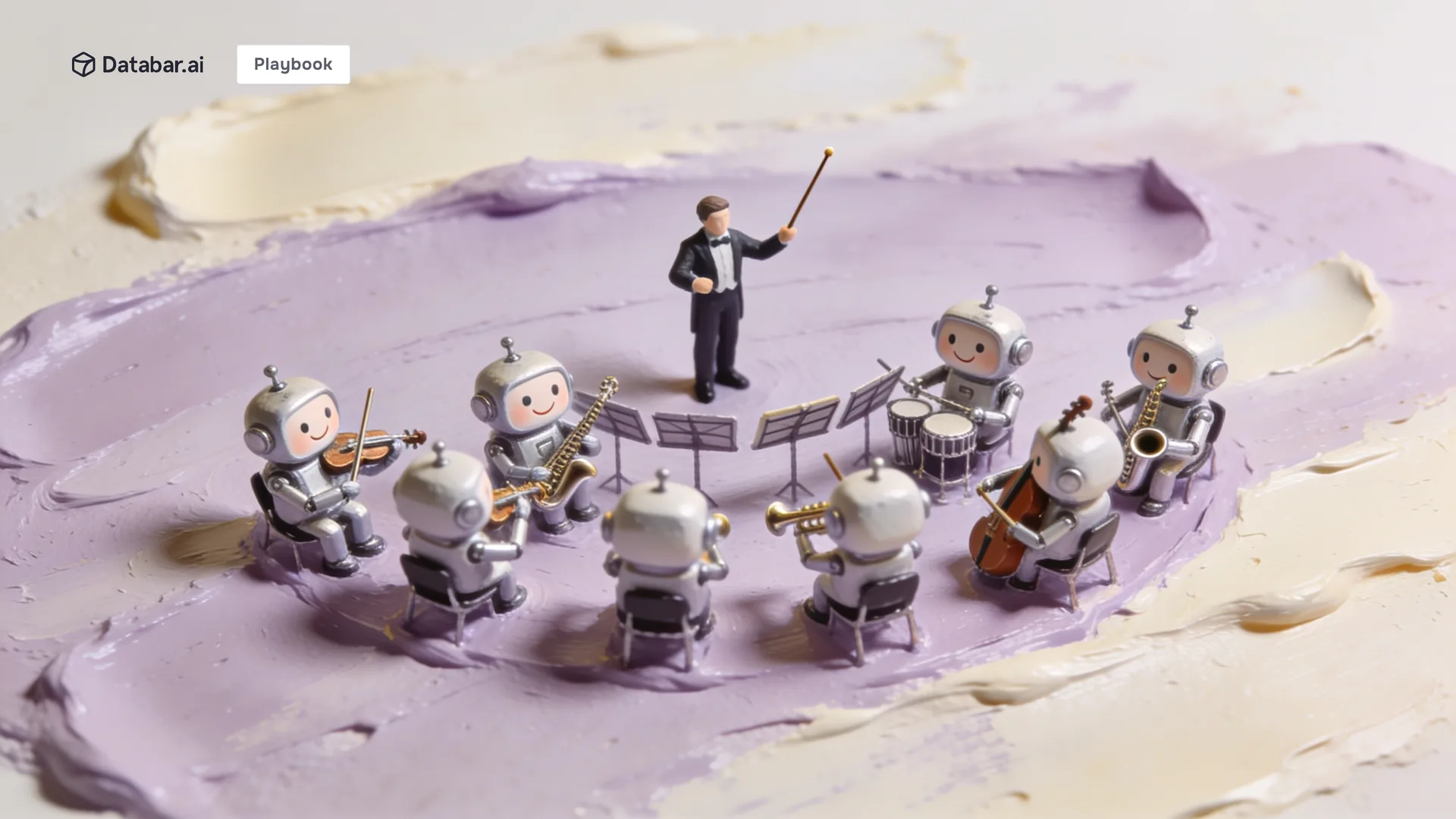
A multi-agent workflow runs two or more specialist agents coordinated by a controller, where each specialist owns one stage of the work. A typical outbound motion split this way:
Research agent. Reads the prospect's company website, recent news, hiring patterns. Outputs a structured research brief.
Enrichment agent. Calls Databar's data layer to pull firmographics, contact data, and verified emails. Outputs a structured enrichment table.
Scoring agent. Combines research and enrichment to score fit and prioritization. Outputs a ranked list with reasoning.
Copy agent. Reads the top-ranked records and drafts personalized first emails using context files. Outputs draft sequences.
Controller agent. Coordinates the four specialists, passes outputs between stages, and surfaces final results to the operator.
Each specialist gets a focused prompt and a focused tool set. The controller handles orchestration. The operator reviews the final output, not every intermediate step.
When Multi-Agent Workflows for GTM Win Over Monolithic Agents
Three scenarios where splitting work across specialist agents genuinely beats running one monolithic agent.
Distinct stages with different prompt requirements. A research agent and a copy agent want different things from a prompt. Research wants thoroughness. Copy wants tone-match. Cramming both into one prompt produces worse output on each. Specialist agents let you tune each prompt separately.
Context window overflow risk. A monolithic agent reading 50 prospect researches plus 50 enrichment results plus voice rules plus closed-won examples runs out of context fast. Specialist agents each carry only what their stage needs, which keeps individual context windows manageable.
Different models for different stages. The research stage might run on a faster, cheaper model. The copy stage might run on a stronger model where tone-match matters most. Multi-agent lets you mix models per stage. Monolithic forces one model for everything.
For GTM workloads with all three properties (multi-stage, high context, model-diverse), multi-agent is the cleanest architecture. For simpler workloads, the coordination overhead does not pay off.
When Monolithic Agents Beat Multi-Agent for GTM
Three scenarios where one monolithic agent ships better than a multi-agent setup.
Narrow, single-stage workloads. If the workflow is "score 100 leads against ICP criteria," that is one stage and one prompt. Splitting into specialist agents adds coordination cost without improving output. Monolithic wins on simplicity.
Strong context files do most of the work. A well-tuned CLAUDE.md with ICP, voice rules, closed-won patterns, and forbidden phrases lets a single agent handle multi-stage work because the context is doing the specialization. The GTM alpha with Claude Code piece walks through this pattern.
Coordination cost outweighs specialization gain. Multi-agent setups have real overhead: passing structured output between stages, handling stage failures, debugging which specialist broke. For workloads where a single agent's output is "good enough," that overhead is wasted.
Most GTM teams should start with monolithic agents and only move to multi-agent when they hit specific limits. Premature multi-agent is a common trap.
How to Architect Multi-Agent Workflows for GTM
Three architectural patterns work in production. Pick the pattern that fits the motion:
Pattern | How it works | Best for |
|---|---|---|
Sequential pipeline | Specialist agents run in order. Output of one becomes input to the next. | Linear workflows like outbound (research, enrich, score, draft, send) |
Parallel fan-out | Controller dispatches work to specialists in parallel. Aggregates results. | Independent tasks like enriching a list across multiple data types simultaneously |
Hierarchical controller | Top-level controller delegates to mid-level coordinators, which delegate to specialists. | Complex workflows with branching logic and conditional sub-tasks |
For most GTM workloads, sequential pipeline is the right starting point. Parallel fan-out fits enrichment-heavy stages where independent work can run concurrently. Hierarchical is overkill for most outbound motions.
The Five Stages Most GTM Multi-Agent Pipelines Cover
Production multi-agent workflows for GTM usually have five stages, each owned by a specialist agent.
Stage 1: Research. Agent reads company website, news, hiring data, public statements. Output: structured research brief per prospect. Context-heavy stage that benefits from a thorough prompt.
Stage 2: Enrichment. Agent calls the data layer (Databar's MCP) to pull firmographics, contact data, verified emails, intent signals. Output: structured enrichment table. Tool-heavy stage that benefits from clean MCP integration.
Stage 3: Scoring. Agent combines research and enrichment outputs to score ICP fit, intent strength, and prioritization. Output: ranked list with reasoning. Logic-heavy stage that benefits from clear scoring rules in the prompt.
Stage 4: Copy. Agent reads top-ranked records and drafts personalized first emails using voice rules. Output: draft sequences with subject lines and first lines. Voice-heavy stage that benefits from strong CLAUDE.md context.
Stage 5: Quality control. Agent reviews drafts for hallucinated facts, off-brand tone, or missing personalization. Output: filtered drafts with quality flags. Verification stage that benefits from a different model than the copy agent (judge bias matters here).
The controller passes structured output between stages. Most teams add a human review step between stage 4 and stage 5 (drafts) or after stage 5 (filtered drafts) before sending. The LLM evals for revenue agents piece walks through how to measure quality at the boundaries between stages.
Where Multi-Agent Workflows for GTM Break
Three failure modes show up in production multi-agent setups. Recognize them up front.
Cascading errors across stages. A bad enrichment output (single-source provider returned a wrong email) flows into scoring and copy unchanged. The downstream agents do not know the input was wrong. Fix: validation between stages, plus a strong data layer that catches errors at the source. Multi-source aggregators with verification (Databar) cap fewer errors at stage 2 because waterfall fallback handles single-source misses.
Coordination overhead. Each stage adds latency, complexity, and failure surface. A 5-stage pipeline takes longer than a single agent doing the same work in one prompt. Fix: only split when the gains (better per-stage prompts, parallelism, model diversity) genuinely outweigh the overhead.
Inconsistent context across stages. One specialist sees the ICP definition, another does not. The downstream output drifts from the upstream intent. Fix: shared context file (CLAUDE.md) that every specialist reads, plus explicit handoff structures that pass relevant context between stages.
The teams running multi-agent well treat the controller and the handoffs as the most important architectural decisions. Specialist agents are easy. Coordination is hard.
The Stack for Multi-Agent Workflows for GTM
Production multi-agent setups need three layers wired together.
Layer | What it does | Tool |
|---|---|---|
Agent runtime | Hosts specialist agents and the controller. Manages context per stage. | Claude Code, Cursor, or custom Python orchestration |
Data layer | Returns enrichment data the specialist enrichment agent calls. | Databar (100+ providers, MCP, SDK, REST) |
Inspectable storage | Stores per-stage outputs for review and debugging. | Databar tables, custom logs, or agent tracing |
The data layer matters most. Multi-agent setups built on single-source enrichment cap match rates around 50%, which means errors propagate through every stage downstream. Aggregators like Databar with waterfall fallback lift coverage toward 85% before the multi-agent pipeline ever runs. The agentic GTM stack 5-layer architecture walks through the broader pattern.
Build Multi-Agent Workflows for GTM That Actually Ship
Multi-agent workflows for GTM are powerful for specific motions and overbuilt for others. Pick the architecture that fits the workload. Start monolithic. Move to multi-agent when context overflow, prompt-requirement diversity, or model-diversity needs make it the right call.
The data layer matters more than the agent count. Databar covers 100+ providers with waterfall fallback, native MCP and SDK, outcome-based billing where you only pay when data is returned. 14-day free trial at build.databar.ai.
FAQ
What are multi-agent workflows for GTM?
Multi-agent workflows split GTM work across specialist agents (research, enrichment, scoring, copy, quality control) coordinated by a controller, instead of running one monolithic agent that does everything in one prompt. The pattern works for multi-stage workloads with distinct prompt requirements per stage. It loses for narrow workloads where a single agent with strong context handles the work.
When should I use multi-agent vs monolithic agents for GTM?
Three signals point to multi-agent. Distinct stages with different prompt requirements. Context window overflow risk on a monolithic agent. Different models needed for different stages (faster cheaper model for research, stronger model for copy). For workflows missing all three, monolithic agents with strong context files usually ship better.
What's the most common architecture pattern for multi-agent GTM workflows?
Sequential pipeline. Specialist agents run in order, output of one becomes input to the next. Fits linear workflows like outbound (research, enrich, score, draft, send). Parallel fan-out works for independent enrichment tasks. Hierarchical controllers fit complex branching workloads but are usually overkill for outbound.
Where do multi-agent GTM workflows break?
Three places. Cascading errors when a bad upstream output flows downstream unchanged. Coordination overhead when stages add latency without enough gain to justify it. Inconsistent context when one specialist sees information another does not. The fix in all three cases is better data quality (multi-source aggregators) and better handoff structures (shared context files plus validation between stages).
Does multi-agent need a different data layer than monolithic?
No, but the data layer matters more in multi-agent setups because errors at the enrichment stage propagate through every downstream specialist. Multi-source aggregators with waterfall fallback (Databar) lift match rates from around 50% on single-source toward 85%, which dramatically reduces cascading errors regardless of the agent architecture.
How long does it take to build a multi-agent GTM workflow?
About a week for a working sequential pipeline. Day one for the data layer, days two and three for the specialist agents and their prompts, day four for the controller and handoff structure, day five for validation between stages, days six and seven for the first end-to-end run. The longer ongoing work is tuning the per-stage prompts as the workflow runs.
What's the biggest mistake teams make with multi-agent for GTM?
Splitting into multi-agent before they need to. A monolithic agent with strong context (CLAUDE.md with ICP, voice rules, closed-won patterns) handles most GTM workloads cleanly. Teams that move to multi-agent prematurely add coordination overhead without enough gain to justify it. Start monolithic. Move to multi-agent when you hit specific limits.
Also interesting
Related articles
See all