Companies using CRM report an average return of $8.71 for every $1 invested. That's not a typo. And yet 37% of organizations lose revenue as a direct result of poor CRM data quality - with 1 in 4 experiencing a 20% or greater drop in annual revenue.
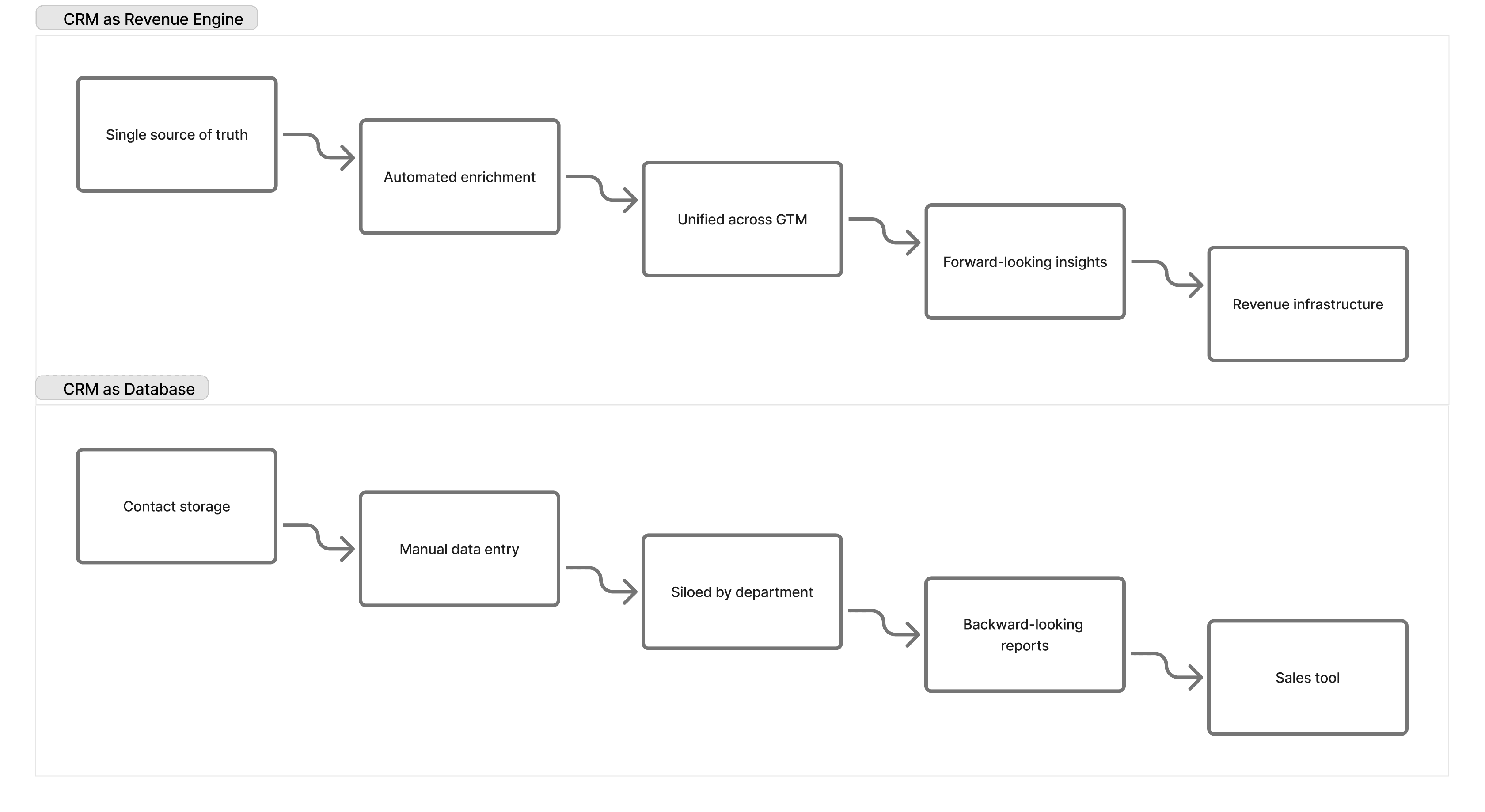
The difference? Whether you treat your CRM as a database or as your CRM revenue engine. This guide walks through building your GTM foundation using CRM as the engine that powers predictable revenue growth.
Why Most CRMs Fail as Revenue Engines
Your CRM probably holds the answers to your most pressing revenue questions. But only if the data is clean, complete, and connected.
Here's the reality for most companies:
Data decay works against you constantly. B2B data decays at roughly 2.1% per month, that's 22.5% annually. Job changes, company moves, email bounces. Without active maintenance, your CRM becomes less reliable every single day.
Silos fragment the customer view. Marketing tracks leads in one system. Sales logs opportunities in another. Customer success manages accounts somewhere else entirely. Nobody sees the complete picture, and according to research, 60-70% of B2B content created by marketing goes unused by sales because teams aren't aligned.
Manual processes don't scale. When your sales team was five people, manual data entry worked fine. At 25 people, it breaks. Reps spend hours on admin work instead of selling - and the data quality suffers anyway.
Reports describe the past, not the future. Most CRM reports tell you what happened. Revenue engines tell you what's likely to happen and what to do about it.
Companies lose an average of 16 sales deals per quarter as a direct result of poor-quality data. That's not a minor inefficiency, it's a direct hit to revenue.
The Four Pillars of a CRM Revenue Engine
Building a true revenue engine requires getting four things right: data foundation, process architecture, team alignment, and intelligence layer.
Pillar 1: Data Foundation
Your CRM is only as good as its data. Period.
Start with data governance. Define standards before data enters the system. What fields are required? What formats are acceptable? Who owns data quality? Without governance, entropy wins every time.
Establish single source of truth. Every team, marketing, sales, customer success, should work from the same customer record. No shadow spreadsheets. No separate databases. One unified view that everyone trusts.
Build data quality into workflows. Don't rely on quarterly cleanup projects. Implement validation at point of entry, use automated enrichment to fill gaps, and schedule regular hygiene routines. The companies that get this right see measurable results: businesses using CRM systems report 42% improvement in sales forecast accuracy and 29% increase in sales.
Define your data model deliberately. What objects do you need? How do they relate? A messy data model creates messy processes - think this through before you scale.
Pillar 2: Process Architecture
Your CRM should encode how revenue actually flows through your business.
Map the full customer journey first. From first touch through closed deal through renewal, every stage needs clear entry criteria, exit criteria, and ownership. If you can't see where deals stall, you can't fix it.
The marketing-to-sales handoff deserves special attention because that's where most revenue leaks occur. Most marketing leads never convert into sales, often due to poor handoff processes and lack of nurturing. Specify exactly when, how, and to whom leads transfer.
Automate everything that's repeatable. Trigger-based workflows eliminate manual steps and human error. Lead assignment, task creation, notification sending, if it follows rules, automate it.
And build for visibility. Every stakeholder should see what they need without asking. Sales needs pipeline views. Marketing needs funnel metrics. Leadership needs revenue dashboards. Design for self-service so nobody's waiting on reports.
Pillar 3: Team Alignment
Technology alone doesn't create alignment. People and processes do.
Shared definitions are non-negotiable. What is a qualified lead? What is an opportunity? What constitutes a customer? If marketing and sales define these differently, your numbers will never reconcile - you'll spend every QBR arguing about whose data is right.
Common KPIs drive common behavior. When marketing is measured on MQLs and sales is measured on closed revenue, you've created competing incentives. Align metrics to align teams.
Regular communication prevents drift: weekly pipeline reviews that include both marketing and sales, monthly business reviews that examine the full funnel, constant feedback loops between teams.
Unified technology reduces friction too. Teams that work from the same CRM, see the same data, and use the same tools collaborate better. Separate tech stacks create separate teams. Only 8% of companies have strong alignment between their sales and marketing departments - that's a competitive opportunity for everyone else.
Pillar 4: Intelligence Layer
The difference between a database and an engine is what you do with the data.
Lead scoring identifies who matters. Not all leads are equal. Score based on fit and engagement to focus attention where it actually drives results.
Pipeline analytics reveal the truth. Where do deals stall? Which sources convert best? What's the real sales cycle by segment? Your CRM should answer these questions automatically, not require someone to build a report.
Forecasting enables planning. With clean data and proper process, forecasting becomes reliable. With bad data, it's guesswork dressed up in spreadsheets. AI-enhanced CRMs help businesses improve lead conversion and qualification rates by up to 30%. The intelligence layer turns historical patterns into forward-looking guidance.

Step-by-Step: Building Your GTM Foundation
Here's the practical path from CRM-as-database to CRM revenue engine.
Step 1: Audit Current State
Before building forward, understand where you are.
Run a data quality assessment: What percentage of records are complete? How many duplicates exist? When was data last verified? What's the email bounce rate?
Document current processes: How do leads flow today? Where are the handoffs? What's automated versus manual?
Analyze actual usage: Who uses the CRM regularly? What workarounds exist? Why do people avoid the system?
Be honest about what you find. Most companies discover their CRM is messier than they thought - that's normal.
Step 2: Define Your Data Model
Design how information should be structured.
Core objects include Contacts, Companies, Deals/Opportunities, and Activities. Define the relationships between them clearly.
For required fields, keep this minimal but enforce it strictly. What must exist for a record to be useful?
Standardize naming conventions - industries, sources, deal stages, everything. And map integration points: What other systems need to connect? Where does data flow in and out?
Step 3: Establish Governance
Rules only work if they're enforced.
Assign data ownership clearly. Marketing owns lead source. Sales owns opportunity data. Customer success owns account health. No ambiguity.
Define quality standards, what "good" looks like, and set thresholds for completeness and accuracy.
Build enforcement mechanisms: validation rules, required fields, automation that flags issues before they compound.
Schedule regular data health reviews. Monthly at minimum.
Step 4: Clean and Enrich
You can't build forward on a broken foundation.
Deduplication comes first. Merge duplicate records. This is tedious but essential, skipping it undermines everything that follows.
Then standardization: normalize existing data to new standards, fix formatting issues, fill obvious gaps.
Enrichment uses external data sources to complete records - firmographics, technographics, contact details. Platforms that connect to multiple data providers through waterfall enrichment can fill gaps that single sources miss.
Finally, verification. Validate emails. Confirm phone numbers. Update job titles. Data that was accurate six months ago probably isn't anymore.
Step 5: Build Process Workflows
Now encode your revenue process into the system.
Lead management covers capture, routing, assignment, and nurture. Define each step and automate transitions between them.
Opportunity management includes stage progression, required fields per stage, and win/loss tracking with actual reasons.
Customer lifecycle workflows handle onboarding triggers, health scoring, and renewal processes.
Reporting automation builds dashboards that update automatically. Eliminate manual reporting wherever possible - if someone's building the same report every week, that should be automated.
Step 6: Enable and Train
Systems only work if people use them.
Role-based training matters because sales needs different training than marketing than leadership. Customize for each audience and their actual daily workflow.
Document workflows clearly. Create accessible documentation for every process so new team members can ramp quickly.
Identify champions - power users in each team who become your internal support system and advocates.
Gather feedback actively. Listen to what's working and what isn't. Iterate based on real usage, not assumptions.
Step 7: Measure and Optimize (Ongoing)
Revenue engines require continuous tuning.
Track adoption metrics like login frequency, data entry quality, and feature usage.
Monitor data health: completeness rates, decay patterns, quality scores over time.
Measure business outcomes: pipeline velocity, conversion rates, forecast accuracy.
Iterate continuously. Use insights to improve processes, add capabilities, fix problems. This work never truly ends.
What Your CRM Revenue Engine Should Deliver
When built right, your CRM strategy produces measurable results:
Unified customer view. Every team sees the same complete record. No more "which system is right?" debates.
Predictable pipeline. Clear visibility into what's coming, where it's stuck, and what's at risk.
Efficient operations. Less time on admin, more time on revenue-generating activities. Sales teams save 4-5 hours per week by eliminating manual data entry.
Accurate forecasting. Forecasts you can actually trust because they're built on reliable data.
Aligned teams. Marketing and sales working from shared definitions, shared data, and shared goals.
Actionable insights. Not just reports about the past, but guidance for what to do next.
Companies that achieve this see 33% year-over-year revenue growth compared to those that don't align their revenue operations.
FAQ
What makes a CRM a "revenue engine" versus just a database?
A database stores information. A CRM revenue engine actively drives revenue through clean data, automated processes, aligned teams, and actionable insights. The difference is whether you're recording history or enabling future growth. Revenue engines produce predictable pipeline, accurate forecasts, and measurable ROI.
How long does it take to build a proper GTM foundation?
Expect 8-12 weeks for the initial build, with ongoing optimization after that. Weeks 1-4 focus on audit, data model, and governance. Weeks 4-8 cover cleaning, enrichment, and workflow building. Weeks 8-10 address enablement and training. The work never truly ends, revenue engines require continuous tuning.
Should we buy a new CRM or fix our existing one?
Usually, fix what you have first. Most CRM problems are process and data problems, not technology problems. A new platform with the same bad habits produces the same bad results. If your current CRM genuinely can't support your needs, consider migrating - but fix your processes first so you don't recreate the same issues.
How do we get sales to actually use the CRM?
Make it useful to them, not just to management. Reduce data entry burden through automation and enrichment. Show them insights they can't get elsewhere. Tie CRM usage to outcomes they care about. And enforce adoption consistently - if it's optional, it won't happen. Reps using mobile CRM are 65% more likely to hit quota.
Related articles
See all