
Your team adopted three AI sales tools last quarter. One auto-generates emails nobody reads. Another "scores" leads using signals nobody can explain. The third creates call summaries that sit in a Slack channel collecting dust. You are paying for AI features. You aren't getting AI results.
The gap between AI sales tool marketing and AI sales tool reality is wide. Most tools slap "AI-powered" on existing features and charge a premium. A few actually change how reps sell, prospect, and close. This guide separates the two.
Quick picks:
Category | Best Tool | Why |
|---|---|---|
AI prospecting + enrichment | Databar | 100+ data providers, waterfall enrichment, MCP & SDK |
AI prospecting database | Apollo | Free tier, built-in sequencing |
AI email writing | Lavender | Real-time coaching inside your email client |
AI call coaching | Gong | Best conversation intelligence and deal analytics |
AI scheduling | Calendly | AI-powered routing and qualification |
AI CRM assistant | HubSpot AI | Native AI built into CRM workflows |
AI content generation | ChatGPT | Most flexible for sales collateral and research |
AI forecasting | Clari | Revenue prediction with pipeline inspection |
What "AI Sales Tool" Actually Means in 2026
Every sales tool now claims AI capabilities. The label has become meaningless on its own. What matters is what the AI specifically does and whether it saves reps time or improves outcomes.
The best AI sales tools fall into five functional categories:
Prospecting and enrichment: Finding the right accounts and contacts, enriching records with useful data
Writing and personalization: Generating emails, sequences, and messaging that match the prospect
Conversation intelligence: Recording, transcribing, and analyzing sales calls for coaching
Scheduling and routing: Qualifying inbound leads and routing them to the right rep
Forecasting and analytics: Predicting deal outcomes and pipeline health
The tools below are evaluated on what they actually do, not what their marketing page claims.
Best AI Sales Tools for Prospecting and Enrichment
Databar
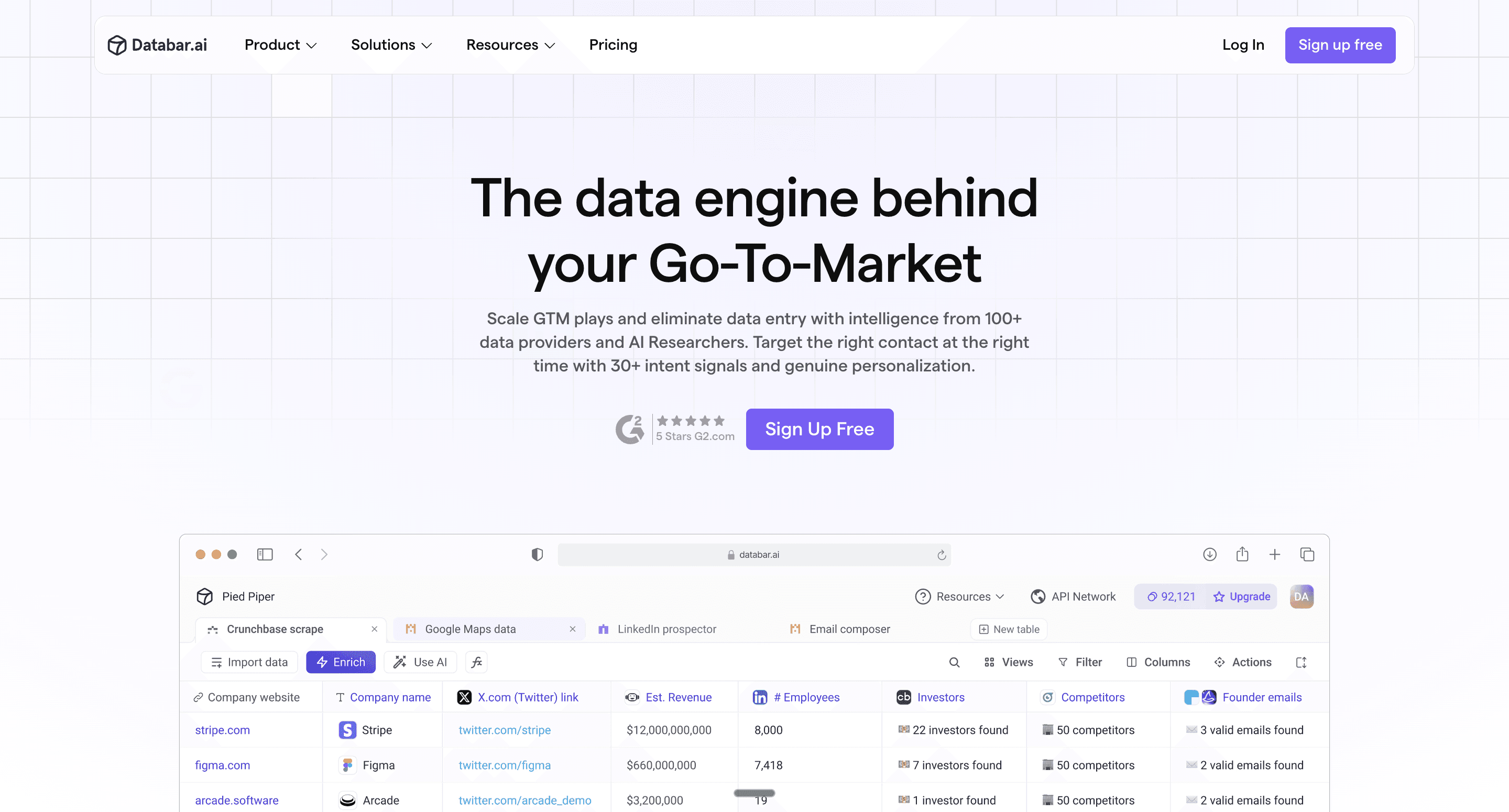
What it does: Databar connects to 100+ data providers for enrichment, prospecting, and data operations. You send a company domain or contact name, and Databar cascades through multiple providers to return verified emails, phone numbers, technographics, firmographics, and more.
Why it matters for sales: Most sales teams use one or two data providers and accept the coverage gaps. Databar's waterfall approach means you query multiple sources automatically, which pushes match rates to 80-90%+ than any single provider.
AI angle: Databar's MCP server lets AI agents run entire enrichment workflows programmatically. If you are building AI-powered prospecting workflows with Claude or other agents, Databar is the data layer underneath.
Pricing: Credits-based system, starting at $99/month. Only pay if data is returned.
Best for: Teams that need high-coverage enrichment across multiple data types without managing individual provider contracts. Check out our full comparison of email enrichment tools for more options in this category.
Apollo
What it does: Apollo combines a prospecting database of over 270 million contacts with built-in email sequencing, a Chrome extension, and AI-assisted email writing.
Why it matters for sales: Apollo is the best free entry point for sales teams. The free tier gives you access to the database and basic sequencing. The AI features help generate email drafts and suggest prospect sequences based on your ICP filters.
AI angle: Apollo's AI scoring ranks leads by engagement signals and fit criteria. The AI writing assistant generates email copy, though most experienced SDRs use it as a starting draft rather than sending AI output directly.
Pricing: Free tier available. Paid plans from $49/user/month.
Best for: Early-stage teams that need a prospecting database and sequencer in one tool. For finding specific decision-makers, see our guide on finding decision makers.
Best AI Sales Tools for Email Writing and Personalization
Lavender
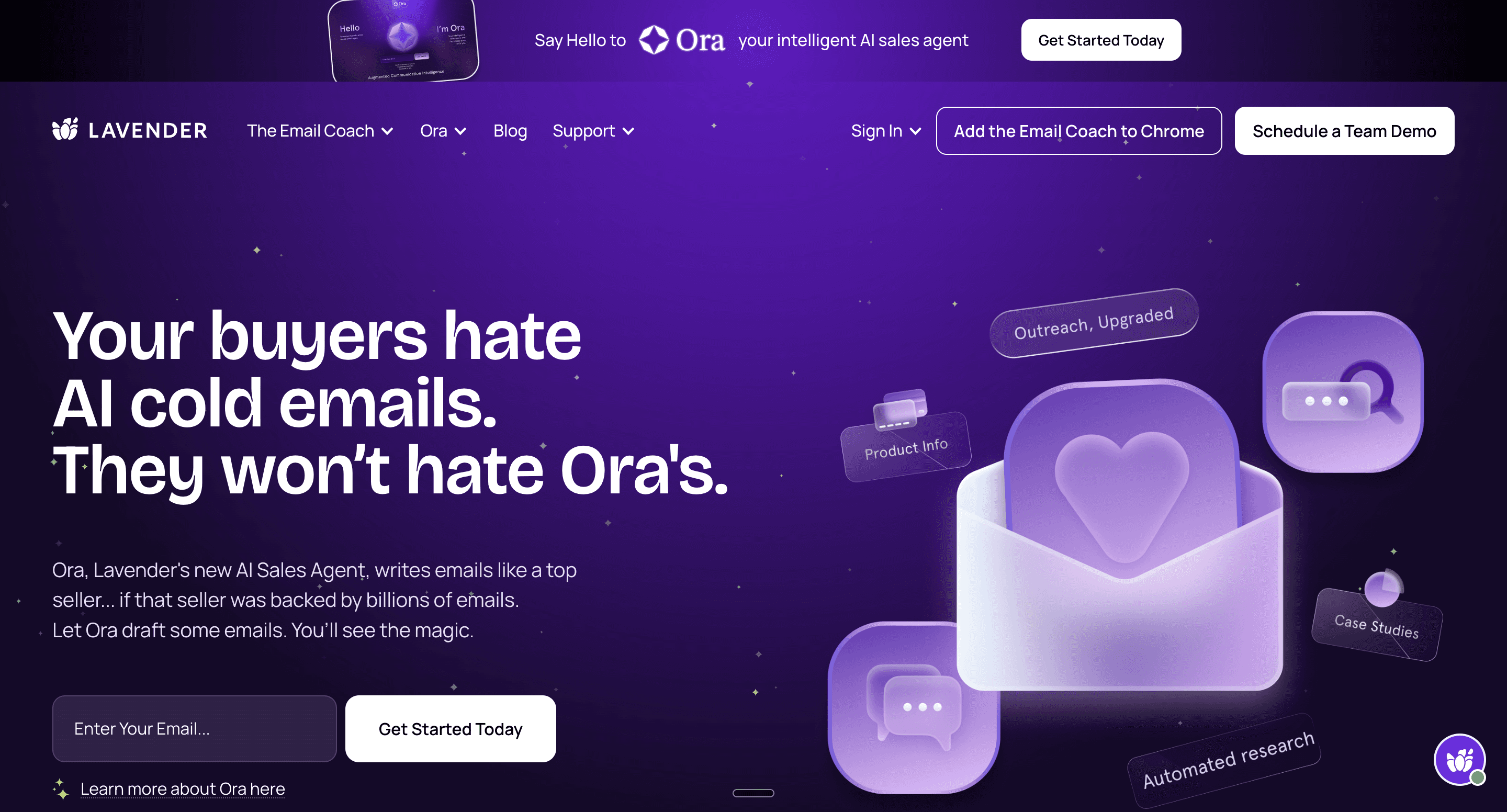
What it does: Lavender is an AI email coaching tool that sits inside your email client (Gmail, Outlook, or your sequencing tool). It analyzes your email in real time and suggests improvements to subject lines, opening lines, length, readability, and personalization.
Why it matters for sales: Most AI writing tools generate emails from scratch. Lavender takes the opposite approach. It coaches reps on the emails they are already writing. This builds skill over time rather than creating dependency on AI-generated output.
AI angle: Lavender scores every email on a scale and flags specific issues: too long, too formal, weak opener, missing personalization. It also pulls prospect data from LinkedIn and your CRM to suggest personalization angles.
Pricing: Free tier for individuals. Paid plans from $29/month.
Best for: SDR teams where email quality varies across reps and managers want consistent improvement.
ChatGPT (OpenAI)
What it does: ChatGPT is a general-purpose AI that sales teams use for drafting emails, creating sales collateral, researching prospects, summarizing documents, and brainstorming objection handling.
Why it matters for sales: ChatGPT is the Swiss Army knife. It isn't purpose-built for sales, but it handles a wide range of sales-adjacent tasks faster than any dedicated tool. Reps use it to research industries, draft proposals, prepare for calls, and rewrite messaging for different personas.
AI angle: The custom GPT feature lets teams create a sales-specific assistant trained on their messaging guidelines, product documentation, and objection-handling playbooks.
Pricing: Free tier. Plus plan at $20/month. Team plan at $25/user/month.
Best for: Any sales team. The ROI on a $20/month subscription is immediate for most reps.
Best AI Sales Tools for Conversation Intelligence
Gong
What it does: Gong records, transcribes, and analyzes sales calls. It tracks talk-to-listen ratios, competitor mentions, pricing discussions, next steps, and dozens of other conversation signals across your entire team.
Why it matters for sales: Gong turns sales calls from black boxes into data. Managers can coach based on what reps actually said, not what reps recall saying. Deal reviews become specific. "You mentioned pricing at minute 12 before establishing value" is more useful than "try to wait longer on pricing."
AI angle: Gong's AI summarizes calls, flags risk signals in active deals, and predicts deal outcomes based on conversation patterns. The deal board uses AI to highlight which deals are progressing and which are stalling.
Pricing: Custom pricing based on team size. Typically $100-150/user/month for mid-market teams.
Best for: Sales teams with 5+ reps where coaching and deal visibility matter. Smaller teams may find the cost hard to justify.
Chorus (ZoomInfo)
What it does: Chorus is Gong's main competitor. It records and analyzes sales conversations, provides coaching insights, and integrates with ZoomInfo's prospecting data.
Why it matters for sales: If you are already a ZoomInfo customer, Chorus gives you conversation intelligence inside the same ecosystem. The integration between prospecting data and call analytics is tighter than using separate tools.
AI angle: Similar AI capabilities to Gong for call analysis and deal prediction. The ZoomInfo integration adds automatic enrichment of contacts mentioned during calls.
Pricing: Bundled with ZoomInfo plans. Standalone pricing available on request.
Best for: Teams already in the ZoomInfo ecosystem. For teams evaluating from scratch, Gong typically wins on feature depth.
Best AI Sales Tools for Scheduling and Lead Routing
Calendly
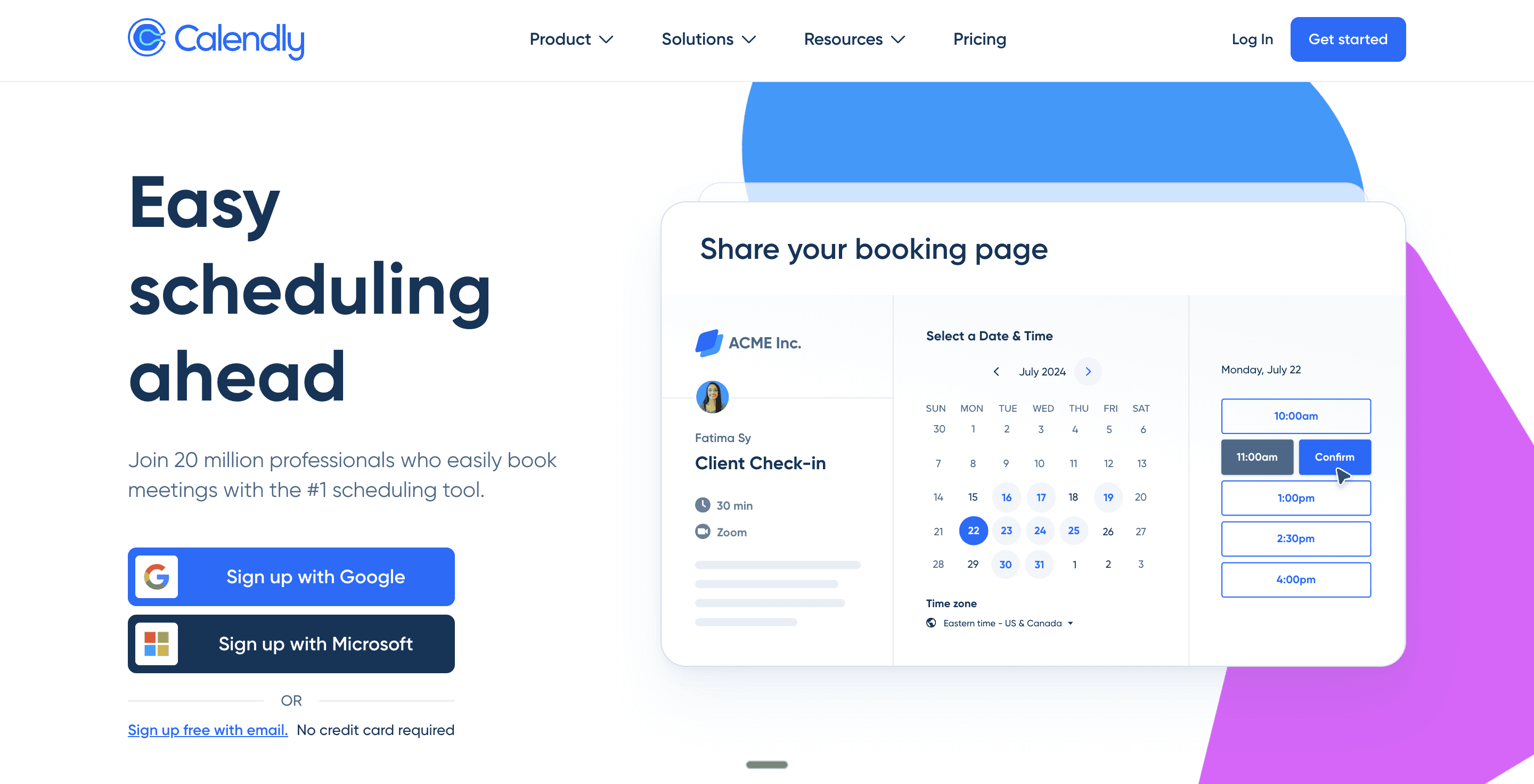
What it does: Calendly started as a scheduling link tool but now includes AI-powered lead qualification, routing, and round-robin assignment. When a prospect books a meeting, Calendly can qualify them, enrich their record, and route them to the right rep based on territory, deal size, or custom rules.
Why it matters for sales: Speed to lead is one of the biggest factors in conversion. Calendly's routing reduces the time between form fill and meeting from days to minutes. The AI qualification asks screening questions and scores leads before they hit a rep's calendar.
AI angle: The AI features focus on pre-meeting qualification and smart routing. It isn't flashy, but it directly impacts conversion by matching leads to the right rep faster. You can also integrate with tools for checking tech stacks to enrich booking data automatically.
Pricing: Free tier for individuals. Teams plan from $16/user/month.
Best for: Any team with inbound leads that need routing and qualification before a meeting.
Best AI Sales Tools for Forecasting and Analytics
Clari
What it does: Clari is a revenue platform that uses AI to forecast pipeline, inspect deals, and predict revenue outcomes. It pulls data from your CRM, email, calendar, and conversation tools to build a unified view of deal health.
Why it matters for sales: CRM data is notoriously unreliable for forecasting because reps update it inconsistently. Clari bypasses this by pulling signals directly from rep activity: emails sent, meetings booked, call recordings, and engagement patterns. This gives sales leaders a forecast based on behavior, not self-reported stage updates.
AI angle: Clari's AI predicts which deals will close, which are at risk, and where pipeline gaps will appear. The predictions are based on historical patterns in your data, not generic models.
Pricing: Custom pricing. Typically mid-market and enterprise.
Best for: Sales organizations with $5M+ in pipeline where forecast accuracy directly impacts business decisions.
HubSpot AI
What it does: HubSpot has embedded AI across its CRM, including email drafting, meeting summaries, predictive lead scoring, content generation, and workflow automation. The AI features are native, meaning they work inside the HubSpot interface without additional tools.
Why it matters for sales: For teams already on HubSpot, the AI features add capability without adding another tool or integration. The predictive lead scoring uses your CRM data to identify which leads are most likely to convert, and the email assistant drafts messages using your contact's history.
AI angle: HubSpot's AI is practical rather than flashy. It saves time on repetitive tasks (meeting notes, email drafts, data entry) rather than trying to replace strategic decisions.
Pricing: AI features included in Professional ($100/user/month) and Enterprise plans.
Best for: Teams already using HubSpot who want AI features without adding point solutions.
The AI Sales Stack Audit: Cut What Doesn't Drive Revenue
Before adding another tool, audit the ones you have. Companies with deliberate AI strategies see 2x the revenue growth compared to those adopting tools ad hoc. The difference is discipline. Score every AI tool in your stack on three axes:
AI Tool | Time Saved (hrs/rep/week) | Pipeline Influenced ($) | Revenue Attributed ($) | Verdict |
|---|---|---|---|---|
Example: Gong | 3 hrs (no manual call notes) | $200K (deal risk alerts) | $80K (saved 2 at-risk deals) | Keep |
Example: AI email writer | 2 hrs | $0 (reps don't use the output) | $0 | Cut |
Example: Databar enrichment | 5 hrs (no manual research) | $500K (better targeting) | $150K (higher close rate) | Keep |
Any tool that scores zero on both pipeline and revenue should be cut. Paying for AI features nobody uses is worse than not having AI at all. It creates the illusion of progress without the results.
How to Choose the Right AI Sales Tools for Your Team
Once you've cut what doesn't work, fill the gaps based on your biggest bottleneck.
Your Bottleneck | Start Here | Why |
|---|---|---|
Not enough qualified prospects | Databar | Coverage and volume for prospecting |
Low email reply rates | Lavender | Coaching improves quality across the team |
No visibility into sales calls | Gong | Coaching and deal intelligence from conversations |
Slow lead response time | Calendly | Instant routing and qualification |
Inaccurate forecasts | Clari | AI prediction based on activity, not CRM fields |
General productivity | ChatGPT + HubSpot AI | Broad time savings on daily tasks |
For teams doing outbound, start with data quality. The best email copy in the world doesn't matter if you are sending it to the wrong people. Tools like Databar and Apollo fix the foundation. Then layer on writing tools and coaching tools once your prospecting pipeline is solid.
If you want to understand how these tools fit into a modern GTM stack, our reverse email lookup guide covers how enrichment connects the pieces.
What AI Sales Tools Cannot Do
AI tools make reps more efficient. They don't make bad sales processes good. Here is what to watch for:
AI doesn't fix product-market fit. If prospects don't need what you sell, no amount of AI-powered outreach will change that. Fix the offer before optimizing the distribution.
AI-generated emails still need editing. Every experienced sales leader knows that AI drafts are a starting point. The best reps use AI to generate a framework, then add the human insight that makes the message relevant. Sending raw AI output is a fast way to sound like every other automated email in the prospect's inbox.
AI scoring is only as good as your data. Predictive lead scoring models train on your historical data. If your CRM is full of bad data, the model learns bad patterns. Invest in data quality (through enrichment and hygiene) before trusting AI scores.
AI tools require adoption. Buying a tool is the easy part. Getting 20 reps to actually use it is the hard part. Pick tools that integrate into existing workflows rather than requiring reps to learn a new interface.
FAQ
What are AI sales tools?
AI sales tools are software products that use artificial intelligence to help sales teams prospect, write outreach, analyze conversations, forecast revenue, or automate repetitive tasks. The most useful ones focus on specific bottlenecks rather than trying to replace entire sales workflows.
Which AI sales tool is best for prospecting?
For data enrichment and multi-source prospecting, Databar offers the widest provider coverage with 100+ data sources. For a combined database and sequencing tool, Apollo provides the best free tier. Most teams benefit from using both: Apollo for initial prospecting and Databar for enrichment and verification.
Are AI sales tools worth the cost?
It depends on the tool and the problem. Tools that save reps 5+ hours per week on manual tasks (like Gong for call notes or ChatGPT for research) pay for themselves quickly. Tools that add complexity without clear time savings become shelfware. Start with your biggest bottleneck and measure the impact before expanding.
Can AI replace SDRs?
Not in 2026. AI handles research, drafting, and data tasks well. It doesn't handle relationship building, creative problem-solving, or navigating complex buying committees. The best setup is AI-assisted SDRs who use tools to work faster, not AI-replaced SDRs.
How do I get my sales team to actually use AI tools?
Start with one tool that solves an obvious pain point. Show the team the before and after. Reps adopt tools that save them time on tasks they already dislike (data entry, research, scheduling). They ignore tools that add steps to their workflow, no matter how "powerful" the AI is.
What is the difference between AI sales tools and sales automation?
Sales automation follows predefined rules: if X happens, do Y. AI tools make decisions based on patterns and data. A sequencing tool that sends a follow-up on day 3 is automation. A tool that analyzes a call and suggests a different approach for the next meeting is AI. The best modern tools combine both.
Also Interesting
Related articles
See all