

"I've never talked to a leader who says 'I hired my RevOps person too early,' but have heard many people lament the opposite."
That quote from a seasoned ops professional captures something important: companies consistently wait too long to make their first RevOps hire. By the time they finally post the role, data silos have calcified, tech debt has accumulated, and processes have become tangled beyond quick fixes.
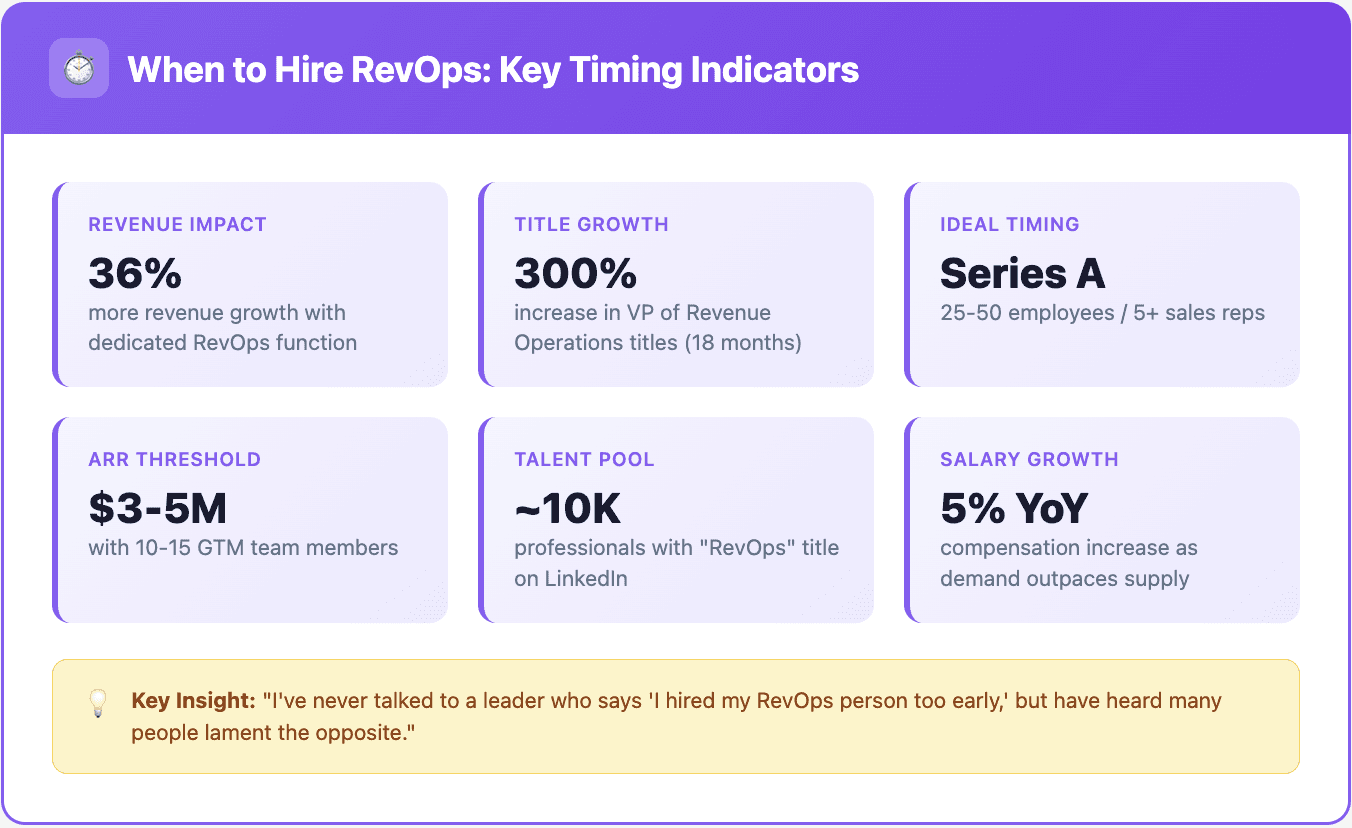
Companies with dedicated RevOps functions report 36% more revenue growth than those without. VP of Revenue Operations titles have increased 300% in the past 18 months. This guide covers exactly when to hire RevOps, what to look for, what to expect, and the mistakes that derail otherwise good hiring decisions.

When to Make Your First RevOps Hire
The right timing isn't about hitting a specific revenue number, but about recognizing when operational complexity has outgrown informal coordination.
You're past founder-led sales. When founders do the selling, they hold context in their heads. They know every customer, every deal, every nuance. Once you hire a sales leader and start building a team, that context needs to be systematized. Your sales leader should be developing playbooks and coaching reps - not spending 10 hours a week building reports and configuring workflows.
Data conflicts are becoming normal. Marketing says pipeline is healthy. Sales says it's thin. Finance has a third number. When you spend more time arguing about whose data is right than acting on insights, you've got a RevOps problem.
Handoffs are breaking down. Leads fall through cracks between marketing and sales. New customers have rocky onboardings because sales didn't document what was sold. Customer success can't find basic information about accounts. Every broken handoff is revenue leaking.
Your tech stack is creating more problems than it solves. You've accumulated tools: CRM, marketing automation, sales engagement, support tickets. Each generates siloed data. Nobody sees the complete picture. Integration debt compounds with every new tool you add.
Leadership time is going to data reconciliation. If your VP of Sales spends Monday mornings rebuilding the same Excel report because CRM data can't be trusted, that's a RevOps signal. Executive time is too expensive for data janitorial work.
You're about to scale. The best time to hire RevOps is when you're preparing to scale, not after scaling has exposed process gaps. Building the right foundation before rapid growth prevents the painful rip-and-replace cycles that come from scaling on shaky infrastructure.
The Stage-by-Stage View
Seed/Pre-Series A: Typically no dedicated hire. Founders or early GTM leaders manage operations. Consider a part-time consultant or RevOps-as-a-service firm if you have complex sales motion or aggressive scaling plans.
Series A: This is where most companies make their first RevOps hire. The triggers: 25-50 employees, sales team growing beyond 5 reps, need to clean up CRM data and improve revenue tracking. A Director-level hire is often ideal.
Series B and Beyond: RevOps shifts from tactical support to strategic function. You'll build a team, integrate sales, marketing, and customer success operations, and elevate RevOps leadership typically to report directly to CEO or COO.
What Your First RevOps Person Actually Does
Here's where hiring goes wrong: companies confuse RevOps with Sales Ops, or they create a laundry list of tasks rather than defining strategic priorities.
RevOps is not Sales Ops. Sales Ops focuses on supporting the sales team - commission structures, territory planning, sales tool management. RevOps takes a broader view, aligning operations across marketing, sales, and customer success. If your job description reads like "Sales Ops plus some other stuff," you're hiring for the wrong role.
The RevOps role encompasses:
Strategic planning: Partnering with revenue leadership to set goals, allocate resources, and design go-to-market motions. Not just executing on others' plans, contributing to strategy.
Process design: Creating standardized workflows for lead management, opportunity progression, customer handoffs, and data governance. Documenting how work gets done and building systems that enforce it.
Tech stack management: Owning the integration and optimization of CRM, marketing automation, sales engagement, and customer success platforms. Making sure tools work as a system, not a collection of disconnected parts.
Data governance: Establishing and enforcing standards for data quality. Building the single source of truth that lets everyone trust the numbers.
Analytics and reporting: Creating dashboards and reports that provide visibility into full-funnel performance. Moving from reactive reporting to proactive insights.
Cross-functional coordination: Acting as neutral arbiter between teams that historically compete for credit and blame each other for failures. The lack of political bias is critical, RevOps bias is to the company, not any particular team.

How to Hire: The RevOps Hiring Process That Works
Step 1: Define Your Priorities
Don't copy a job description from LinkedIn. Start with your specific pain points.
Ask yourself:
What's broken right now that's costing us revenue?
What needs to be built before we can scale?
What decisions are we making poorly because of bad data?
Common first RevOps hire priorities include:
CRM administration and data cleanup
Lead scoring and routing
Forecasting and pipeline management
Sales process documentation
Tech stack integration
Reporting and dashboards
Pick your top 3-5 priorities. Your first hire can't do everything well - and shouldn't try.
Step 2: Choose the Right Level
For most companies making their first RevOps hire, Director-level is the sweet spot.
Too junior (Analyst/Specialist): They need someone to define strategy and priorities. Without leadership, they'll flounder or build systems that don't align with business needs. You'll hire another person within a year to manage them.
Too senior (VP level): They may be overqualified for the hands-on work required at early stages. You need someone who will configure Salesforce workflows on Tuesday and present to the board on Thursday.
Director-level just right: Strategic enough to partner with revenue leadership. Tactical enough to execute without a team. Adaptable enough to evolve with the business.
The exception: if you already have siloed ops people (marketing ops, sales ops) who need unification, a VP-level hire might make sense to bring them together under one umbrella.
Step 3: Look for These Skills
Based on analysis of numerous RevOps job descriptions:
Collaboration: RevOps works across every team. Someone who can't navigate cross-functional politics will fail regardless of technical skills.
Communication: Translating complex data into insights for non-technical stakeholders.
Analytical ability: Comfort with data - pulling it, cleaning it, analyzing it. Excel proficiency is table stakes.
Technical aptitude: CRM experience is critical and builds the one source of truth
Cross-functional experience: The best RevOps hires have worked in sales, marketing, or customer success - not just ops roles.
Strategic thinking: Connecting day-to-day operations to business outcomes.
What matters less than you think: specific industry experience (they'll learn your business), particular tool expertise beyond CRM (most tools are learnable).
Step 4: Structure Your Interview Process
Screen for priorities: Does their experience match your top 3-5 pain points?
Test analytical skills: Give them a real data problem from your business. Watch their thinking process.
Evaluate cross-functional judgment: Present a scenario where sales and marketing disagree. Look for answers that prioritize company outcomes over departmental politics.
Include stakeholders: Have marketing, sales, and CS leaders interview the candidate. They'll work together daily, so chemistry matters.
Compensation: What to Expect
RevOps compensation varies by level, geography, and company size. Current benchmarks:
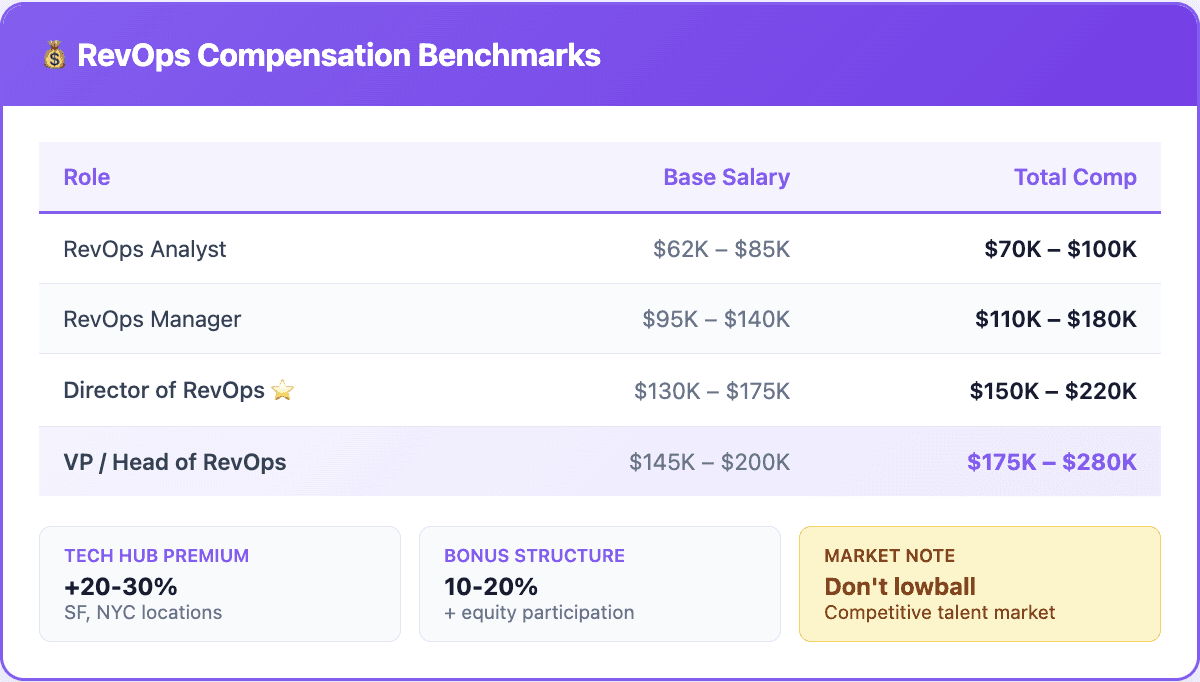
Tech hubs (San Francisco, New York) run 20-30% higher. Compensation has increased roughly 5% year-over-year as demand outpaces supply. Beyond base, consider bonus structure (10-20%), equity participation, and remote flexibility.
Don't lowball. The RevOps talent market is competitive, there are only about 10,000 professionals on LinkedIn with "RevOps" in their title.
Alternatives: Agencies and Fractional Options
Not ready for a full-time hire? Consider agencies helping companies hire strategic RevOps professionals or fractional arrangements.
RevOps-as-a-service firms can:
Accelerate rollout of new initiatives
Bring expertise across all functional areas
Help define requirements before you hire full-time
Handle surge capacity during system implementations
Fractional RevOps leaders work part-time with your company, typically 15-20 hours per week. This works well when:
You need strategic guidance but not full-time execution
You're defining the role before committing to a hire
Budget constraints prevent senior full-time hiring
You need specialized expertise for a specific project
Companies report 30-50% cost savings versus full-time hires, with faster implementation (weeks versus quarters). The tradeoff: less dedicated attention and potential knowledge transfer challenges.
Many companies use a hybrid approach: bring in a consultant or agency to establish foundations, then hire internally once requirements are clearer and the role is defined.
How to Hire and Develop Your RevOps Team Over Time
Your first RevOps hire is just the beginning. Here's how the function typically evolves:
Year 1: Single hire establishes foundations: data quality, core processes, critical integrations. Lean on consultants for specialized projects.
Year 2-3: Add specialists (CRM admin, analytics/BI, enablement). Original hire shifts toward strategy and leadership.
Year 4+: Full team with 4-8 people. Dedicated functions for systems, analytics, enablement, and special projects.
As you grow, it’s highly recommended to resist re-siloing. Keep marketing ops, sales ops, and CS ops together under one RevOps umbrella - splitting them only recreates the original problem.
FAQ
When should I make my first RevOps hire?
The optimal timing is typically Series A stage, 25-50 employees, or when your sales team grows beyond 5 reps. Earlier signals include data conflicts between teams, broken handoffs, tech stack creating more problems than it solves, and executives spending time reconciling data rather than acting on insights. The best time is when you're preparing to scale, not after scaling has exposed gaps.
What's the difference between RevOps and Sales Ops?
Sales Ops focuses specifically on supporting the sales team - commissions, territories, sales tools, forecasting. RevOps takes a broader view, aligning operations across marketing, sales, and customer success. If your hire only serves sales, you have Sales Ops. If they're breaking down silos between all revenue-generating functions, you have RevOps.
What level should my first RevOps hire be?
For most companies, Director-level is ideal for a first RevOps hire. They can both set strategy and execute tactically. Too junior means needing another hire to provide direction. Too senior may be overqualified for the hands-on work required early. Exception: if you have existing siloed ops roles to unify, consider VP-level.
How much does a RevOps hire cost?
Current benchmarks: Manager level ($95K-$140K base), Director level ($130K-$175K base), VP level ($145K-$200K base). Total compensation including bonus and equity runs 15-30% higher. Tech hub locations (SF, NYC) add 20-30% premium. The market is competitive with 5% year-over-year salary growth.
Should I hire full-time or use a RevOps agency?
Full-time when you have sustained need and budget for dedicated focus. Agency or fractional when defining the role, handling specific projects, needing specialized expertise, or facing budget constraints. Many companies use agencies to establish foundations, then hire internally once requirements are clearer. Agencies offer 30-50% cost savings but less dedicated attention.
What skills should I prioritize in a RevOps hire?
Top skills: collaboration (works across teams), communication (translates data for stakeholders), analytical ability (comfortable with data), CRM proficiency, strategic thinking (connects operations to outcomes). Cross-functional experience matters more than perfect background match - diverse paths lead to great RevOps.
Related articles
See all