

The title "VP of Revenue Operations" has increased 300% in the past 18 months. LinkedIn lists "RevOps" as the fifth fastest-growing job search term. And Gartner says that in 2025, 75% of the highest-growth companies have deployed a RevOps model - up from under 30% just a few years ago.
If you're a founder, board member, or sales leader who's been hearing about revenue operations but still isn't sure what it actually means or whether your company needs it - this guide is for you.
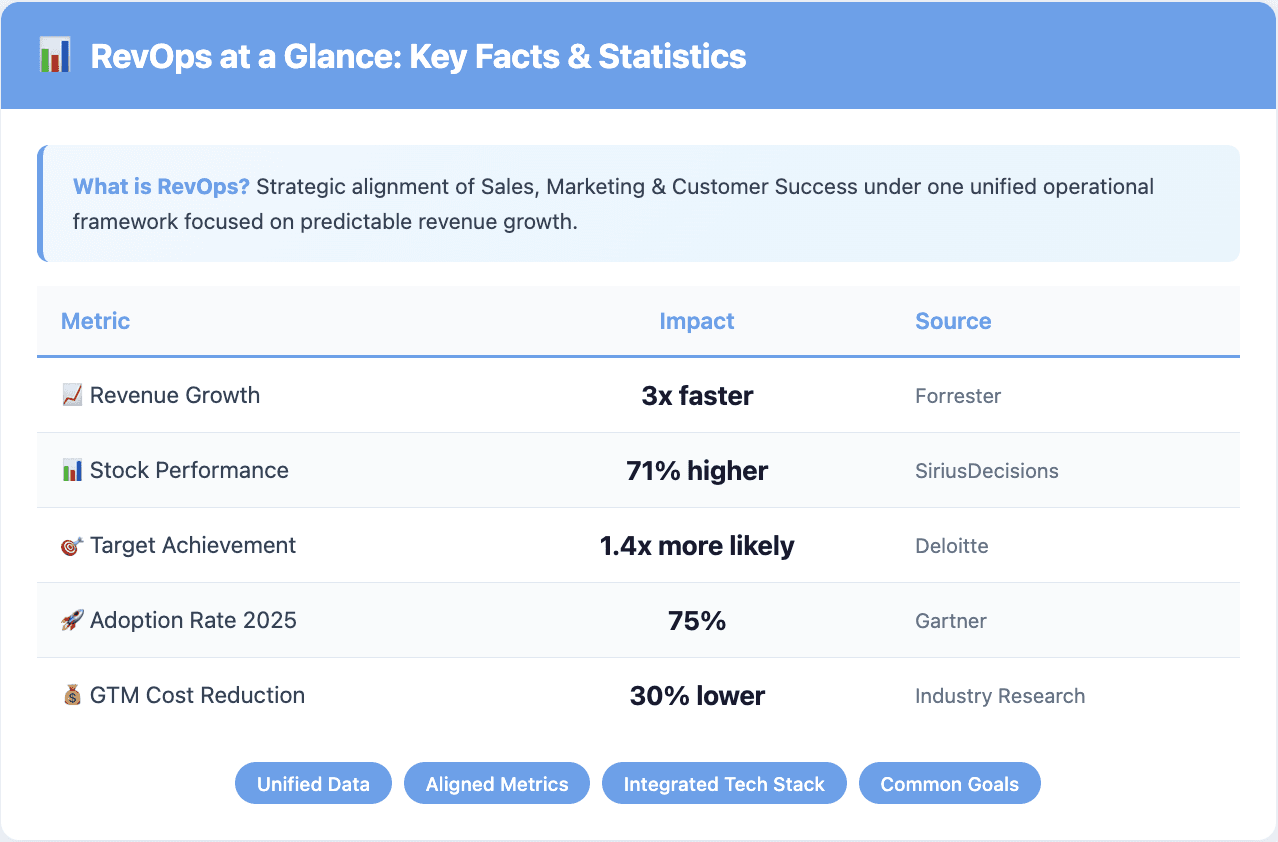
What Is RevOps?
RevOps (short for revenue operations) is the strategic alignment of sales, marketing, and customer success under a unified operational framework. Instead of each team operating with its own processes, tools, metrics, and definitions, RevOps creates a single system focused on one goal: predictable revenue growth.
Here's the simplest way to think about it: RevOps meaning is the integration of everything that affects how your company generates revenue, from the moment a prospect first hears about you until they become a long-term customer.
Traditional B2B companies have separate operations teams:
Sales ops reports to the VP of Sales
Marketing ops reports to the CMO
Customer success ops reports to the CS leader
Each team tracks different metrics. Uses different definitions of "qualified lead." Maintains different tech stacks. Has different goals that sometimes conflict with each other.
The result? Finger-pointing when numbers miss. Disconnected buyer experiences. Wasted resources as teams duplicate effort or work at cross-purposes. Forecasts nobody trusts because the data sources don't match.
RevOps fixes this by creating:
One source of truth for data across the revenue cycle
Shared definitions for stages, metrics, and handoffs
Unified processes that follow the customer journey rather than internal org charts
Integrated technology that connects rather than fragments
Common goals that align incentives across teams
The shift matters because buyer behavior has changed. Customers interact with marketing, sales, and support simultaneously, not sequentially. They expect consistent experiences across every touchpoint. Companies that can't deliver that consistency lose to competitors who can.

Why RevOps Matters Now
The business case for revenue operations has become overwhelming.
According to Deloitte's 2024 study of 650 B2B sales executives, organizations with firmly established RevOps were:
1.4x more likely to exceed revenue goals by 10%+
2.2x more likely to launch new products and services successfully
1.9x more likely to invest in digital transformation tools
2x more likely to use AI in innovative, competitive ways
The research also found that 40% of sales teams failed to hit quota in 2023. RevOps directly addresses this by eliminating the friction, misalignment, and data problems that cause reps to waste time on non-selling activities.
Consider these pain points that RevOps solves:
About 60% of sales rep time is spent on non-revenue-generating activities. That's admin work, data entry, hunting for information across systems, and navigating internal politics about who owns what.
79% of marketing leads never convert to sales. Much of this stems from misaligned definitions of "qualified" and broken handoff processes between marketing and sales.
Only 7% of companies respond to new leads within five minutes (Drift). When lead routing, enrichment, and assignment aren't automated and coordinated, speed suffers.
71% of internet leads are wasted due to slow or no responses (Harvard Business Review). RevOps creates the infrastructure to respond fast and follow up consistently.
The companies investing in RevOps see the returns. Reports state that companies implementing RevOps see 19% faster revenue growth and 15% higher profitability. A Forrester study found that organizations with aligned revenue operations grew revenue nearly three times faster than those without.
For early-stage companies, RevOps is often the difference between scaling efficiently and burning cash trying to force-fit disconnected systems as you grow.

The Three Pillars of RevOps Strategy
Every effective RevOps strategy rests on three foundational pillars: process, platform, and people.
Process
RevOps starts with documented, repeatable processes that span the entire customer lifecycle. This means:
Lead management: Clear definitions of MQL, SQL, and opportunity stages. Documented criteria for what triggers each stage transition. SLAs for response times and handoffs between teams.
Sales process: Standardized stages, exit criteria, and required activities. Consistent forecasting methodology. Defined engagement rules for territories and accounts.
Customer success handoffs: Smooth transitions from sales to onboarding. Clear ownership for renewals and expansion. Coordinated approaches to cross-sell and upsell.
Data governance: Rules for data entry, validation, and maintenance. Defined data owners. Regular audits and cleanup processes.
Without process discipline, you're just building expensive infrastructure on top of chaos.
Platform
The technology stack that supports your revenue engine needs to work as an integrated system, not a collection of disconnected tools.
At the center sits your CRM: HubSpot, Salesforce, or similar - as the single source of truth. Around it, you integrate:
Marketing automation
Sales engagement tools
Customer success platforms
Data enrichment providers
Analytics and BI tools
Communication systems
RevOps owns the integration and ensures data flows cleanly between systems. When a contact fills out a form, that data should automatically enrich the record, score the lead, route it to the right rep, and trigger the appropriate follow-up sequence, without manual intervention.
People
RevOps requires people who can work across functions without political bias. They're not "sales ops people who also do marketing stuff." They're revenue operations professionals whose loyalty is to the data and the process, not to any particular department.
This neutrality matters. When sales complains that marketing sends bad leads, and marketing complains that sales ignores good ones, someone needs to be the impartial arbiter who looks at the data and fixes the actual problem.

When to Make Your First RevOps Hire
Timing your first RevOps hire correctly can accelerate growth. Hiring too early wastes resources. Hiring too late means you're already drowning in technical debt and process chaos.
Here are the signals that it's time:
Your data is fragmented. Marketing has one view of the customer. Sales has another. Customer success has a third. Nobody trusts anyone else's numbers. Meetings devolve into arguments about whose data is right.
Handoffs are failing. Leads fall through cracks between marketing and sales. New customers have rough onboarding experiences. Sales closes deals that CS can't actually deliver on.
Your tech stack is a mess. You've accumulated tools over time without integration strategy. There's duplicate data entry. Systems don't talk to each other. Nobody's sure which tool is the source of truth for what.
You're scaling past founder-led sales. When the founders are selling, they hold the context in their heads. As you hire reps and build teams, that context needs to be systematized. RevOps builds the infrastructure for that transition.
Your forecasts are wrong. Not just occasionally, but consistently. You can't tell the board what next quarter looks like because the data isn't reliable.
You're in the $5-50M ARR range. According to Forbes research, this is when most companies find RevOps critical. Earlier, you can often make do with scrappy solutions. Later, the debt becomes crushing if you haven't built the foundation.
How to Hire Your First RevOps Person
Hiring for RevOps is notoriously tricky. The field is young enough that there's no standardized career path. Job descriptions vary wildly - some read like CRM admin roles, others like strategy consulting.
Define Your Priorities First
Don't copy someone else's job description from LinkedIn. Instead, start with your specific needs.
Ask yourself:
What's broken right now that's costing us revenue?
What systems need to be built before we scale?
What decisions are we making poorly because of bad data?
Common RevOps jobs-to-be-done include:
CRM administration and optimization
Sales process design and enforcement
Lead routing and assignment logic
Territory and quota planning
Forecasting and pipeline management
Tech stack integration and automation
Data quality and enrichment
Reporting and analytics
Compensation plan design
Sales enablement
Prioritize ruthlessly. Your first hire can't do all of these well. Identify your top 3-5 priorities and hire for those specifically.
Determine the Right Seniority
For most companies making their first RevOps hire, a Director-level person is ideal. Here's why:
Too junior (Analyst/Specialist level): They'll need someone to define strategy and priorities. If you don't have that leadership in place, they'll flounder or build systems that don't align with business needs.
Too senior (VP level): They may be overqualified for the hands-on work required in early stages. You need someone willing to configure workflows in HubSpot on Tuesday and present to the board on Thursday.
The right first hire is a strategic partner who's also hands-on - someone who can define what needs to be built and then actually build it.
Look for These Skills
Based on analysis of 100+ RevOps job descriptions, here are the most in-demand qualities:
Collaboration (76% of job descriptions): RevOps works across every team. Political skills matter.
Communication (64%): Translating complex data into actionable insights for non-technical stakeholders.
Data analysis (frequent requirement): Ability to pull, clean, analyze, and present data confidently.
Technical aptitude: Hands-on CRM experience (Salesforce in 64% of job descriptions, HubSpot in 38%, Excel in 63%).
Strategic thinking (49%): Connecting day-to-day operations to business outcomes.
Process orientation: Ability to document, systematize, and enforce processes.
Salary Expectations
RevOps compensation varies significantly by level and geography, but here are typical ranges:
Revenue Operations Analyst: $62,000-$80,000
Revenue Operations Manager: $80,000-$103,000
Director of Revenue Operations: $130,000-$160,000
VP of Revenue Operations: $145,000-$175,000
Given the competitive market (there are only about 10,000 professionals on LinkedIn with "RevOps" in their title), expect to pay at or above market to attract strong candidates.
Alternative: RevOps Agency or Consultant
If you're not ready for a full-time hire, a RevOps agency or fractional RevOps consultant can jump-start your program.
This approach works well when:
You need to audit and fix immediate problems before hiring
You want to define the role requirements before committing
You need specialized expertise for a specific project (CRM migration, process redesign)
Budget constraints prevent a senior full-time hire
Many companies use a hybrid model: bring in an agency to establish foundations, then hire internally once the requirements are clearer.
RevOps Best Practices for Getting Started
Whether you're building a RevOps function from scratch or optimizing an existing operation, these RevOps best practices accelerate results:
Start with data quality. Nothing else works if your data is garbage. Before building sophisticated processes, audit your CRM. Clean up duplicates. Fill in missing fields. Establish data governance rules. This isn't glamorous work, but it's foundational.
Define your revenue stages clearly. Get sales, marketing, and CS leaders in a room. Agree on what "MQL," "SQL," "Opportunity," and "Customer" actually mean. Document the criteria. Publish them where everyone can reference them.
Create SLAs between teams. Marketing commits to delivering X qualified leads per month. Sales commits to following up within Y hours. CS commits to onboarding within Z days. Written agreements with metrics create accountability.
Build your single source of truth. Pick your CRM and make it authoritative. Other systems integrate with it and not around it. When data conflicts between systems, the CRM wins.
Automate handoffs. Manual handoffs create friction and errors. When possible, use workflow automation to route leads, trigger sequences, and create tasks without human intervention.
Measure what matters. Focus on metrics that drive revenue outcomes: pipeline velocity, conversion rates at each stage, lead response time, win rates, customer lifetime value. Vanity metrics (email opens, page views) only matter if they correlate with revenue.
Review and iterate. Schedule regular reviews of your RevOps performance. What's working? What's broken? What needs to change as the business evolves?
FAQ
What is RevOps?
RevOps (Revenue Operations) is the strategic alignment of sales, marketing, and customer success operations under a unified framework focused on driving predictable revenue growth. It integrates processes, platforms, and people across the full customer lifecycle to eliminate silos, improve efficiency, and create accountability for revenue outcomes.
What does RevOps mean in practical terms?
In practical terms, RevOps meaning is the function that owns your revenue infrastructure: the CRM, the data quality, the lead routing, the handoff processes, the forecasting, and the metrics that everyone trusts. It's the operational backbone that enables go-to-market teams to work together effectively.
How is RevOps different from Sales Ops?
Sales Ops focuses specifically on supporting the sales team, quota setting, territory planning, commission structures, sales tool management. RevOps takes a broader view, aligning sales operations with marketing operations and customer success operations. The goal is optimizing the entire revenue cycle, not just the sales portion.
When should a company hire their first RevOps person?
Most companies find RevOps critical in the $5-50M ARR range, when scaling past founder-led sales but before operational debt becomes overwhelming. Signs you're ready include fragmented data across teams, failing handoffs, an unintegrated tech stack, and unreliable forecasts.
What skills should I look for in a RevOps hire?
Priority skills include collaboration (working across functions), strong communication, data analysis capabilities, hands-on CRM experience (especially Salesforce and HubSpot), strategic thinking, and process orientation. For a first hire, look for someone who can both set strategy and execute tactically.
What is a RevOps agency?
A RevOps agency provides outsourced or fractional revenue operations expertise. These firms help companies build RevOps infrastructure, integrate tech stacks, optimize processes, and sometimes provide ongoing operational support. They're useful when you're not ready for a full-time hire or need specialized expertise for specific projects.
What are the key RevOps best practices?
Core RevOps best practices include: establishing data quality foundations, defining clear revenue stages with documented criteria, creating SLAs between teams, building a single source of truth (usually your CRM), automating handoffs, measuring revenue-correlated metrics, and conducting regular operational reviews.
Related articles
See all