
A prospect visits your pricing page, downloads a case study, and requests a demo - all within the same hour. By the time your sales rep sees them in the CRM tomorrow morning, that prospect has already taken calls from two competitors.
This is the problem with static lead scoring. Traditional models update overnight, or once a week, or whenever someone remembers to run the batch job. Meanwhile, buying signals happen in real-time. Interest peaks and fades within minutes. The window between "actively evaluating" and "already chose someone else" is measured in hours, not days.

Research backs this up with stark numbers. Responding to leads within 5 minutes makes you 21 times more likely to qualify them compared to waiting 30 minutes. The first vendor to respond wins 35-50% of sales. And yet, the average B2B company takes 42 hours to respond to an inbound lead, nearly two full business days of silence.
Real-time lead scoring closes this gap by recalculating scores the moment behavior happens. When a lead visits your pricing page, their score updates instantly. When they open three emails in one day, the system notices immediately. When multiple signals combine to indicate hot buying intent, your sales team gets alerted now, not tomorrow.
In this guide, I'll walk you through how real-time scoring works, why it outperforms traditional approaches, and how to implement it without overcomplicating your tech stack.
What Makes Real-Time Lead Scoring Different
Traditional lead scoring runs on a schedule. Whether it's nightly batch processing or weekly recalculations, there's always a delay between when behavior happens and when scores reflect it. This worked fine when sales cycles were slower and competition was less intense.
Real-time lead scoring operates differently:
Instant recalculation. Scores update the moment new data arrives - a page view, an email click, an enrichment data point. No waiting for batch jobs.
Immediate alerts. When a lead crosses your qualification threshold, sales gets notified within seconds, not hours.
Dynamic prioritization. Your sales queue reflects right-now intent, not yesterday's snapshot.
Behavioral surge detection. The system recognizes when a normally quiet lead suddenly becomes active - a strong buying signal that batch processing would miss entirely.
The business impact is straightforward. If you can identify hot leads while they're actively engaged and get sales on the phone within minutes, you dramatically increase your chances of winning the deal.
The Speed-to-Lead Problem (And Why It Matters)
Let me share some numbers that should make every revenue leader uncomfortable:
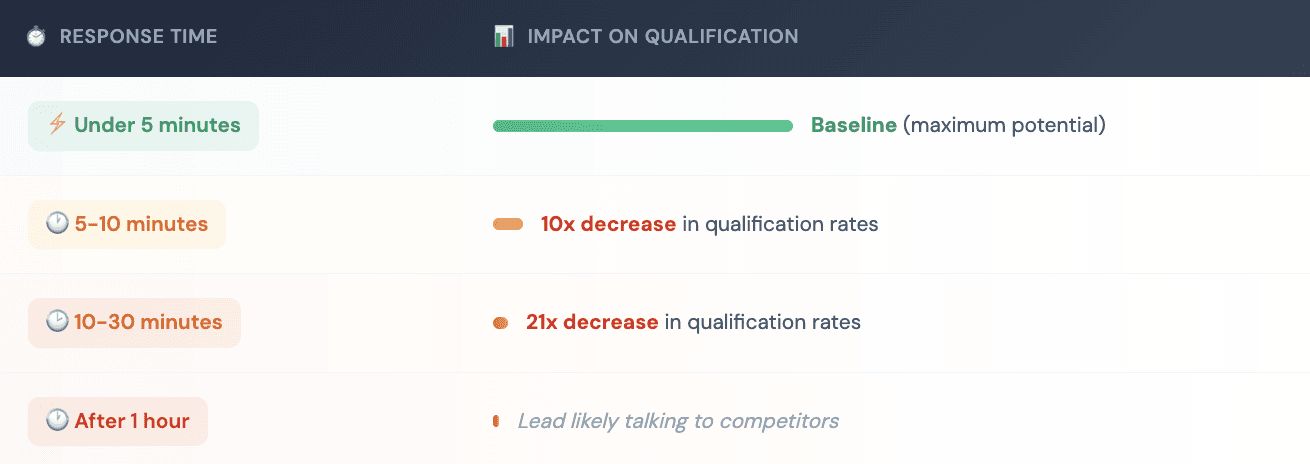
According to research from MIT and InsideSales.com, the drop-off is exponential, not linear. Waiting 10 minutes instead of 5 doesn't cut your chances in half - it decimates them.
Here's what makes this worse: 78% of buyers go with the first company that responds. In competitive markets, being second means being too late. The company that contacts the lead while they're still engaged and evaluating wins the conversation. Everyone else is playing catch-up.
Yet most organizations are nowhere close to hitting these benchmarks. The average B2B response time is 42 hours. More than 30% of leads are never contacted at all. Billions in marketing spend generates leads that simply evaporate because nobody followed up fast enough.
Real-time lead scoring isn't just about accurate prioritization, it's about speed. The scoring system becomes the trigger for immediate action, not just a classification exercise that sits in your CRM.

How Real-Time Lead Scoring Actually Works
The mechanics behind real-time scoring involve three core components working together.
Event Streaming
Instead of storing data and processing it later, real-time systems capture events as they happen:
Website page view → Event captured
Form submitted → Event captured
Enrichment data appended → Event captured
Each event feeds into the scoring engine immediately. There's no staging database, no nightly ETL job, no "we'll process this tomorrow."
Continuous Score Calculation
Traditional scoring runs a calculation once and stores the result. Real-time scoring recalculates continuously based on the latest data. When a lead visits your pricing page, their behavioral component updates. When enrichment reveals they work at a 500-person company, their fit component updates. These changes compound into a new score within seconds.
Threshold-Based Automation
The real power emerges when scoring connects to action triggers:
Score hits 70 → Slack notification to assigned rep with lead details and recent activity
Score hits 80 → Auto-assignment to senior rep with calendar booking link sent
Score hits 90 → Priority alert with "call within 5 minutes" urgency flag
Score spikes suddenly → Surge alert indicating re-engaged or highly active lead
Without these automations, real-time scores are just faster numbers. With them, you've built a system that converts behavioral signals into immediate sales action.

Best Practices for Real-Time Lead Scoring
Implementing real-time scoring requires more than turning on a feature. Here's what separates effective implementations from ones that generate noise.
1. Weight Recency Heavily
A pricing page visit yesterday matters less than a pricing page visit five minutes ago. Real-time scoring should decay points over time so that recent behavior carries more weight than historical behavior.
Example decay model:
Action within last hour: Full point value
Action within last 24 hours: 75% of point value
Action within last 7 days: 50% of point value
Action older than 30 days: 25% of point value
This ensures your hottest leads are actually hot right now, not based on activity that happened weeks ago.
2. Identify High-Intent Signals
Not all real-time events deserve equal attention. Focus your scoring weight on signals that indicate immediate buying intent:
High-intent signals (weight heavily):
Pricing page visits
Demo or trial requests
Competitor comparison page views
Multiple sessions in a single day
Return visit after period of inactivity
Medium-intent signals:
Case study downloads
Product feature page exploration
Webinar registration
Email reply
Low-intent signals (weight lightly):
Blog post views
Social media engagement
Newsletter opens
The goal is ensuring that leads exhibiting buying behavior rise to the top immediately, not get lost among leads who just happen to be casually browsing.
3. Combine Fit and Behavior Scores
Real-time behavioral scoring is powerful, but it needs context. A lead showing high engagement from a company that doesn't fit your ICP shouldn't consume sales time at the same rate as a perfect-fit prospect showing similar behavior.
The best implementations calculate two separate scores:
Fit score (based on firmographic attributes): company size, industry, job title, technology stack
Behavior score (based on real-time activity): page views, email engagement, content consumption, product usage
Both scores contribute to the final prioritization. A lead needs to pass fit criteria AND show intent to become a top priority.
4. Set Intelligent Alert Thresholds
Real-time scoring can overwhelm sales teams if every score change triggers a notification. Be selective about what deserves immediate attention:
Alert on:
First-time threshold crossing (lead becomes MQL)
Significant score increases (jump of 20+ points in 24 hours)
Re-engagement after dormancy (inactive lead suddenly active)
High-intent action regardless of score (demo request, pricing page)
Don't alert on:
Minor score fluctuations
Expected behavior from already-engaged leads
Low-fit leads regardless of behavior
The goal is ensuring alerts represent actual opportunities, not generating notification fatigue that trains reps to ignore the system.
5. Build Feedback Loops
Real-time scoring systems improve when they learn from outcomes. Create mechanisms for sales to indicate whether scored leads were actually qualified:
Quick rating after every call (qualified/not qualified)
Closed-won and closed-lost disposition tracking
Patterns analysis: what score ranges actually convert?
Use this feedback to adjust point values and thresholds. If leads scoring 70 rarely convert but leads scoring 85+ close consistently, your MQL threshold might be too low.
What Is Predictive Lead Scoring?
Predictive lead scoring takes real-time scoring a step further by using machine learning to discover which signals actually predict conversion - rather than relying on human assumptions.
Here's how the two approaches differ:
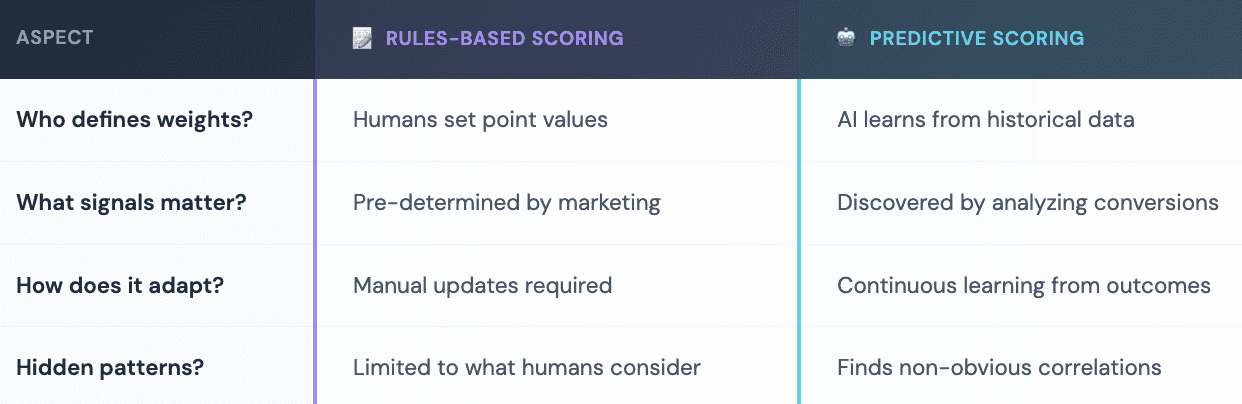
Predictive models analyze your closed-won deals to identify common characteristics and behaviors. They might discover patterns humans would never think to look for, like leads who visit a specific combination of pages, or companies that recently raised funding, or contacts who engage on Tuesday afternoons.
98% of sales teams using AI say it helps them prioritize leads better. The advantage comes from processing more data points, eliminating human bias, and continuously improving based on real outcomes.
The tradeoff is transparency. With rules-based scoring, you know exactly why a lead received their score. With predictive scoring, the model might weight factors you wouldn't expect, making it harder to explain decisions.
Many organizations use hybrid approaches: predictive models to discover patterns, rules-based systems to implement them with transparency.
AI Tools for Real-Time Lead Scoring
Modern platforms have made real-time scoring accessible without requiring a data science team. Here's how different categories of tools approach the problem:
CRM-Native Scoring
Platforms like Salesforce Einstein and HubSpot Predictive Scoring offer built-in capabilities. They analyze your existing CRM data to build scoring models that update automatically.
Pros:
No additional integration required
Learns from your specific conversion patterns
Scores visible directly in rep workflows
Cons:
Limited to data already in your CRM
May require substantial historical data to train
Less flexibility in scoring logic
Dedicated Scoring Platforms
Tools like MadKudu, Clearbit Reveal, and 6sense specialize in lead scoring and often incorporate third-party data signals.
Pros:
More sophisticated scoring models
Incorporate intent data and external signals
Often include real-time website visitor identification
Cons:
Additional tool in your stack
Integration complexity
Higher cost
Enrichment + Scoring Combinations
Platforms like Databar.ai combine data enrichment with scoring can fill firmographic gaps AND calculate scores in one workflow. When a lead enters your CRM, enrichment appends company data, and scoring calculates priority simultaneously.
Pros:
Solves the data completeness problem
Enables fit-based scoring even with minimal form data
Real-time from lead capture through prioritization
Cons:
May require workflow configuration
The right choice depends on your existing tech stack, data maturity, and how much customization you need.
Common Mistakes to Avoid
After seeing organizations implement real-time scoring, certain patterns lead to failure.
1. Scoring without action automation. If scores update in real-time but sales still checks the CRM once a day, you've gained nothing. The value of real-time scoring comes from real-time response. Connect scoring to immediate notifications and routing.
2. Over-weighting vanity signals. Email opens and social follows are easy to track but rarely indicate buying intent. Don't let high-frequency, low-intent signals inflate scores and waste sales attention.
3. Ignoring fit in favor of behavior. A lead from a two-person company visiting your enterprise pricing page five times is highly engaged but not a real opportunity. Fit criteria should gate whether behavioral scoring even matters.
4. Setting thresholds without data. Your MQL threshold shouldn't be a round number someone picked arbitrarily. Analyze historical conversions by score range to set thresholds that actually predict success.
5. Never updating the model. Markets change. Products evolve. Buyer behavior shifts. A scoring model built two years ago may be completely wrong today. Review performance quarterly and adjust.
6. Creating alert fatigue. If sales gets 50 "hot lead" notifications per day, they'll start ignoring them. Be selective about what triggers alerts, and make sure every alert represents a genuine priority.
FAQ
What is real-time lead scoring?
Real-time lead scoring is a methodology where lead scores update immediately as new data arrives, whether from website behavior, email engagement, enrichment, or other sources. Unlike traditional batch scoring that runs on a schedule, real-time scoring ensures that scores always reflect the lead's current situation and intent level.
What is predictive lead scoring?
Predictive lead scoring uses machine learning algorithms to analyze historical conversion data and automatically identify which attributes and behaviors predict success. Instead of humans manually assigning point values, the AI discovers patterns from past deals and applies them to score new leads. Predictive models can find non-obvious correlations that rule-based systems miss.
How does real-time scoring improve conversion rates?
Real-time scoring enables faster response times. When you can identify hot leads the moment they become hot, and alert sales immediately, you reach prospects while they're actively engaged. Research shows that responding within 5 minutes makes you 21 times more likely to qualify the lead compared to waiting 30 minutes.
What's the difference between dynamic and static lead scoring?
Static scoring assigns points once and doesn't change unless manually updated. Dynamic scoring continuously recalculates based on new data and time-based decay rules. Real-time scoring is a form of dynamic scoring that updates immediately rather than on a schedule.
Do I need AI for real-time lead scoring?
Not necessarily. Real-time scoring can work with rules-based systems that recalculate instantly without machine learning. However, AI-powered predictive scoring can improve accuracy by discovering patterns humans wouldn't identify. Many organizations start with rules-based real-time scoring and add predictive capabilities as they mature.
How do I measure if real-time scoring is working?
Track conversion rates by score range, compare response times before and after implementation, and monitor sales acceptance rates (are reps agreeing that high-scoring leads are actually qualified?). If higher scores correlate with higher conversion rates and faster response times, the system is working.
Related articles
See all