

Your sales team needs phone numbers. Not generic company switchboard numbers that ring to a receptionist. Direct dials and mobile numbers that actually connect to the person you want to reach. The difference between a 3% connect rate on switchboard numbers and a 20% connect rate on verified direct dials is the difference between a productive calling day and a wasted one.
The phone number lookup market has dozens of tools, and they vary wildly in accuracy, coverage, and pricing. Some charge per seat regardless of usage. Others charge per lookup. Some specialize in mobile numbers. Others are better for office direct dials.
Key takeaway: B2B phone number lookup tools vary widely on accuracy, coverage, pricing model, and direct dial rates. The right choice depends on your geography, volume, and budget. Waterfall enrichment across multiple providers typically outperforms any single source because no one provider covers every region or industry well.
What to Look for in a B2B Phone Lookup Tool
Before diving into specific tools, here is what matters when evaluating phone data providers.
Direct dial vs. switchboard ratio. A tool that returns 10,000 phone numbers sounds great until you discover 80% are company main lines. Ask specifically about direct dial and mobile number coverage rates for your target market.
Accuracy and freshness. Phone data ages. If a provider is serving data from a database that refreshes quarterly, you are going to hit a lot of disconnected numbers. Ask how often they refresh and what their stated accuracy rate is for direct dials.
Geographic coverage. US and UK phone data is relatively abundant. European, Asian, and Latin American markets have much lower coverage. If your target accounts are international, verify coverage for your specific regions before committing.
Pricing model. Per-seat pricing penalizes efficient teams. Per-lookup pricing rewards precise targeting. Credit-based models give you flexibility. Annual contracts lock you in before you know if the data quality meets your needs.
Integration depth. Phone numbers are only useful if they flow into your CRM and dialer. Check whether the tool integrates with your existing stack or if you'll be doing manual CSV exports.
How to Test Phone Data Quality: The Connect Rate Benchmark
Every provider claims high accuracy. Here's how to test it yourself before committing budget.
Pull 200 contacts from your existing CRM where you already have some verified phone numbers.
Run the same 200 contacts through 2-3 phone lookup tools you're evaluating.
Compare: How many numbers did each tool return? How many matched your known-good numbers? How many new numbers did each find?
Cold call the new numbers. Track connect rate (reached a human), wrong-number rate (wrong person or disconnected), and switchboard rate (reached a gatekeeper, not the prospect).
Calculate cost-per-connected-call: (Tool cost for 200 lookups) / (number of successful connections). This is the number that matters, not cost-per-lookup.
This test takes one afternoon and saves you from committing to a tool based on marketing claims. Cognism's human-verified Diamond Data numbers reportedly boost connection rates by 3x vs. standard database numbers, but at 3x the price. The cost-per-connected-call math tells you whether that premium is worth it for your specific segment.
7 Best Phone Number Lookup Tools for B2B Sales (2026)
1. Databar
Best for: Maximum coverage through multi-provider waterfall enrichment
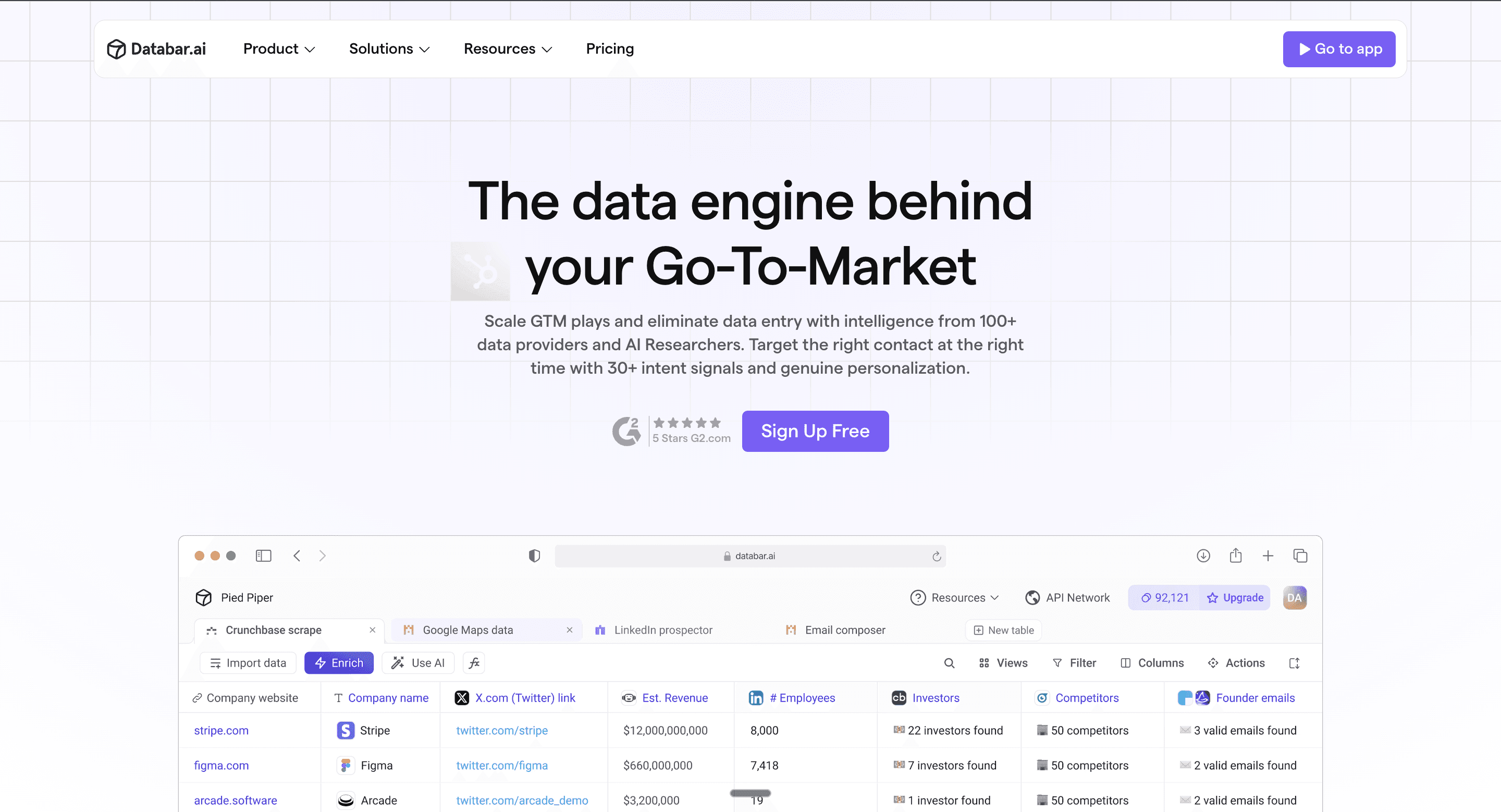
Databar isn't a single phone data provider. It is a platform that connects to 100+ data providers and runs waterfall enrichment across them. For phone number lookup, this means your query cascades through multiple phone data sources automatically until a verified number is found. The result is coverage rates that no single provider can match.
The waterfall enrichment approach is especially valuable for phone data because provider coverage is inconsistent. Provider A might have a mobile number for a prospect that Provider B misses entirely, and vice versa. Running a waterfall across 3-4 phone providers through Databar typically yields 60-85% coverage compared to 35-45% from any individual source.
Key features:
Waterfall across multiple phone data providers in one workflow
Credit-based pricing with no per-seat fees
API and no-code workflow builder
Built-in verification and line type detection
Exports to CRM, dialer, or custom integrations
Pricing: From $99/mo, only pay for successfully returned data
Pros: Highest coverage through multi-provider waterfall. No contracts or minimums. Access to 100+ providers through one platform. Transparent credit-based pricing.
Cons: Not a proprietary database, so results depend on underlying provider quality.
2. Lusha
Best for: Quick lookups with a browser extension
Lusha is a contact data platform with a strong Chrome extension that lets reps find phone numbers while browsing LinkedIn. The extension overlays contact data directly on the profile, making it fast for individual lookups. Lusha has invested heavily in direct dial accuracy for US contacts.
Key features:
Chrome extension for LinkedIn and web lookups
Direct dial and mobile number data
CRM integrations (Salesforce, HubSpot)
Team management and usage controls
Prospecting lists with filters
Pricing: Free (5 credits/mo), paid from $49/user/mo
Pros: Easy to use. Good Chrome extension. Decent accuracy for US direct dials. Free tier for light usage.
Cons: Per-seat pricing adds up fast with larger teams. Limited international phone coverage. Credits are restricted per plan.
3. ContactOut
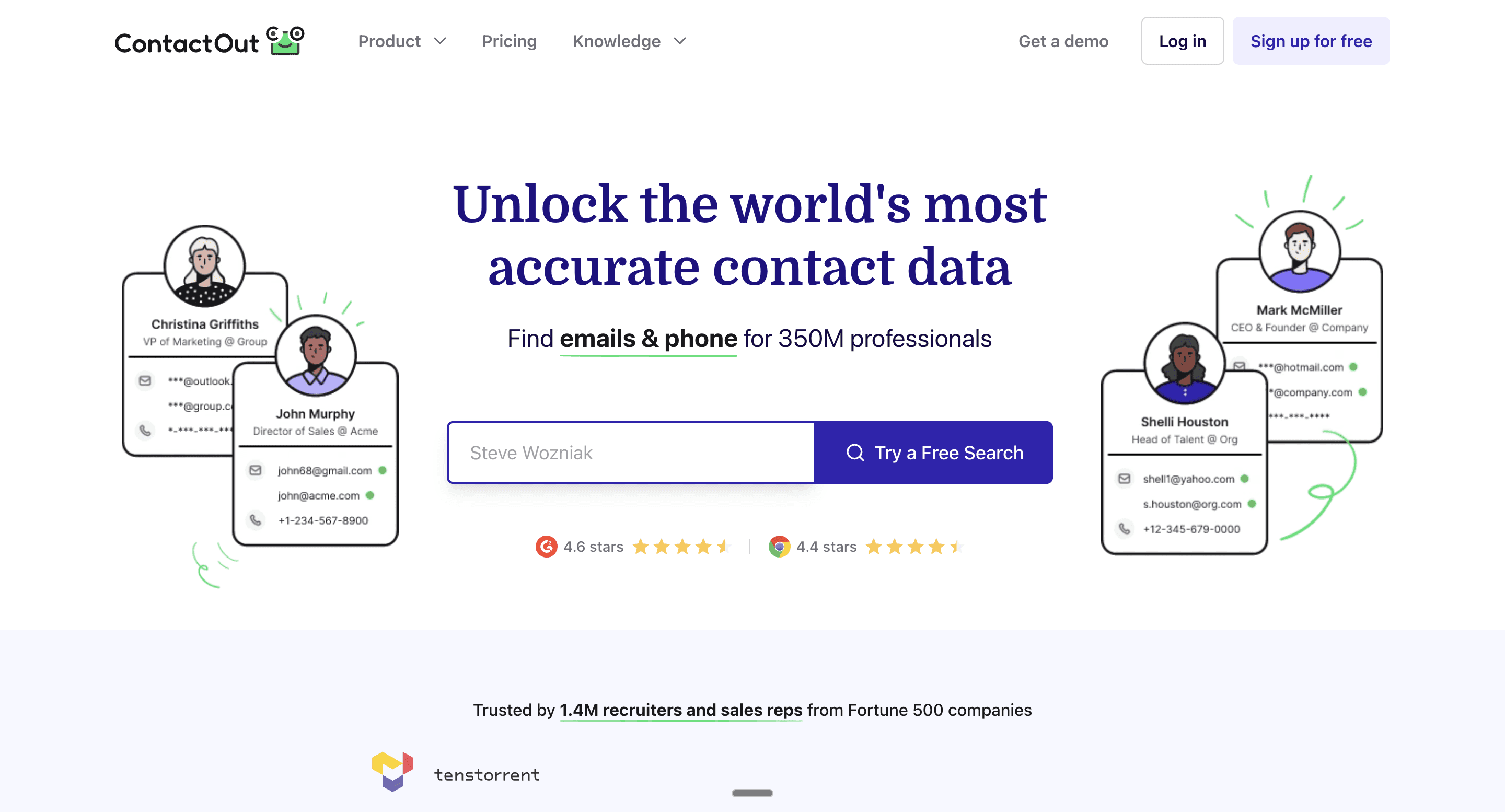
Best for: Finding personal emails and phone numbers for hard-to-reach prospects
ContactOut specializes in finding personal contact information that other providers miss. Originally built for recruiters, it has expanded into sales use cases. The platform is particularly strong at finding mobile numbers because of its data sourcing approach. Use reverse email lookup alongside ContactOut to build complete prospect profiles.
Key features:
Chrome extension for LinkedIn lookups
Personal and work email addresses
Mobile phone number data
Search portal for bulk lookups
API access on higher tiers
Pricing: From $79/mo
Pros: Strong mobile number coverage. Good at finding personal contact data. Solid LinkedIn integration.
Cons: Higher starting price. Accuracy varies outside US/UK. API only on premium plans.
4. Cognism
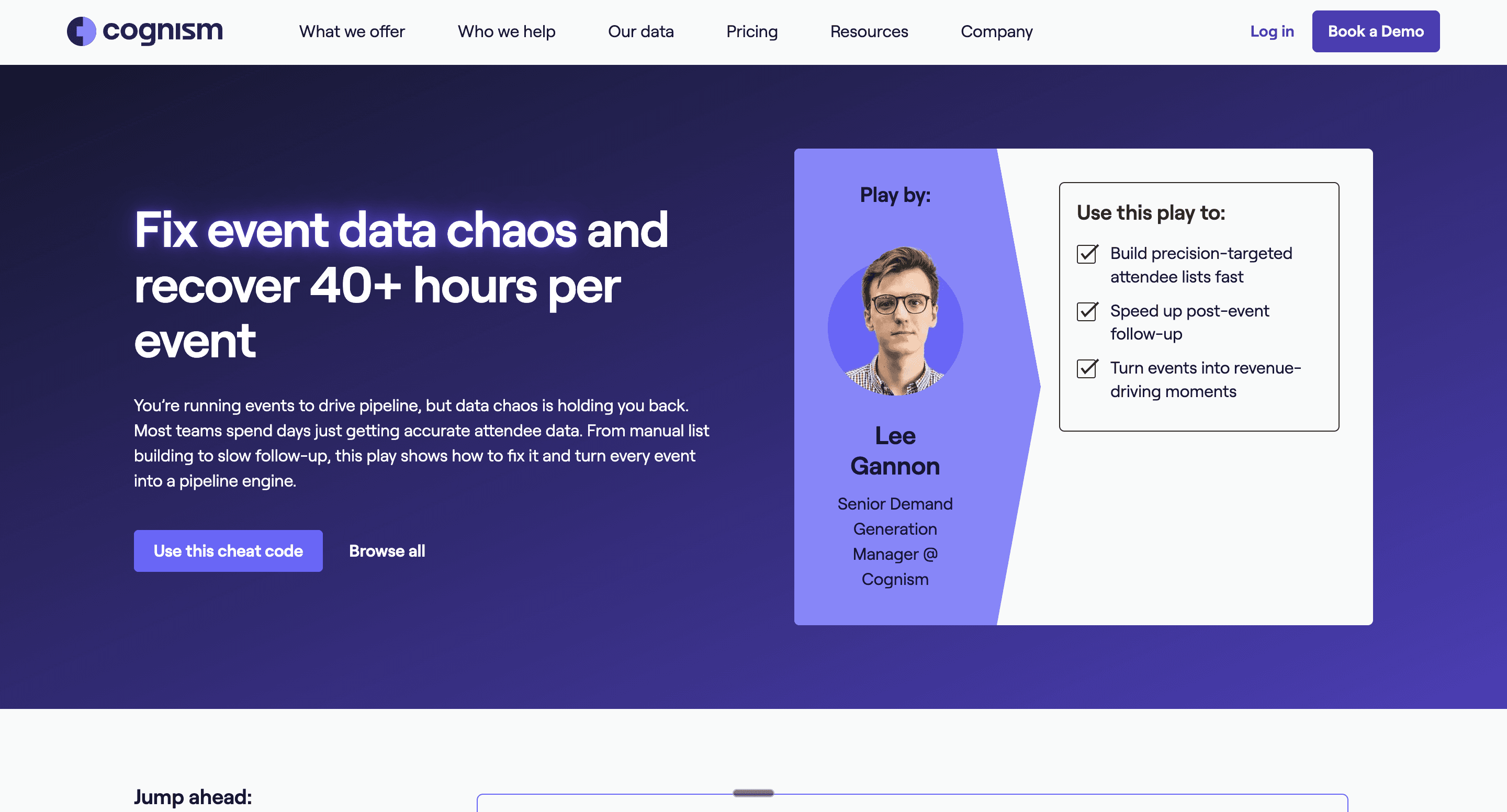
Best for: European mobile numbers with GDPR compliance built in
Cognism stands out for its Diamond Data offering: phone-verified mobile numbers for European prospects. If your target market includes DACH, UK, or Western Europe, Cognism's phone data coverage is among the best available. Their team manually verifies a subset of phone numbers, which improves accuracy.
Key features:
Diamond Data (phone-verified mobile numbers)
Strong EMEA coverage
Built-in GDPR and DNC compliance
Intent data integration (Bombora)
CRM and sales engagement integrations
Pricing: Custom pricing, typically starting around $15K/yr
Pros: Best-in-class European phone data. Phone-verified numbers are more accurate. Strong compliance infrastructure.
Cons: Expensive. Annual contract required. US coverage isn't as strong as European data. Enterprise pricing makes it inaccessible for smaller teams.
5. Apollo
Best for: Teams that need phone data bundled with a full prospecting platform
Apollo is a prospecting platform with a built-in database of over 200M contacts. Phone number coverage is included in the platform alongside email data, company information, and a built-in sequencer. For teams that want one tool for prospecting and outreach, Apollo covers a lot of ground. Check our roundup of B2B enrichment tools for how Apollo compares on data quality.
Key features:
Large contact database with phone numbers
Built-in email sequencer and dialer
Advanced search filters
Free tier with limited credits
CRM integrations and API
Pricing: Free (limited), paid from $49/user/mo
Pros: Generous free tier. All-in-one platform (data + outreach). Large database. Good for teams starting outbound.
Cons: Phone number accuracy can be inconsistent. Direct dial coverage is weaker than specialized phone data providers. Per-seat pricing at scale is expensive.
6. SignalHire
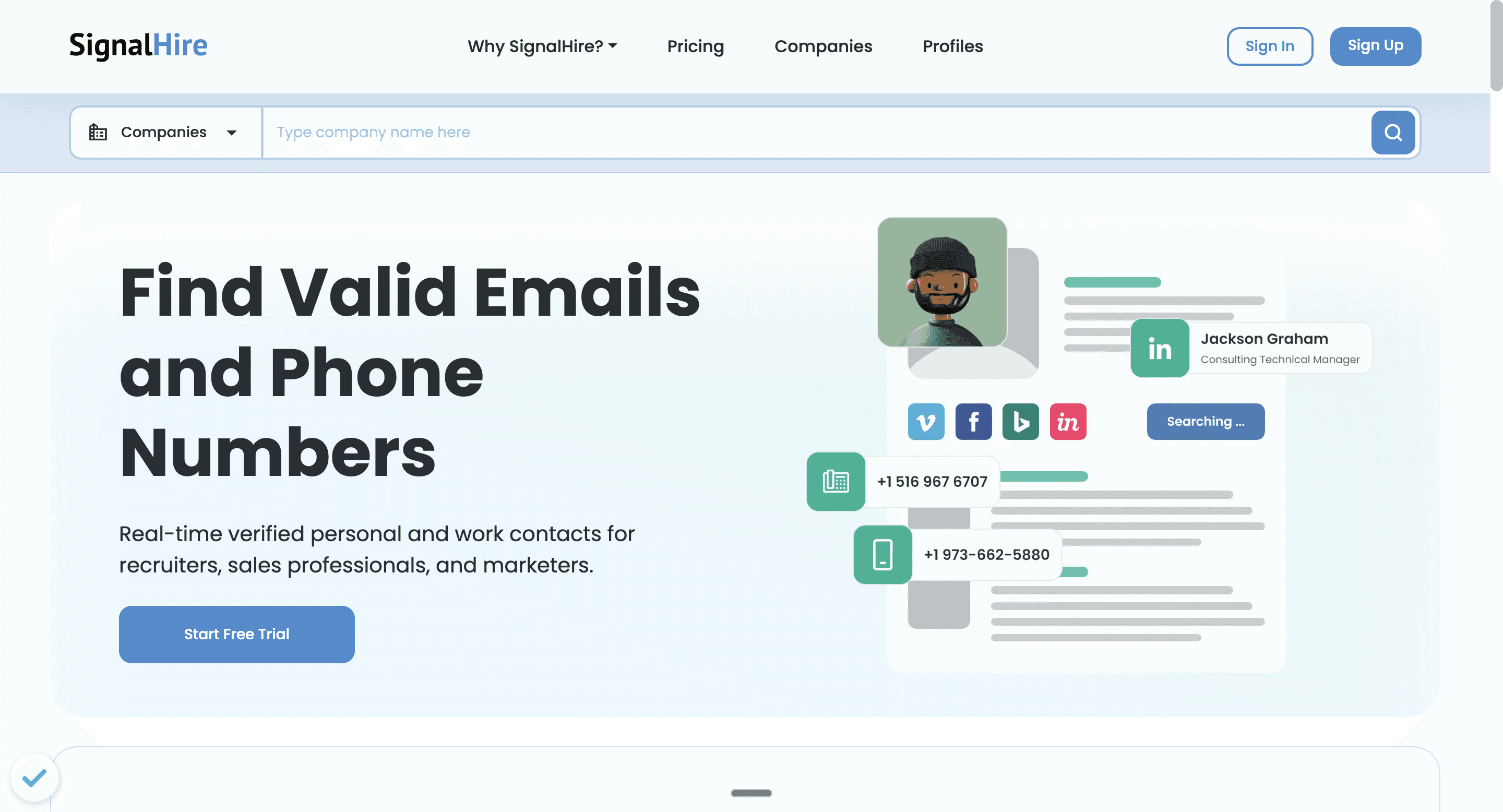
Best for: Affordable phone lookups with real-time verification
SignalHire pulls contact data from multiple sources and verifies numbers in real time. The platform focuses on accuracy over database size, which means fewer results but higher quality. Useful for teams that prioritize connect rates over list volume. For a broader comparison, see our guide on email finder alternatives.
Key features:
Real-time phone number verification
Chrome extension for LinkedIn
Bulk lookup capability
Multi-source data aggregation
Team collaboration features
Pricing: From $49/mo
Pros: Real-time verification improves accuracy. Reasonable pricing. Good for targeted lookups where quality matters more than volume.
Cons: Smaller database than larger competitors. Limited advanced filters. Bulk capabilities are basic compared to enterprise tools.
7. RocketReach
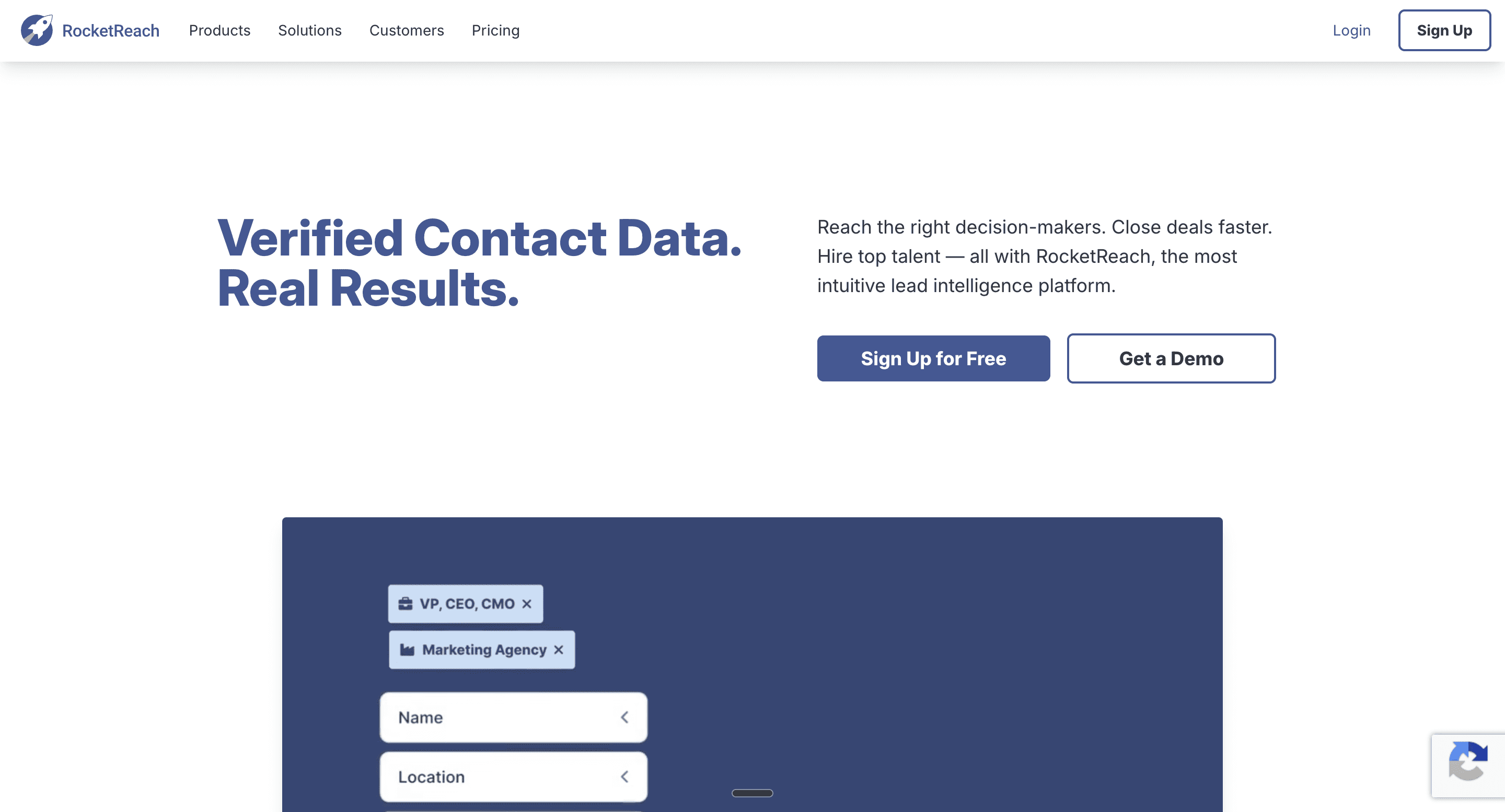
Best for: Broad lookup coverage across a large professional database
RocketReach offers phone and email lookup across a database of over 700M professionals. The platform is straightforward: search by name, company, or title, and get contact information including phone numbers. It is popular with teams that need broad coverage without complex workflows. For teams focused on building complete lead profiles, combining RocketReach with finding decision makers strategies improves results.
Key features:
Large professional contact database
Email and phone lookup in one search
Company search and org chart browsing
API access for bulk operations
Integrations with Salesforce, HubSpot, Outreach
Pricing: From $39/mo
Pros: Large database. Simple interface. Affordable entry point. Good API documentation.
Cons: Direct dial coverage varies by region. Stronger for email data than phone data. Results benefit from verification before dialing.
Head-to-Head Comparison
Tool | Best For | Phone Data Approach | Direct Dial Focus | Starting Price | Pricing Model |
|---|---|---|---|---|---|
Databar | Max coverage (waterfall) | Multi-provider waterfall | High (aggregated) | $99/mo | Credits, only pay for successfully returned data |
Lusha | Quick individual lookups | Proprietary database | Medium-High | $49/user/mo | Per-seat + credits |
ContactOut | Personal/mobile numbers | Multi-source aggregation | High (mobile focus) | $79/mo | Credits |
Cognism | European mobile numbers | Phone-verified database | Highest (Diamond Data) | ~$15K/yr | Annual contract |
Apollo | All-in-one platform | Proprietary database | Medium | $49/user/mo | Per-seat + credits |
SignalHire | Verified lookups | Real-time multi-source | Medium-High | $49/mo | Credits |
RocketReach | Broad coverage | Large static database | Medium | $39/mo | Credits |
How to Choose the Right Tool for Your Team
The best tool depends on your specific situation. Here is how to narrow it down.
If you need maximum coverage and target diverse segments: Databar's waterfall approach gives you the highest coverage because it pulls from multiple providers. If no single source has great coverage for your target market, waterfalling is the way to go.
If your target market is Europe: Cognism's Diamond Data is the leader for GDPR-compliant European mobile numbers. If you can afford the annual contract, the phone-verified data is worth the premium.
If you are just starting outbound and need an all-in-one tool: Apollo's free tier gives you phone data, email data, and a sequencer in one platform. The data quality isn't best-in-class, but the value for early-stage teams is hard to beat.
If you need mobile numbers specifically: ContactOut and SignalHire are strong for personal and mobile numbers. Both have approaches that surface data other providers miss.
If you have a large SDR team doing high-volume calling: Avoid per-seat pricing. Databar's credit model and RocketReach's credit plans are more cost-effective when you have 10+ reps needing data.
Getting More from Your Phone Data
Whichever tool you choose, a few practices will help you get more value from your phone numbers.
Verify before dialing. Run numbers through a verification service before loading into your dialer. Even the best providers have some stale data. Verifying saves your team from wasting time on disconnected numbers.
Prioritize mobile numbers. When your enrichment returns both a direct dial and a mobile number, route the mobile number to your dialer first. Mobile connect rates are higher than office direct dials.
Combine phone with email data. Phone and email work better together in a multi-channel sequence. A call after an opened email converts at a much higher rate than a cold call alone. Using waterfall enrichment for both email and phone through the same platform keeps your data unified.
Track and feed back. Log which numbers connect and which do not. Over time, this data tells you which providers give you the best results for your specific segments. Use that information to optimize your waterfall order.
Frequently Asked Questions
Which phone lookup tool has the most accurate direct dial data?
Cognism's Diamond Data has the highest stated accuracy for direct dials because they phone-verify a subset of numbers with human callers. For the broadest coverage (not just accuracy per number, but the most numbers found), Databar's waterfall approach wins by aggregating across multiple providers. Accuracy and coverage are different problems. The best setup uses high-coverage enrichment followed by verification.
How do I know if a returned phone number is a direct dial or a switchboard?
Some providers label the number type. If yours does not, run the number through a line type detection service before loading it into your dialer. Mobile numbers are easy to identify. The tricky distinction is between a direct desk line and a department or company main number. If your connect rates are low despite having "direct dials," audit a sample of 50 numbers manually.
Can I use one tool for both email and phone lookup?
Yes. Apollo, Lusha, ContactOut, SignalHire, and RocketReach all provide both email and phone data. Databar provides both through its waterfall across 100+ providers. The advantage of using one platform is unified data management. The disadvantage is that a tool strong in email data might be weaker in phone data, or vice versa. For phone-specific accuracy, a dedicated phone provider or waterfall approach usually outperforms bundled solutions.
What is the best way to test phone data quality before committing to a tool?
Take a list of 50-100 prospects where you already know some phone numbers are correct. Run them through the tool and compare results. Check what percentage of known numbers the tool returns correctly, how many new numbers it finds, and what percentage of those new numbers actually connect when dialed. This real-world test is more reliable than any stated accuracy rate from the vendor.
Also Interesting
Related articles
See all