
Here's a scenario every RevOps professional knows: you spend a week enriching your CRM with fresh firmographics, technographics, and contact details. Two months later, half that data is spread across duplicate records - some enriched, some not. Your "single source of truth" is now multiple sources of confusion.
Deduplication and enrichment aren't separate projects. They're two halves of a complete data quality workflow. Miss one, and the other falls apart.
Without Deduplication | Without Enrichment |
Enriched data splits across duplicates | Clean records with incomplete data |
Multiple versions of "truth" | Can't segment or personalize |
Wasted enrichment spend | Missed opportunities from blind spots |
Conflicting reports | Poor lead scoring accuracy |
Companies without data management initiatives commonly have 10-30% duplicate rates. Each duplicate costs an average of $96 to resolve. Meanwhile, organizations lose $15 million annually from poor data quality overall.
This article breaks down what each process does, why sequence matters, and how to build workflows that keep your CRM actually useful.

What Deduplication Does
Deduplication identifies and merges duplicate records in your CRM - contacts, companies, leads, deals. One record per entity, containing all relevant information.
Why duplicates exist in the first place: manual entry errors are the obvious culprit (typos, "Jon" vs. "Jonathan," inconsistent formatting). But that's just the start.
Multiple data imports without matching logic create duplicates in bulk. Web forms often create new records instead of updating existing ones. Integrations push records without checking if they already exist. And sales reps create records without searching first because, honestly, who has time when you're trying to close a deal?
More than 33% of company data is duplicated according to industry research. That's a third of your database potentially causing problems.
What duplicates cost you:
Sales reps waste 550 hours annually dealing with inaccurate CRM information. Up to 20% of annual revenue can disappear from duplicate-driven errors. CRM pricing tied to record count means you're paying for bloat.
But the real damage is operational. When the same customer exists in three records with different information, nobody knows what's true. Sales calls the wrong number. Marketing sends duplicate emails - nothing says "we don't know you" like the same promotion twice in one day. Customer success doesn't see the full history.
What Enrichment Does
Enrichment adds missing data to existing records: firmographics, technographics, contact details, intent signals. The goal: complete, accurate profiles that enable segmentation, scoring, and personalization.
What enrichment typically adds:
Firmographics cover company size, industry, revenue, location. Technographics reveal the tools in their tech stack. Contact details include direct phone numbers, verified emails, updated job titles. Intent signals indicate buying behavior. Some providers also pull social profiles and recent company news.
Why enrichment matters:
76% of organizations report that less than half their CRM data is accurate and complete. That's a staggering number given how much we rely on CRM data for decisions.
Incomplete records break lead scoring - your model can't score what it can't see. Personalization requires data you don't get from form fills alone. And data decays at 22.5% annually, so even good data goes stale without refreshing.
Without enrichment, you're making decisions with partial information. Your "best-fit" accounts might actually be poor fits. You just don't have the data to know.

The Key Difference
Here's the simplest way to think about it:
Deduplication works with data you already have. It cleans, consolidates, and removes redundancy. After deduplication, you might have fewer records - but each one is accurate and unique.
Enrichment brings in data you don't have. It adds external information to existing records. After enrichment, you have the same number of records - but each one is more complete.
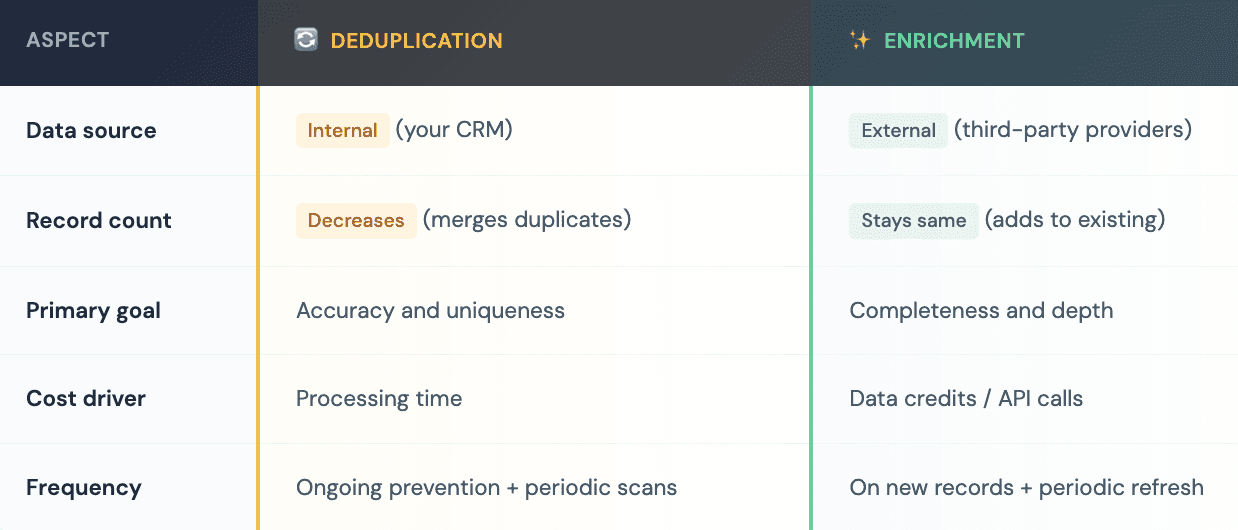
Both improve data quality. Neither replaces the other.
The Critical Sequence: Deduplicate First
Here's where most teams get it wrong: they enrich before deduplicating.
What happens when you enrich first:
You pay to enrich duplicate records separately, money wasted. Enriched data spreads across multiple records for the same entity. When you finally deduplicate, you have to decide which enriched data to keep. Some inevitably gets lost in the merge.
The correct sequence:
Step 1: Deduplicate → One clean record per entity
Step 2: Enrich → Add data to that single record
Step 3: Maintain → Prevent new duplicates, refresh enrichment
This isn't just about efficiency. It's about data integrity. Enrichment should happen against a known, unique record. Otherwise you're building completeness on a foundation of confusion.
The Exception
Some enrichment workflows include matching as part of the process. When you upload a list for enrichment, the provider matches against their database, which can identify duplicates implicitly.
In this case, you might enrich first, then deduplicate using the enriched fields (verified company domain, standardized names) for more accurate matching.
But even then - run basic deduplication before enrichment to avoid paying twice for the same record.
Building a Combined Workflow
A sustainable approach combines both processes into continuous operations, not one-time projects.
Initial Cleanup
Before ongoing processes, clean your existing database.
For deduplication: export and analyze your current duplicate rate, define matching rules (what constitutes a duplicate?), run bulk deduplication with manual review for edge cases. Document which data wins in merges - this prevents arguments later.
For enrichment: identify critical fields that are incomplete, prioritize by value (active opportunities first, then engaged leads, then cold database). Run batch enrichment against deduplicated records and validate before trusting it.
Prevention Layer
Cleaning is pointless if problems keep recurring.
Duplicate prevention: Enable real-time detection at point of entry. Require email or domain matching before creating new records. Set up integration rules that match before inserting. Block form submissions that match existing records, or better yet, update the existing record instead.
Enrichment automation: Trigger enrichment when new records are created so profiles start complete. Schedule periodic refresh for existing records. Set up alerts for decay indicators like bounced emails and job change signals.
Platforms like Databar can handle both workflows—running waterfall enrichment across 160+ providers while deduplicating against your existing records before pushing updates to your CRM.
Ongoing Maintenance
Weekly: Review duplicate alerts, check for failed enrichment jobs, monitor data entry quality by source.
Monthly: Run scheduled deduplication scans, refresh enrichment on high-priority segments, report on quality metrics.
Quarterly: Full database audit, evaluate enrichment provider accuracy, update matching rules based on patterns you're seeing.
Tools That Handle Both
The best solutions combine deduplication and enrichment in unified workflows rather than forcing separate tools.
What to look for:
Matching during enrichment means you can deduplicate and enrich simultaneously. Waterfall enrichment across multiple data sources maximizes coverage while deduplication logic prevents paying for the same record twice. Native CRM integrations with Salesforce, HubSpot, and other platforms reduce manual work.
Fuzzy matching capabilities catch variations like "Jon Smith" vs. "Jonathan Smith" that exact matching misses. Customizable rules let you define what "duplicate" means for your specific data. Master record selection logic determines what happens during merges automatically.
Platforms like Databar connect to 160+ data providers and can run enrichment workflows that check against existing records before creating new ones - solving both problems in a single pass.
Common Mistakes
Treating cleanup as one-time. Your database was clean Monday. By Friday, five duplicates exist from form fills and imports. Data quality requires ongoing process, not annual projects that get deprioritized until the problem becomes unbearable.
Over-enriching. More fields don't automatically mean better data. Focus on fields that drive action - scoring inputs, segmentation criteria, personalization variables. Every field you add is another field that can decay and another field someone has to maintain.
Ignoring integration hygiene. Your CRM connects to marketing automation, sales engagement, support tickets, and probably a dozen other tools. Each integration can create duplicates if misconfigured. Audit integration logic regularly or duplicates will keep appearing from sources you forgot existed.
Skipping validation. Enrichment providers aren't perfect. Sample-check enriched data against known sources. If accuracy drops below acceptable levels, switch providers or add verification steps. Trusting blindly is how you end up with confidently wrong data.
No clear ownership. Without someone responsible for data quality, not as a side project, but as actual job responsibility, entropy wins. Define who owns deduplication rules, who monitors enrichment accuracy, who investigates when metrics slip.
FAQ
Should I deduplicate before or after enrichment?
Deduplicate first in almost all cases. Enriching duplicates means paying twice for the same entity and spreading enriched data across multiple records. When you eventually merge, some enriched data gets lost. The exception: if enrichment adds fields that improve matching (verified email, standardized company name), you might enrich first, then use those fields for more accurate deduplication.
How often should I run deduplication?
Combine real-time prevention with scheduled scans. Enable duplicate detection at point of entry so new duplicates get caught immediately. Run weekly scans to catch what slips through, monthly full-database audits for deeper analysis. High-volume databases may need daily scans.
What's a realistic target for duplicate rate?
Industry benchmark is 1%, achieved by about 22% of organizations. World-class performers maintain rates as low as 0.14%. If you're currently at 10-30% (common without data quality programs), target under 5% within 90 days, then under 1% within six months.
Can one tool handle both deduplication and enrichment?
Yes. Several platforms like Databar.ai combine both capabilities with matching logic built into enrichment workflows. They identify duplicates during enrichment and update the single correct record. More efficient than running separate tools sequentially, though you trade some flexibility.
What fields are most important to keep complete?
Focus on fields that drive action: email for outreach, company domain for matching, job title for segmentation, company size and industry for scoring, plus any custom fields used in routing or scoring models. Don't try to complete everything - prioritize what influences decisions.
How do I prioritize which records to enrich first?
Start closest to revenue. Active opportunities first, then engaged leads, then accounts in target segments. Enriching cold database records that haven't engaged in two years delivers less immediate ROI than completing profiles of prospects in active deal cycles.
Related articles
See all