
A sales rep gets a new lead: "Sarah Johnson, sarah@acme.com." That's it. No phone number, no job title, no company size, no idea if Acme is a 10-person startup or a 10,000-person enterprise.
Without more context, that rep is flying blind. Should they prioritize this lead or work other opportunities? Is this person a decision-maker or an intern doing research? Does the company even fit the ICP?
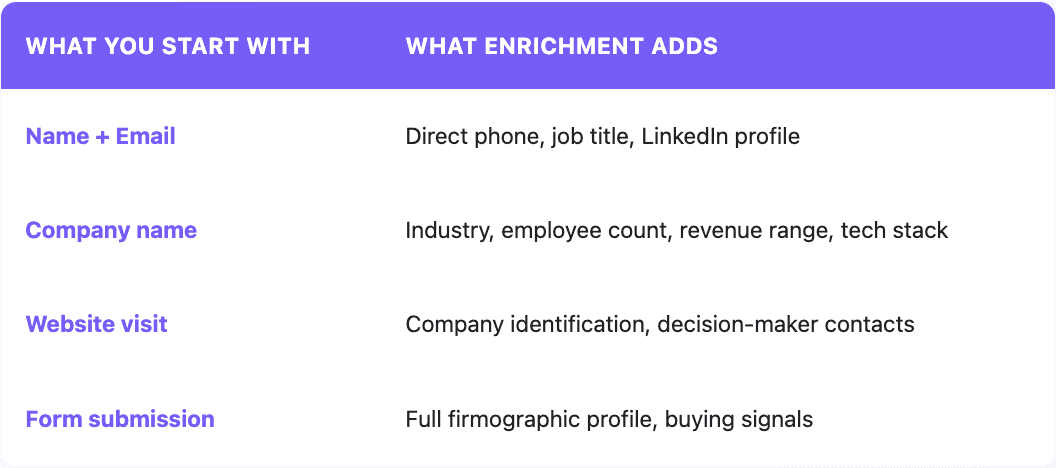
Contact data enrichment solves this problem by automatically adding the missing pieces. Within seconds, that bare-bones lead becomes a complete profile: Sarah Johnson, VP of Marketing at Acme Corp, a 500-person SaaS company in the healthcare vertical, using HubSpot, with $50M in annual revenue.
Now the rep knows exactly how to prioritize and personalize their outreach. That's the difference enrichment makes.

What Is Contact Data Enrichment?
Contact data enrichment is the process of enhancing existing records in your CRM or database by adding information from external sources. You start with basic details, typically just a name and email, and enrichment fills in everything else: phone numbers, job titles, company information, social profiles, and more.
The process works by matching your existing records against large databases of business information. When a match is found, the missing fields get populated automatically. Modern enrichment happens in real-time (as new leads enter your system) or in batch (cleaning up existing records).
Think of it as the difference between a sketch and a photograph. Basic lead data gives you an outline. Enriched contact data gives you the complete picture, enough detail to make informed decisions about how to engage.
The B2B data enrichment market reflects how essential this has become: it's projected to grow from $5 billion in 2025 to approximately $15 billion by 2033, a 15% compound annual growth rate. Companies aren't just adopting enrichment, they're making it core infrastructure.
Why Companies Need Contact Data Enrichment
The business case is straightforward: incomplete data wastes time, breaks automation, and costs deals.
Sales Productivity
Research shows each sales rep loses approximately 550 hours and $32,000 annually due to bad or incomplete data. That's time spent manually researching prospects, hunting for phone numbers, or chasing leads that were never a good fit.
With enriched data, reps spend less time researching and more time selling. When a lead comes in with complete firmographic and contact information already attached, qualification happens immediately. The rep knows within seconds whether this is worth pursuing.
Lead Scoring Accuracy
Lead scoring models are only as good as the data feeding them. If half your leads are missing company size, industry, or job title, your scoring is essentially guessing.
Full contact data enrichment enables precise scoring. You can weight leads based on actual firmographics (company size matches ICP), actual seniority (decision-maker vs. researcher), and actual tech stack (uses complementary tools). Demandbase research found that B2B companies enriching their firmographic data see a 12% increase in conversion rates.
Personalization at Scale
Generic outreach doesn't work. But personalizing manually doesn't scale. Enrichment bridges the gap by providing the context needed to personalize automatically.
When you know a prospect's industry, company size, tech stack, and role, you can segment dynamically and tailor messaging at scale. An email to a VP of Sales at a 500-person company can reference different pain points than one to a Marketing Manager at a 50-person startup, all without manual research.
Routing and Assignment
How do you route leads accurately if you don't know the company size or location? With enriched data, leads automatically flow to the right rep, the right sequence, and the right priority level. Territory assignment becomes accurate. Round-robin gets smarter.
Common Use Cases for Enriching CRM Contact Data
Enrichment applies across the entire customer lifecycle. Here's where it creates the most impact:
Inbound Lead Enrichment
A form submission typically captures minimal information, name, email, maybe company. Enriching CRM contact data in real-time adds everything else before the lead even hits the sales queue.
The result: leads arrive qualified and prioritized. Reps don't waste time researching or calling low-fit prospects. Marketing can segment immediately for nurturing campaigns.
Outbound Prospecting
Building target account lists requires more than just company names. Enrichment identifies the right contacts at target accounts, finding new contacts at existing companies, uncovering org structures, and providing verified direct dials.
This is particularly powerful for ABM data enrichment programs, where complete contact coverage across target accounts directly impacts campaign success.
Database Cleanup
Historical CRM data decays fast. B2B contact data degrades at approximately 22-30% per year as people change jobs, companies merge, and phone numbers disconnect. Enrichment refreshes stale records, fills gaps in incomplete ones, and flags data that's gone bad.
Event and Webinar Follow-Up
Event leads often come with minimal data - just what someone scribbled on a badge scanner. Enrichment transforms a name and email into a complete profile, enabling proper prioritization and personalized follow-up.
Customer Expansion
Enrichment isn't just for prospects. Identifying new contacts at existing companies supports expansion selling. When your champion gets promoted or leaves, enrichment helps find their replacement. When you want to multi-thread into other departments, enrichment surfaces those contacts.
Types of Data Enrichment
Not all enrichment is the same. Different data types serve different purposes.
Contact Enrichment
This adds information about individual people: direct phone numbers, mobile numbers, email addresses, job titles, seniority levels, LinkedIn profiles, and professional history.
Contact enrichment is essential for sales outreach - you can't call someone without a phone number or personalize without knowing their role.
Company Data Enrichment
Company data enrichment adds firmographic details about organizations: industry, employee count, revenue, headquarters location, funding status, and business model.
This data powers lead scoring, segmentation, and ICP matching. Knowing that a company has 200 employees and $30M in revenue tells you far more than just knowing their name.
Firmographic Enrichment
Firmographics go deeper into company attributes: parent/subsidiary relationships, company hierarchy structures, technology stack, growth signals, and buying intent.
Enriched contact data with company hierarchy segmentation enables sophisticated account-based strategies, identifying all locations of a global company, understanding reporting structures, and mapping out buying committees.
Technographic Enrichment
This reveals what technologies a company uses, their CRM, marketing automation, cloud providers, dev tools, and more.
Technographics power competitive displacement campaigns and integration-based positioning. If you know a prospect uses a competitor's tool, your messaging can address switching. If they use complementary tools, you can lead with integration.
AI-Powered Custom Enrichment
Here's where things get interesting. Traditional enrichment pulls from fixed databases with predetermined fields. But what if you need something specific that no standard provider offers?
AI agents can extract virtually any data point from publicly accessible websites. Need to know if a company has a careers page with open sales roles? Whether their pricing page shows enterprise plans? What their latest press release announced? An AI agent can visit the website, find that information, and add it to your CRM record.
This opens up enrichment use cases that weren't possible before:
Custom qualification signals: Check if prospects have specific pages, features, or content that indicate fit
Competitive intelligence: Identify which competitors a prospect lists as integrations or partners
Hiring signals: Detect job postings that indicate growth or specific team investments
Product fit indicators: Verify that a company has the prerequisites your product requires
The difference from traditional enrichment: you're not limited to whatever fields a data provider decided to collect. You define what matters for your business, and AI agents go find it.

How to Enrich CRM Data with Accurate Contact Information
Getting started with enrichment requires choosing the right approach for your situation.
Real-Time vs. Batch Enrichment
Real-time enrichment processes records as they enter your CRM. A form submission triggers immediate enrichment before the lead hits the sales queue. This approach is ideal for high-velocity inbound motion where speed matters.
Batch enrichment processes records in bulk on a schedule - daily, weekly, or as needed. This works well for database cleanup projects and ongoing maintenance of existing records.
Most mature operations use both: real-time for new records, batch for maintaining the existing database.
Single Provider vs. Waterfall Enrichment
No single data provider has complete coverage. Each has gaps, certain industries, company sizes, or regions where their data is thin.
Waterfall enrichment addresses this by querying multiple providers in sequence. If Provider A doesn't have a phone number, the system automatically checks Provider B, then Provider C. This approach typically achieves 80%+ match rates compared to 50% from single providers.
CRM Integration
Enrichment only works if it flows into your existing workflows. The best enrichment tools integrate directly with Salesforce, HubSpot, or whatever CRM you use, updating records automatically without manual data entry.
Look for native integrations, real-time sync capabilities, and support for your specific CRM's data model and custom fields.
GDPR Compliance and Contact Data Enrichment
GDPR compliance for contact and company data enrichment is non-negotiable for any company doing business with EU residents.
The short version: B2B contact enrichment is generally permissible under GDPR's "legitimate interest" basis, but with conditions.
Key Requirements
Lawful basis for processing. For B2B outreach, legitimate interest typically applies - you have a reasonable business reason to contact someone in their professional capacity. But the individual's rights can override your interest if your use is unexpected or intrusive.
Data source transparency. You need to know where your enrichment data comes from. Reputable providers obtain data legally, maintain transparency with data subjects, and honor opt-out requests.
Right to access and deletion. Individuals can request to see what data you hold and ask for deletion. Your systems need to support these requests.
Data processing agreements. When using third-party enrichment providers, you need proper contracts in place that define data handling responsibilities.
Getting Started: A Contact Data Enrichment Checklist
Ready to implement? Here's a practical starting point.
Step 1: Assess Current State
Audit your CRM for data completeness: What percentage of contacts have phone numbers? Job titles? Company information?
Identify your highest-impact gaps: Which missing fields hurt sales productivity or lead scoring most?
Document current data sources: Where does your data come from today?
Step 2: Define Requirements
Determine which data fields you need enriched (contact info, firmographics, technographics)
Decide on real-time vs. batch enrichment based on your workflow
List your required integrations (CRM, marketing automation, etc.)
Establish compliance requirements for your target markets
Step 3: Evaluate Providers
Compare coverage for your target market and segments
Test match rates with a sample of your data
Evaluate data accuracy (not just coverage—is the data correct?)
Review compliance certifications and data sourcing practices
Compare pricing models (per-record, subscription, credits)
Step 4: Implement and Measure
Start with a pilot: enrich a subset of records and measure impact
Track improvement in field completion rates
Monitor downstream metrics: lead scoring accuracy, sales productivity, conversion rates
Scale based on results
What's Next
Contact data enrichment transforms how sales and marketing teams work. Instead of wasting time on manual research and chasing incomplete leads, teams get the context they need to prioritize, personalize, and close.
The companies doing this well aren't just more efficient, they're more effective. Better data means better decisions, and better decisions compound into better results.
Start with an honest assessment of your current data gaps. Identify where incomplete information is costing you time or deals. Then build a systematic approach to filling those gaps, real-time for new records, batch for existing data, and ongoing refresh to prevent decay.
The ROI math on enrichment is usually straightforward: if reps save even a few hours per week on research, or if conversion rates improve by 10-15%, the investment pays for itself quickly. The only question is how much opportunity you're leaving on the table while you wait.
FAQ
What is contact data enrichment? Contact data enrichment is the process of enhancing existing CRM records by adding information from external data sources. Starting with basic details like name and email, enrichment automatically adds phone numbers, job titles, company information, social profiles, and other relevant data points that help sales and marketing teams work more effectively.
What's the difference between data enrichment and data cleaning? Data cleaning corrects errors in existing data, fixing typos, removing duplicates, updating outdated information. Data enrichment adds new information that wasn't there before, appending phone numbers, company size, or industry to records that were missing those fields. Both are important, and enrichment often works alongside cleaning.
How does contact data enrichment improve sales productivity? Sales reps waste approximately 550 hours annually on bad or incomplete data, researching prospects manually, hunting for phone numbers, and chasing poor-fit leads. Enrichment eliminates this overhead by providing complete profiles upfront, enabling reps to focus on actual selling rather than data gathering.
Is B2B contact data enrichment GDPR compliant? B2B contact enrichment can be GDPR compliant when done properly. Most B2B use cases fall under "legitimate interest" as a legal basis for processing. However, companies must work with compliant data providers, maintain data source transparency, honor opt-out requests, and have proper data processing agreements in place.
What types of data can be enriched? Common enrichment data includes contact information (phone, email, job title, LinkedIn), firmographic data (company size, industry, revenue, location), technographic data (technology stack, tools used), and intent data (buying signals, research behavior). The specific data needed depends on your sales and marketing use cases.
What is AI-powered custom enrichment? AI-powered enrichment uses AI agents to extract specific data points from publicly accessible websites, information that traditional database providers don't offer. This includes custom signals like whether a company has specific web pages, job postings, pricing tiers, or other indicators relevant to your qualification criteria. It's useful when standard firmographic data isn't enough for your specific use case.
Related articles
See all