

Account-based marketing sounds straightforward on paper. Pick your best-fit accounts, personalize everything, watch deals close faster.
In practice? It falls apart at the data layer.
You build a target account list, but half the records are missing key contacts. You identify decision-makers, but their titles are from two jobs ago. You want to run personalized campaigns, but you don't actually know what technology they use, what initiatives they're funding, or whether they're even in-market right now.
This is where ABM data enrichment comes in. It's the process of filling your target accounts with the firmographic, technographic, contact, and intent data that makes account-based strategies actually work. Without it, you're just running expensive campaigns at companies you don't really understand.
This guide covers what ABM enrichment includes, why it matters more than most teams realize, how to build it into your operations, and where it fits in your broader account-based marketing strategy.
What ABM Data Enrichment Means
ABM data enrichment enhances your target account records with data points that enable better targeting, personalization, and prioritization. Standard enrichment fills in missing fields. ABM enrichment is more strategic - it adds the specific dimensions that account-based programs need to function.
Here's what that looks like in practice:
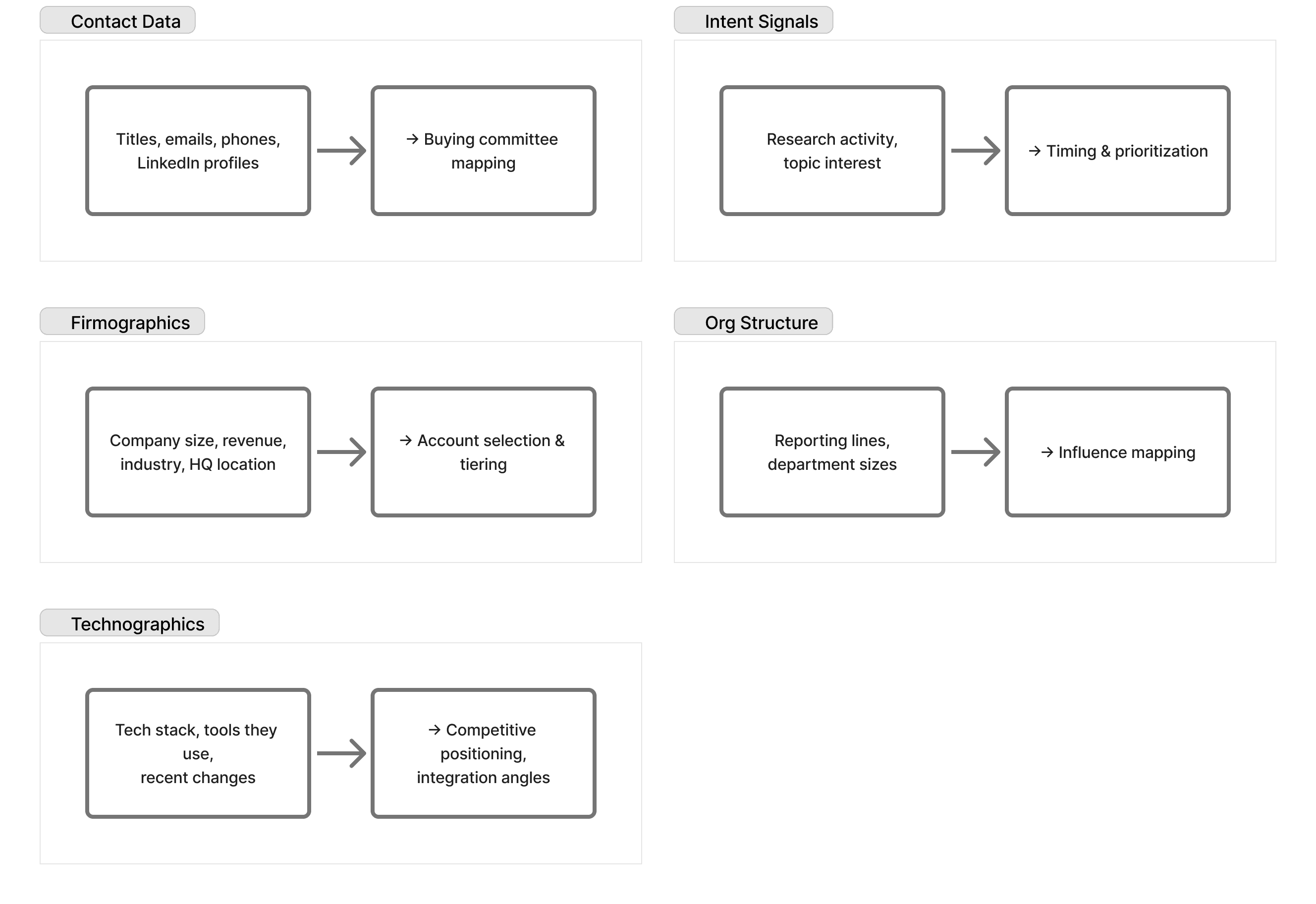
The difference between regular lead enrichment and ABM enrichment? Scope. Lead enrichment fills in individual contacts. ABM enrichment builds complete account profiles - the company, its context, everyone involved in buying, and signals about what they're doing right now.
Why Enrichment Is the Foundation (Not a Nice-to-Have)
ABM only works when you know enough about each account to treat it like its own market. Without enrichment, you're guessing. And guessing at scale gets expensive fast.
Account Selection Falls Apart Without Good Data
Your target account list is only as good as the data behind it.
Most ABM programs start with basic criteria: industry, company size, geography. That's table stakes. The programs that actually work layer in additional signals: Do they use technology that complements yours? Are they on a competitor's platform? Have they raised funding recently? Are they actively hiring for roles your product supports?
Enriched data lets you tier accounts properly. Instead of treating everyone the same, you can distinguish between:
Tier 1 - High ICP fit plus active intent signals. These get your most personalized, resource-intensive campaigns.
Tier 2 - Strong fit but moderate intent. Worth pursuing, but with lighter-touch tactics.
Tier 3 - Fits the profile but no current buying signals. Keep them warm, don't burn budget on heavy personalization.
Without enrichment, you're either treating every account identically (wasteful) or guessing at tiers (inaccurate). Neither works.
You Can't Engage a Buying Committee You Haven't Mapped
B2B purchases involve a lot of people. The research says 6-10 on average, sometimes more for enterprise deals. If you're only engaging one contact per account, you're missing most of the people who influence the decision.
Enrichment shows you who else matters:
Decision-makers with budget authority, your C-suite and VP-level contacts. Influencers who evaluate options and make recommendations, directors and senior managers.
Champions inside the account who want your solution to win. And blockers who might resist change or prefer a competitor.
Knowing the full committee with verified contact data means you can run coordinated outreach across roles. You're not betting everything on one relationship that might go nowhere.
Personalization Without Data Is Just... Guessing
Generic ABM isn't really ABM. The whole point is relevance at the account level.
But here's the problem: you can't personalize without data. Enrichment gives you the raw material.
With enriched accounts, you can reference their specific industry challenges. You can position against whatever technology they're currently using. You can tailor messaging by role - different value props for the CFO than for the end users. You can mention recent news, funding rounds, or leadership changes that make your outreach feel timely and relevant.
Without enrichment, personalization becomes a manual research project for every single account. That doesn't scale.
Timing Is Everything (Intent Data Tells You When)
Not every target account is ready to buy today. Some won't be ready for months. Others are actively researching right now and you're missing the window.
Intent data, a key enrichment dimension, tells you who's in-market.
The signals that matter: researching topics related to your solution, visiting competitor websites, consuming bottom-funnel content like pricing comparisons and buying guides, multiple stakeholders from the same company all engaging at once.
When you layer intent onto your target account list, you know where to focus. High-intent accounts get immediate, personalized attention. Low-intent accounts stay in nurture until something changes.
The Four Layers of ABM Enrichment
Solid ABM enrichment combines multiple data types into complete account profiles. Think of it as building up layers.
Layer 1: Firmographic Foundation
Firmographics are your baseline - company-level attributes that determine basic fit.
You're looking at employee count and revenue range. Industry and sub-verticals. Where they're headquartered and where they have offices. Company structure (is this a subsidiary? part of a larger enterprise?). Growth stage, are they a scrappy startup or a mature enterprise?
This data drives your initial account selection and segmentation. Most CRMs capture basic firmographics, but accuracy decays fast. Companies get acquired, change focus, grow or shrink. Regular re-enrichment keeps this current.
Layer 2: Technographic Intelligence
Technographics show what technology an account actually uses. This matters more than most teams realize.
If they're on a competitor's platform, that's a displacement opportunity, but you need to position differently than you would for a greenfield account. If they use tools that integrate with yours, that's an easy angle. If they're running legacy systems, you might be selling digital transformation. If they've recently adopted modern tools, they might be more receptive to new solutions.
Common technographic data points include CRM platform, marketing automation, sales engagement tools, analytics stack, security solutions, and cloud infrastructure. The specific technologies you care about depend on what you sell and how it fits into their stack.
Layer 3: Contact and Buying Committee Data
Account-level data tells you which companies to target. Contact data tells you who to actually engage.
For ABM, you need more than names and email addresses. Job title and function matter—is this person in a role that cares about what you sell? Seniority level determines whether they can approve purchases or just influence them. Department tells you their perspective and priorities. Direct contact info (work email, direct dial, mobile) lets you actually reach them. LinkedIn profiles enable social selling and research.
The goal is mapping the entire buying committee, everyone involved in purchase decisions, with the contact data you need to reach them.
Layer 4: Intent and Behavioral Signals
Intent data adds timing to your ABM strategy. It tells you which accounts are actively researching, not just which ones fit your ICP.
First-party intent comes from engagement with your own properties. Website visits (especially high-intent pages like pricing), content downloads, email engagement, event attendance. This tells you who's paying attention to you specifically.
Third-party intent tracks activity across the broader web. Topic research on publisher sites, competitor website visits, review site activity, search behavior around your category. This surfaces accounts that are in-market even if they haven't engaged with you yet.
Combining both gives you the fullest picture of who's ready to engage right now.
Building Your ABM Enrichment Workflow
Enrichment isn't a one-time project. It's an ongoing process that keeps target account data fresh and actionable.
Define What Data You Actually Need
Start by figuring out which data points matter for your specific ABM program.
Must-haves: Data required for account selection and outreach. Company size range, industry, at least one decision-maker contact with verified email—probably 2-3 additional buying committee members.
High-value additions: Data that meaningfully improves targeting. Relevant technologies in their stack, recent funding or growth signals, intent indicators, basic org structure.
Nice-to-haves: Useful for advanced personalization but not critical. Recent news mentions, leadership changes, office expansion, social activity.
Document these requirements before you start evaluating enrichment sources. Different providers excel at different data types.
Set Up Enrichment Triggers
Define when enrichment should fire:
On account creation: New accounts hitting your target list should get enriched immediately with firmographics, technographics, and initial contact mapping.
On contact creation: New contacts need title validation, verified contact info, and seniority classification.
On engagement: When an account engages (visits your site, opens emails, requests a demo), trigger additional enrichment to prepare for sales conversations.
On schedule: Existing accounts need periodic refresh. Every 60-90 days catches job changes, company growth, and technology shifts that you'd otherwise miss.
Choose Your Enrichment Approach
You have options here, and the right choice depends on your resources and requirements.
Single provider: Pick one comprehensive platform that covers most data types. Simpler to manage, but you'll have coverage gaps - especially for international accounts or smaller companies.
Best-of-breed: Combine specialized providers for each data type. Better coverage, but more complex to orchestrate and maintain.
Aggregation platform: Use platforms like Databar that connects to 160+ data providers and handles the orchestration for you. You configure your enrichment workflow once, the platform manages waterfall logic across providers, normalizes the data, and returns complete profiles. You get multi-provider coverage without building and maintaining a dozen different integrations.
For ABM specifically, the aggregation approach makes sense because you need multiple data types from multiple sources. Firmographics from one provider, technographics from another, intent from a third. Coordinating that manually is painful.
Sync to Your Systems
Enriched data needs to flow into wherever your team actually works.
CRM records should update with enriched fields. Marketing automation needs the data for segmentation and personalization. Sales engagement tools should surface enriched context. ABM platforms need it for account scoring and prioritization.
Build bidirectional sync where you can. When reps manually correct a title or add a contact, those updates should be preserved, not overwritten by the next enrichment cycle.
Measure and Improve
Track enrichment quality over time:
Coverage rate; What percentage of target accounts have each enriched field populated?
Accuracy rate: When people verify the data, how often is it actually correct?
Decay rate: How quickly does data go stale?
Provider performance: Which sources are delivering the best value?
Use these metrics to refine your enrichment mix and catch quality issues before they torpedo your campaigns.
Putting It to Work: ABM Enrichment Use Cases
Here's how enriched data drives specific ABM activities.
Building Your Target Account List
Start with basic ICP criteria (industry, size, geography). Then layer in enriched data to refine:
Pull an initial list matching firmographic criteria. Enrich with technographics to filter for tech stack fit. Overlay intent data to identify who's actually in-market. Score and tier accounts based on combined signals. Validate and finalize your list.
What started as "companies that look like our customers" becomes "companies that fit our ICP, use complementary technology, and are actively researching solutions like ours."
Multi-Threaded Outreach
You've identified a high-priority account showing strong intent. Now you need to engage the buying committee, not just one person.
Enrich the account to identify all relevant contacts by role. Gather verified contact data for each. Map the org structure to understand who reports to whom and who influences whom. Create role-specific messaging, the CFO cares about different things than the end users. Launch coordinated outreach across the committee.
Competitive Displacement
You're going after accounts currently using a competitor.
Use technographic enrichment to identify competitive installs. Filter for accounts where contracts might be coming up for renewal. Layer intent data to find those actively researching alternatives. Prioritize accounts showing both competitive install AND active research interest. Deploy comparison content to the decision-makers you've identified.
Expanding Within Existing Customers
ABM isn't just for new logos. Enrichment helps you grow within accounts you've already won.
Enrich customer accounts to identify additional business units or departments. Map decision-makers in adjacent teams who might have their own budgets. Use technographic enrichment to spot technology gaps you could fill. Monitor intent signals for new use cases or emerging needs. Launch expansion campaigns targeting these new stakeholders.
What Works: Best Practices
Get your data governance sorted first. Define field standards, ownership rules, and update policies before you start enriching. Otherwise you'll create a mess that's worse than what you started with.
Don't enrich for the sake of it. More fields isn't automatically better. Focus on data your team will actually use for segmentation, personalization, and prioritization. The rest is noise.
Keep humans in the loop. Automated enrichment is powerful but imperfect. Build in checkpoints where humans validate critical data before it drives expensive campaigns.
Re-enrich regularly. Data decays faster than you'd think. Job changes alone affect 30%+ of B2B contacts every year. Schedule periodic refreshes.
Integrate with workflows, not just databases. Enriched data sitting in a database helps nobody. Surface it where reps and marketers actually work in - CRM, in email tools, in meeting prep.
Stay compliant. Make sure your enrichment sources follow GDPR, CCPA, and other regulations. Document where data comes from. You don't want legal problems downstream.
FAQ
What is ABM data enrichment?
ABM data enrichment enhances your target account records with firmographic, technographic, contact, and intent data. It gives you the complete account profiles you need for account-based marketing, better account selection, buying committee mapping, personalization, and timing.
How does enrichment actually improve ABM results?
It provides the data you need at every stage. Firmographics for account selection. Technographics for positioning against their current stack. Contact data for multi-threading across the buying committee. Intent signals for knowing when to engage. Without enrichment, ABM becomes generic outreach to incomplete account lists - which defeats the purpose.
What data should I prioritize for ABM?
Core ABM enrichment includes firmographics (size, industry, location), technographics (tech stack), contact data (buying committee with verified contact info), and intent signals (research activity). The specific fields depend on your ICP and campaign strategy, but those four categories cover most use cases.
What's the difference between ABM enrichment and regular lead enrichment?
Lead enrichment fills in individual contact records. ABM enrichment builds complete account profiles - the company, its context, multiple buying committee contacts, and behavioral signals. It's strategic and account-centric rather than just filling in missing fields on a contact.
How do I choose enrichment providers?
Evaluate based on coverage (what data types and geographies they cover), accuracy (how often data is actually correct), freshness (how frequently they update), and integration (how easily data flows to your systems). Consider aggregation platforms that combine multiple sources, they maximize coverage without you managing a dozen vendor relationships.
Related articles
See all